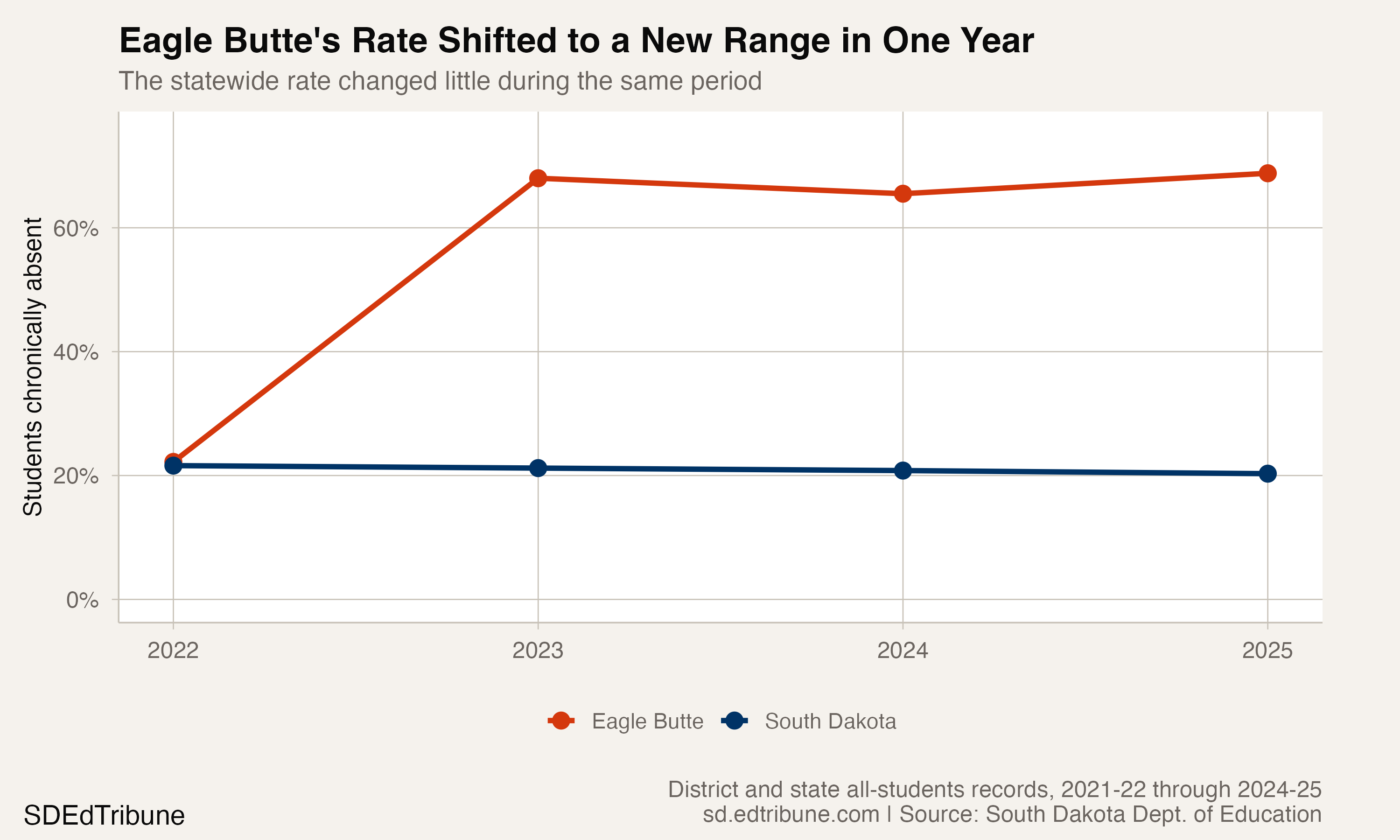
Eagle Butte↗ET reported a 22.2% chronic-absence rate in 2022. One year later, the rate was 68.0%—a 45.8-percentage-point increase and 3.1 times its previous level.
No other South Dakota district in a four-year, stable-enrollment comparison came close to that one-year change. The rate also did not return to its earlier level: Eagle Butte reported 65.5% in 2024 and 68.8% in 2025.
The count changed much more than enrollment
The number of Eagle Butte students meeting the state's chronic-absence definition rose from 264 to 848 between 2022 and 2023. That was an increase of 584 students.
Enrollment moved from 1,189 to 1,247 over the same transition, an increase of 58 students or 4.9%. The larger denominator accounts for only a small part of the change in the chronic-absence count.
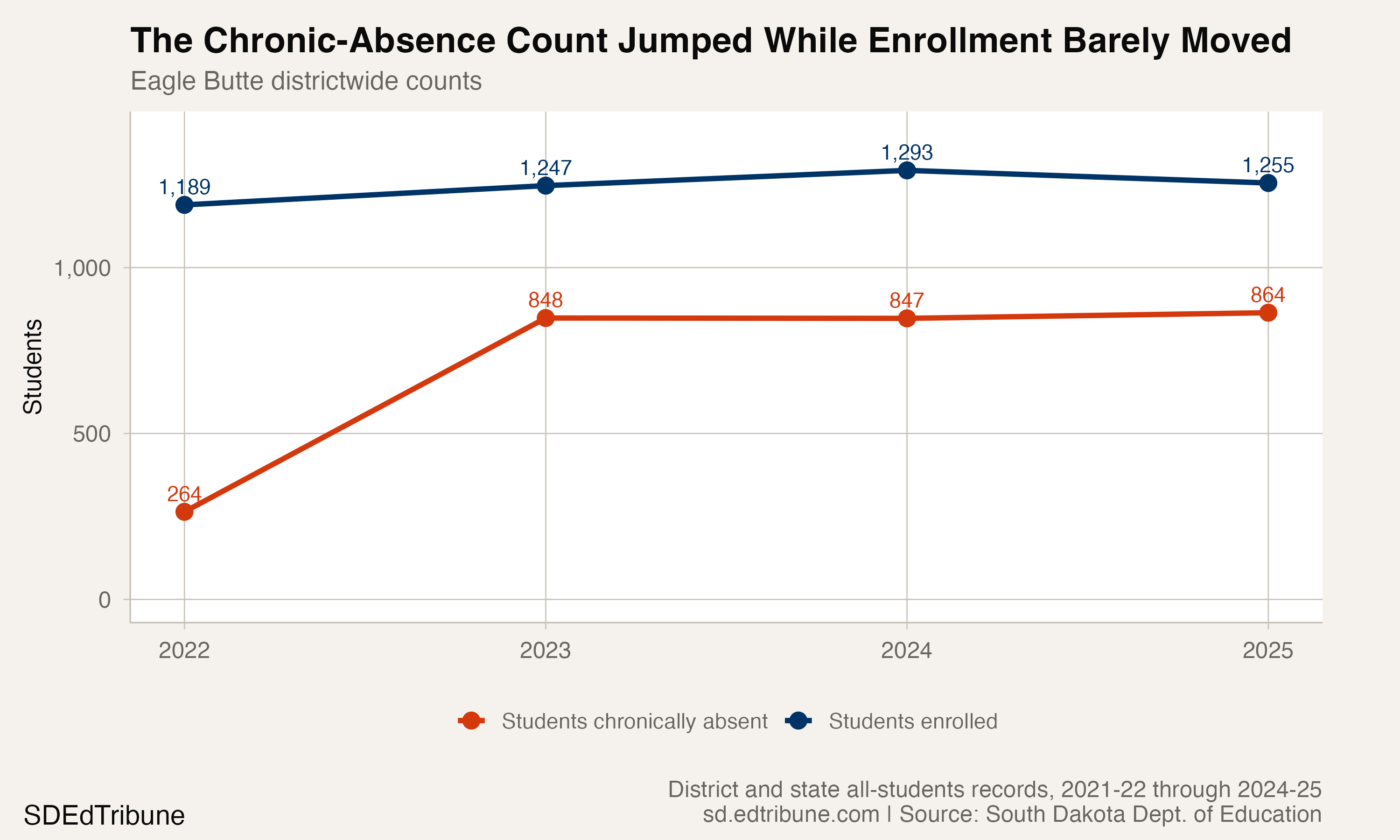
By 2025, Eagle Butte had 1,255 students and 864 met the chronic-absence definition. The count was slightly higher than in 2023 even though enrollment was nearly the same.
The jump ranked first at every tested cutoff
For a consistent comparison, the main analysis used 104 districts with at least 250 students in each of the four reporting years. Those districts represented 94.5% of statewide district enrollment in 2025 and produced 312 adjacent annual transitions.
Eagle Butte's 45.8-point increase ranked first. Kadoka Area's 16.8-point increase was second, leaving a 29.0-point gap between the two largest changes.
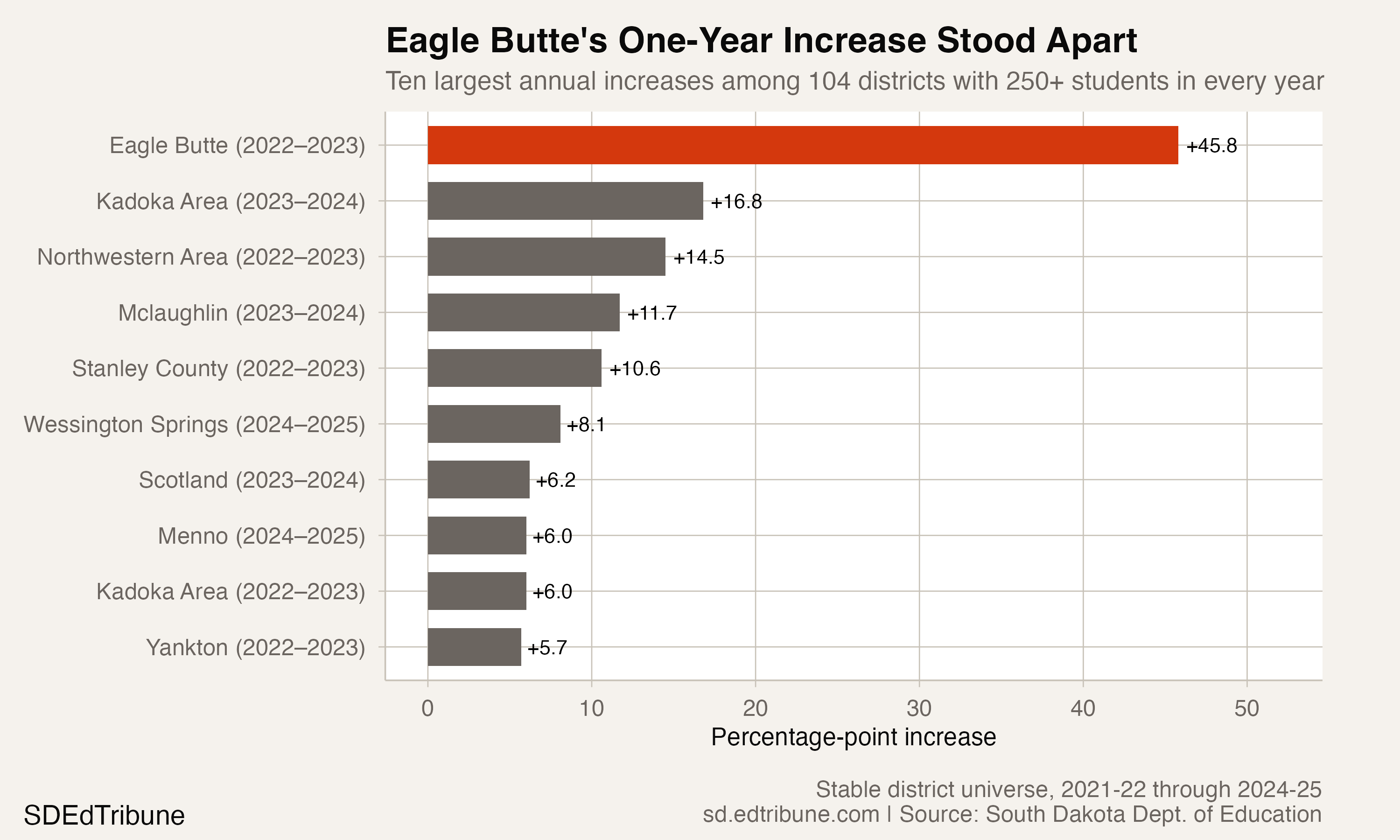
The ranking did not depend on the 250-student choice. Eagle Butte remained first when the minimum enrollment was set at zero, 100 or 500 students in every year. The cutoff is an editorial stability rule, not an accountability threshold.
A new range, not a one-year spike
Eagle Butte's three post-change rates were 68.0%, 65.5% and 68.8%. The 3.3-point range is narrow compared with the original 45.8-point jump, and even the lowest post-change rate remained 43.3 points above the 2022 baseline.
South Dakota's statewide rate moved in the opposite direction during the initial transition, from 21.6% to 21.2%, then declined to 20.8% and 20.3%. The statewide path therefore does not mirror Eagle Butte's discontinuity.
The aggregate records establish the size and persistence of the shift. They do not show why it happened. A change in student attendance, local recording or validation practice, or some combination could produce the observed pattern; this dataset cannot distinguish among them.
Eagle Butte's more recent schoolwide plan treats decreased chronic absenteeism as one benchmark of student engagement. That establishes local attention to attendance, but it does not explain the earlier jump.
This analysis uses South Dakota Department of Education district chronic-absence records for 2022 through 2025. The department publishes the files, annual manuals and report-card resources on its Report Card page.
Detailed code that reproduces the analysis and figures in this article is available exclusively to EdTribune subscribers.
Discussion
Sign in to join the discussion.
Loading comments...