Attendance improved for two South Dakota student groups carrying the state's highest chronic-absence rates. The Native American rate fell 3.5 percentage points from 2022 to 2025, while the rate for students identified as homeless fell 9.1 points.
The gaps nevertheless remained wide in 2025. Native American students were chronically absent at 49.7%, compared with 13.1% for white students. The 36.6-point difference was the narrowest in the four-year panel, but it still separated the two groups by more than the statewide rate itself.
Todd County↗ET, Eagle Butte↗ET and Oglala Lakota County↗ET were among the highest-rate districts that year. That local concentration and the statewide subgroup gap describe the same attendance problem from different reporting levels, but neither establishes why students missed school.
A disproportionate share of absence
Native American students represented 17,282 of South Dakota's 145,933 students in 2025, or 11.8% of enrollment. They represented 8,582 of the 29,615 students who met the chronic-absence definition, or 29.0%.
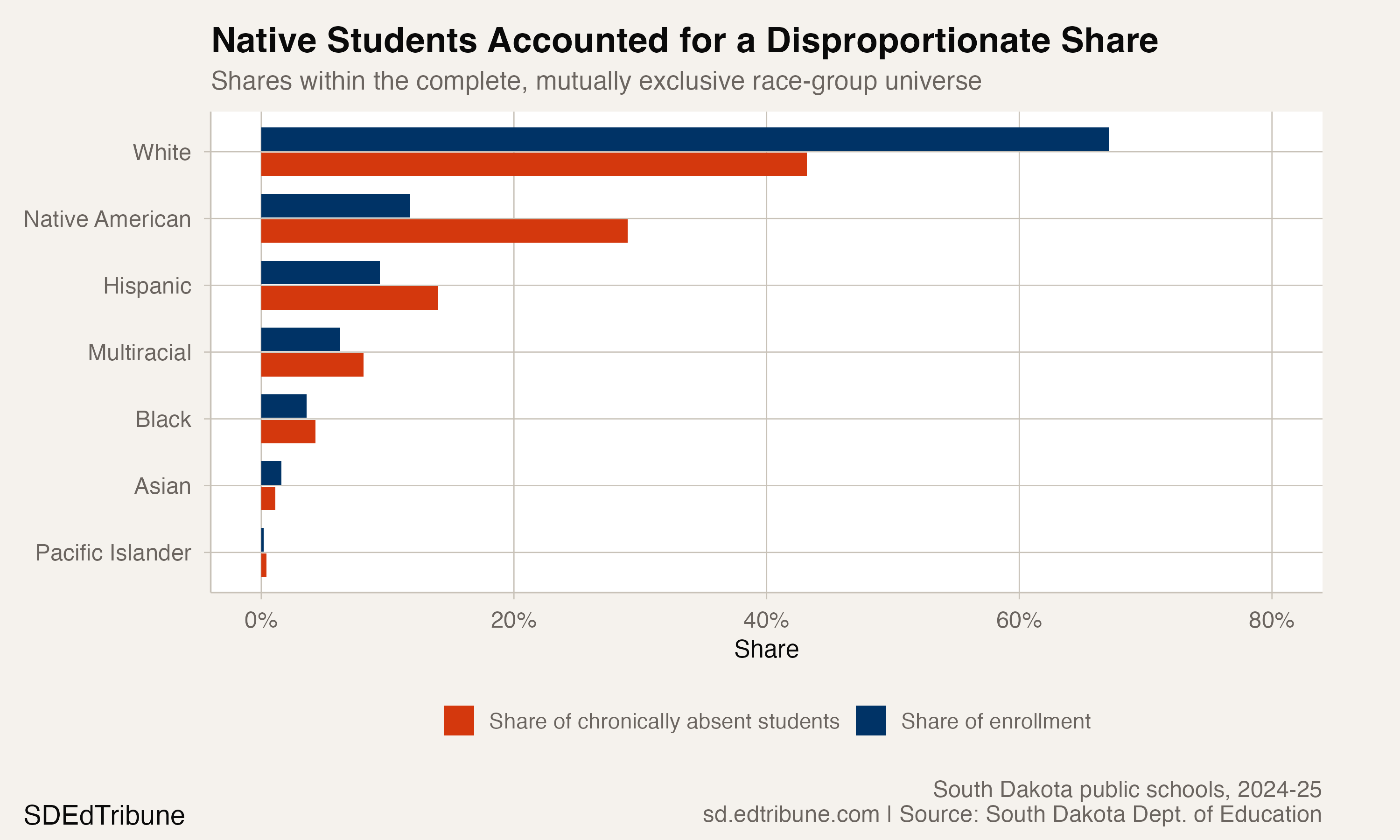
Those shares use a complete set of mutually exclusive race categories. The race-group enrollment total reconciles exactly to the statewide total, as does the race-group chronic-absence count.
The Native American rate moved from 53.2% in 2022 to 53.6% in 2023, then fell to 51.1% in 2024 and 49.7% in 2025. The white rate moved from 14.1% to 13.1% over the same span. The resulting gap peaked at 40.2 points in 2023 before narrowing to 36.6 points.
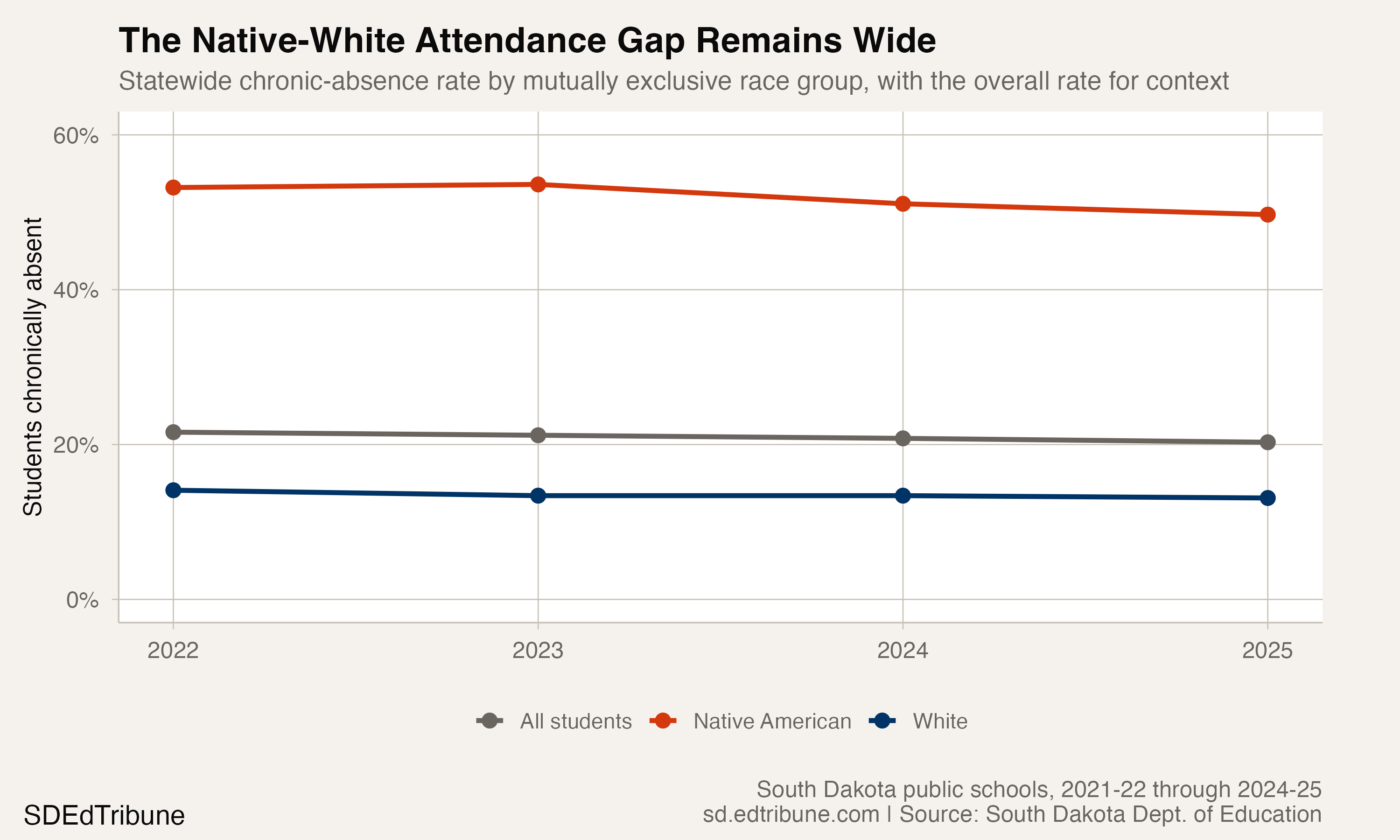
The four-year decline is progress. It is not evidence that the gap will continue narrowing, and the public aggregate file does not identify the reason for either group's movement.
Housing status is a separate lens
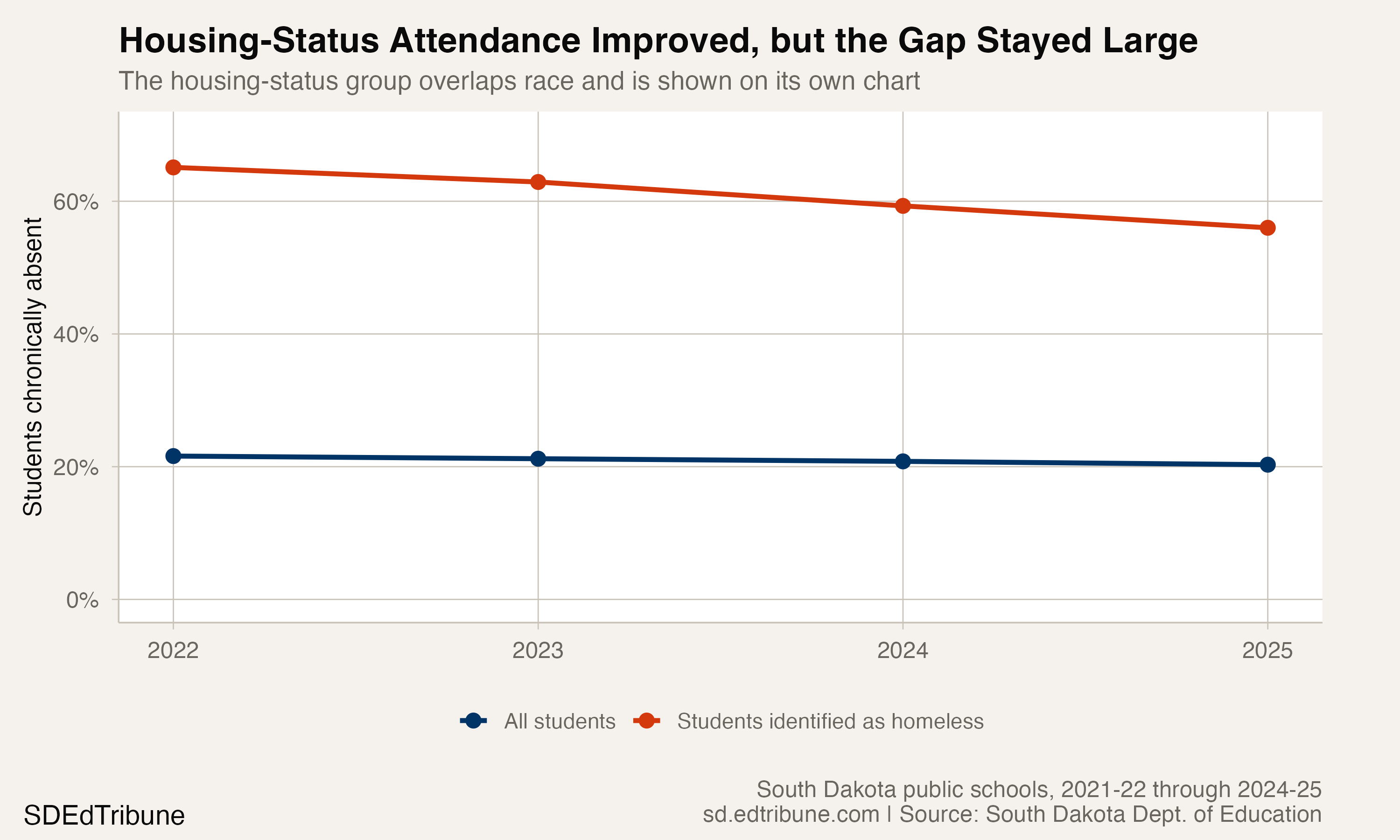
Students identified as homeless are an overlapping service group, not another race category. A student counted in that group is also counted in a race category, so the housing-status rate cannot be added to the race shares.
In 2025, 1,464 of 2,614 students identified as homeless met the chronic-absence definition, a 56.0% rate. That was down from 65.1% in 2022, with declines in every annual transition.
The U.S. Department of Education identifies health challenges, disengagement and limited access to student and family supports as common attendance barriers in its chronic-absenteeism guidance. Those factors are possible context for both patterns. The South Dakota data do not test them or show which barriers affected particular students.
The state's accountability technical manual defines how chronic absence enters the report card. It does not turn a high rate into a judgment about a student group, district or community. The useful question is where the gap is concentrated and what evidence local educators can gather about the barriers behind it.
This analysis uses South Dakota Department of Education state, district and subgroup chronic-absence records for 2022 through 2025. The department publishes the underlying files and documentation on its annual Report Card page.
Detailed code that reproduces the analysis and figures in this article is available exclusively to EdTribune subscribers.
Discussion
Sign in to join the discussion.
Loading comments...