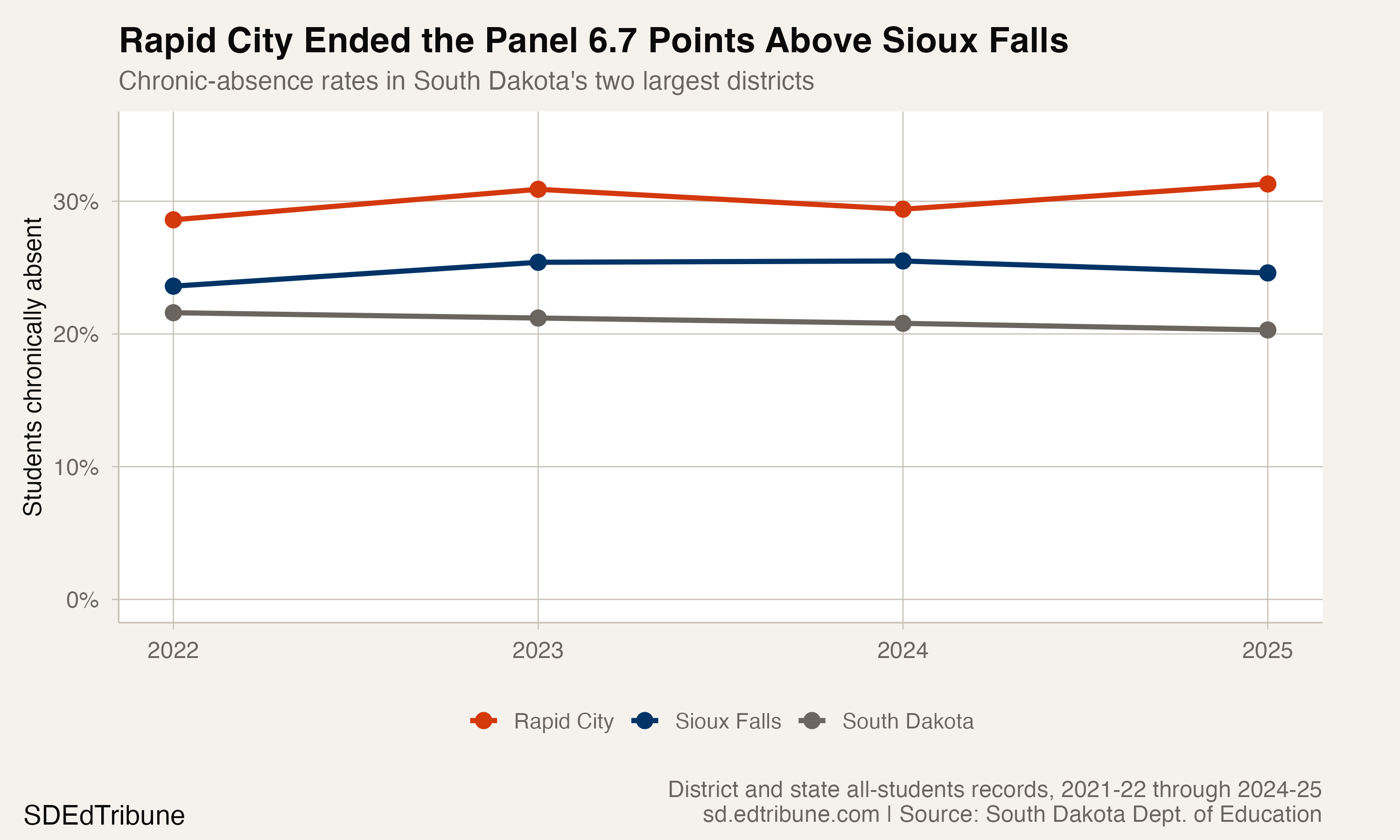
Rapid City Area↗ET ended 2025 with a 31.3% chronic-absence rate, compared with 24.6% in Sioux Falls↗ET. The 6.7-percentage-point difference was the widest between South Dakota's two largest districts in the four-year panel.
It was not a steadily widening gap. The difference moved from 5.1 points in 2022 to 5.5 in 2023, narrowed to 3.9 in 2024 and then expanded by 2.8 points in the final year.
Rapid City reached its panel high
Rapid City's rate moved from 28.6% in 2022 to 30.9% in 2023, fell to 29.4% in 2024 and rose to 31.3% in 2025. The endpoint was its highest in the available panel and 2.7 points above its starting rate.
Sioux Falls followed a different path: 23.6%, 25.4%, 25.5% and 24.6%. Its endpoint was 1.0 point above its starting rate but 0.9 point below its 2024 level.
The enrollment and count directions add context. Rapid City enrolled 749 fewer students in 2025 than in 2022, yet its chronic-absence count was 139 higher. Sioux Falls enrolled 299 more students and its chronic-absence count rose by 331.
Those changes do not explain why the rates differed. They do show that Rapid City's higher endpoint was not produced by enrollment growth.
The gap changed direction twice
The four annual gaps were 5.1, 5.5, 3.9 and 6.7 points. That sequence contains two direction reversals, so describing the metros as continuously separating would overstate the evidence.
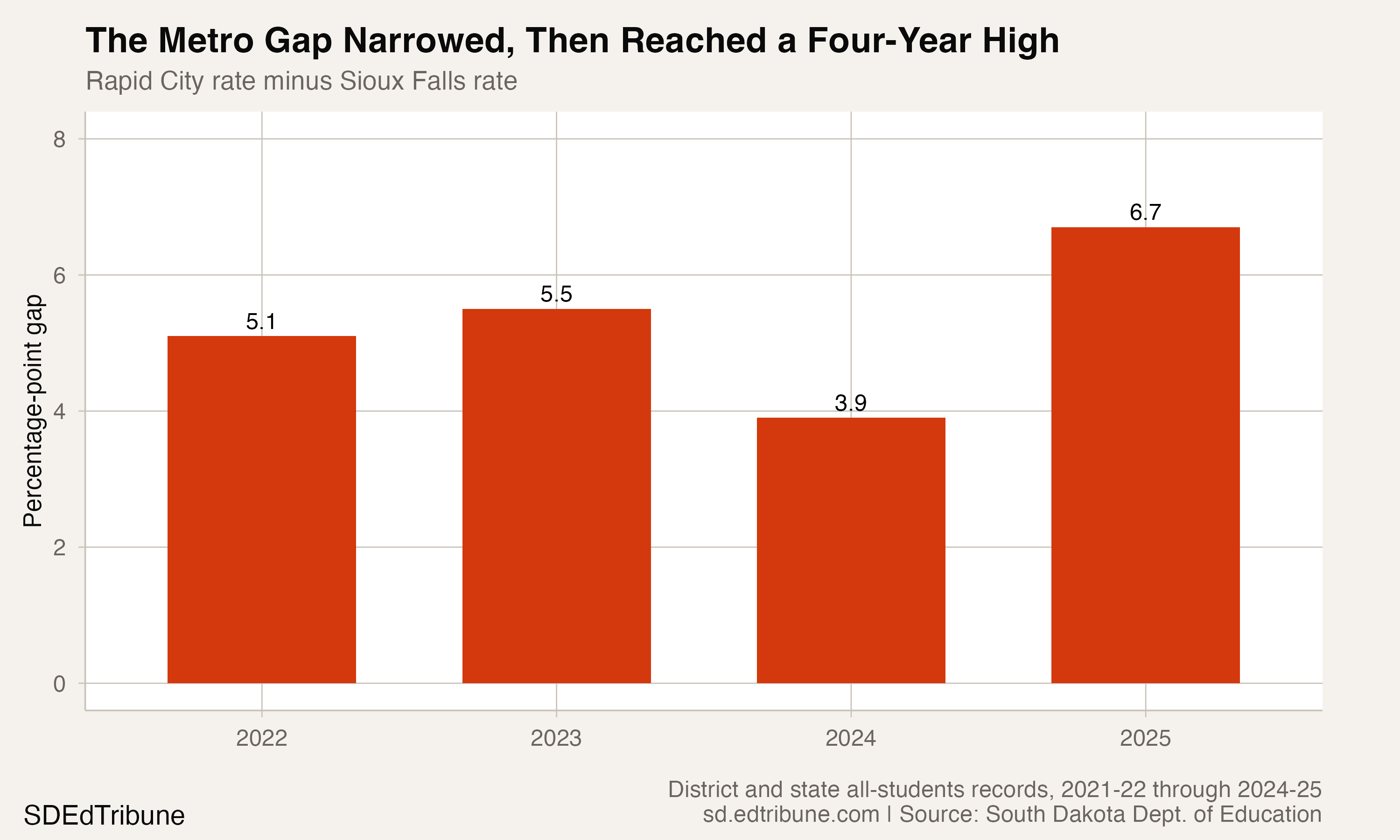
Across the full panel, the gap grew by 1.6 points. The final-year increase was larger than that net change because the comparison began from the lower 2024 gap.
Rapid City also stood out among large systems
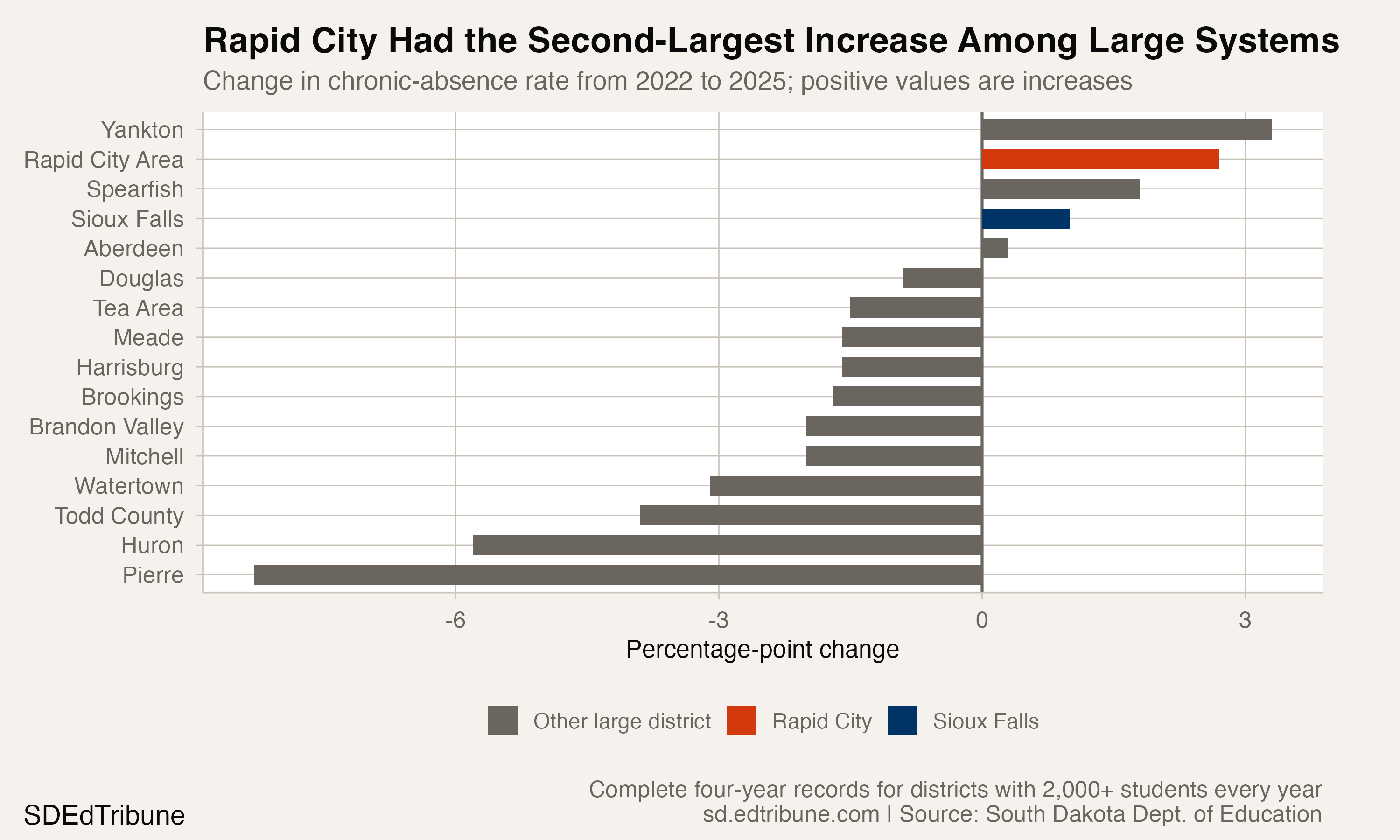
The comparison reused the same stable large-district universe used elsewhere in this series: 16 districts with at least 2,000 students in every reporting year. The group represented 60.4% of district enrollment in 2025.
Rapid City's 2.7-point increase ranked second in that universe. Sioux Falls' 1.0-point increase ranked fourth. The two metros were also the state's first- and second-largest districts by 2025 enrollment, with 26,037 and 13,344 students.
Public district materials show attendance work in both systems. Sioux Falls describes attendance liaisons whose approach centers on relationships with families. A schoolwide plan for one Rapid City school describes tiered teams reviewing attendance data and individualizing interventions.
Those examples are local context, not a test of relative effectiveness. Aggregate district records cannot isolate differences in program reach, student populations, school mix, reporting practice or community conditions.
This analysis uses South Dakota Department of Education district chronic-absence records for 2022 through 2025. The department publishes the files and documentation on its annual Report Card page.
Detailed code that reproduces the analysis and figures in this article is available exclusively to EdTribune subscribers.
Discussion
Sign in to join the discussion.
Loading comments...