Correction, November 27, 2026: An earlier version of this article labeled South Dakota's enrollment figures one school year early. The state's fall 2025 census is the 2025-26 school year, and every year in this article now reflects that. With every year counted, 24 districts were at record lows in 2025-26, not 27, serving 25,019 students (18.0%). Only four of the 20 record-high districts are in the Sioux Falls suburban ring, not nearly all. Rapid City has lost students in six of the past seven years rather than six in a row, Brandon Valley grew 72.5% rather than doubling, and the losing streaks for Redfield, Watertown and Rapid City are nine, five and four years.
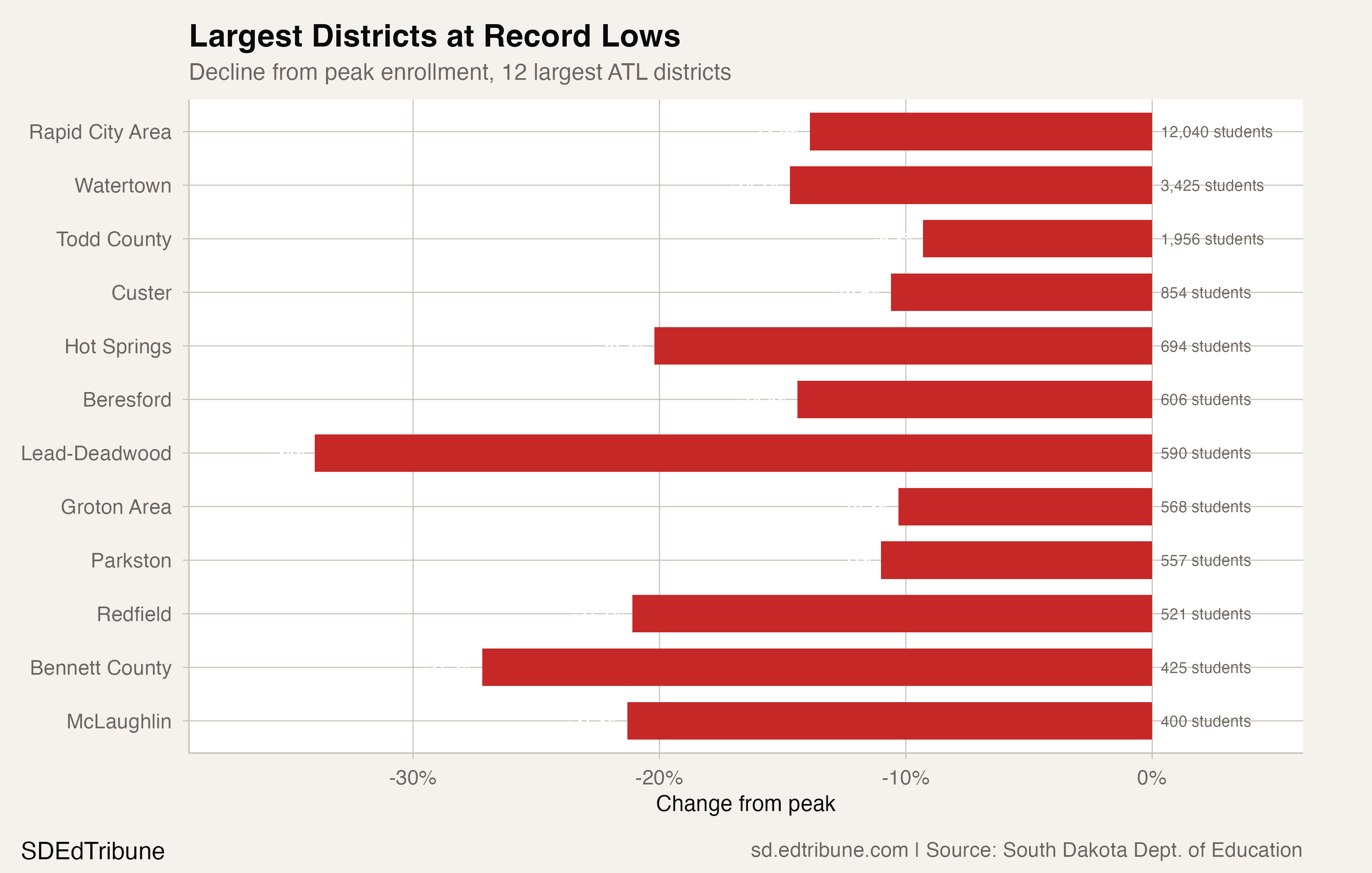
Rapid City Area Schools↗ET, the second-largest district in South Dakota, enrolled 12,040 students in 2025-26. That is the lowest figure in the district's recorded history, down 13.9% from its 2012-13 peak of 13,982. Rapid City is not alone. Twenty-four South Dakota school districts were at their all-time enrollment lows in 2025-26, and collectively they served 25,019 students, 18.0% of the state's total. At the same time, 20 districts sat at all-time highs, including four in the Sioux Falls↗ET suburban ring: Harrisburg, Brandon Valley, Tea Area and Tri-Valley.
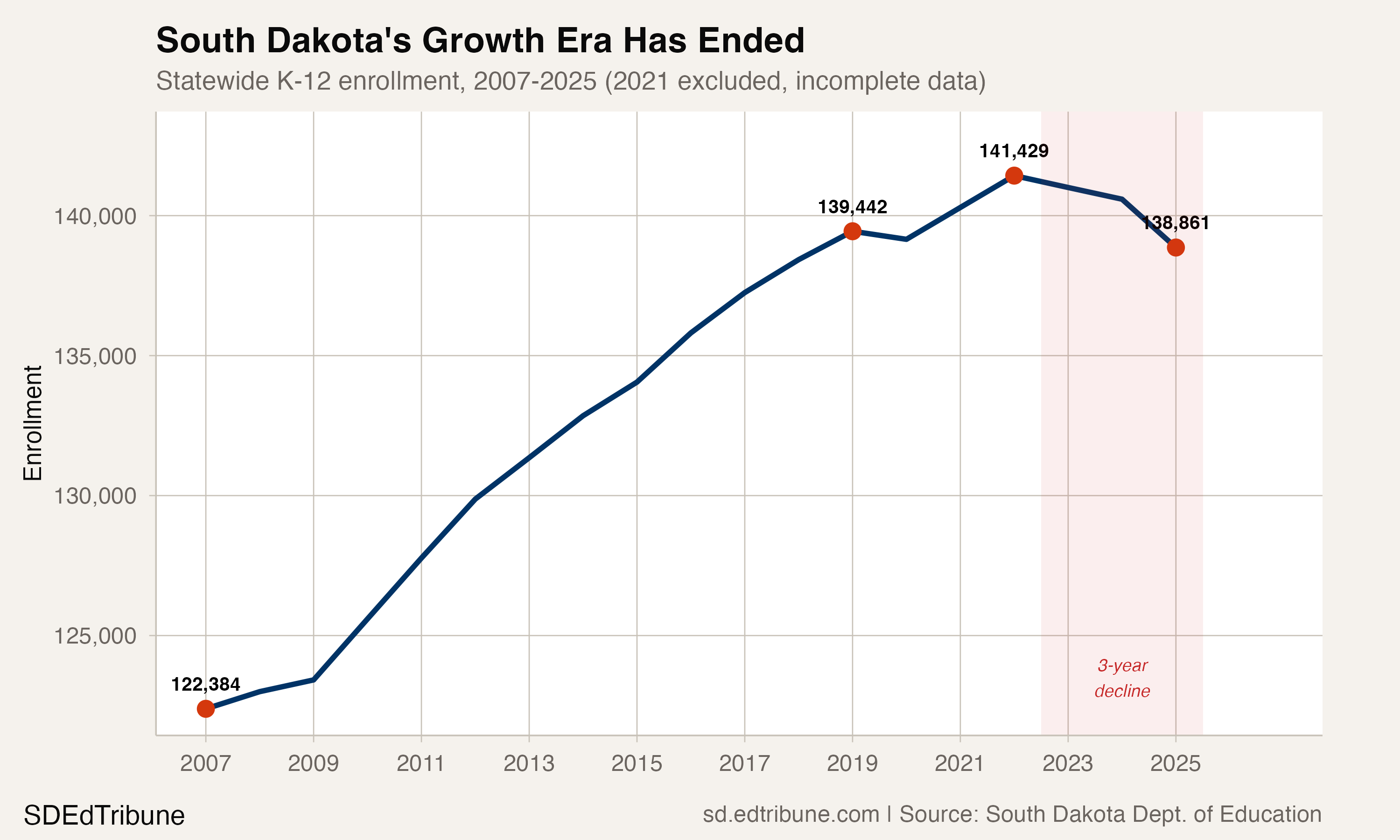
The split captures a state pulling apart. South Dakota added students for 12 consecutive years, from 122,384 in 2007-08 through 2019-20, dipped briefly in 2020-21, then rebounded to a peak of 141,429 in 2022-23. That growth era is over. The state has now declined for three straight years, losing 2,568 students since the peak, with 2025-26's drop of 1,726 the steepest in at least 18 years.
The two South Dakotas
The 24 districts at record lows and the 20 at record highs look very different at the top of each list. The largest record-high districts are in the Sioux Falls metro: Harrisburg↗ET (6,398 students, up 272.8% since 2007-08), Brandon Valley↗ET (5,206, up 72.5%), and Tea Area↗ET (2,514, up 111.3%). Sioux Falls itself has essentially plateaued at 24,841, down slightly from its 2023-24 peak of 25,228. The growth is in the suburban ring, not the city center.
The record-low districts span western South Dakota, reservation communities, and small towns. After Rapid City, the largest are Watertown↗ET (3,425, down 14.7% from its 2015-16 peak), Todd County↗ET (1,956, down 9.3% from 2020-21), and Custer↗ET (854, down 10.6% from 2018-19). Several smaller districts have lost a quarter to two-thirds of their peak enrollment: Bowdle↗ET is down to 45 students from a peak of 147, a 69.4% decline. Newell↗ET has fallen 42.4%, Lead-Deadwood↗ET 34.0%.
Rapid City's long slide
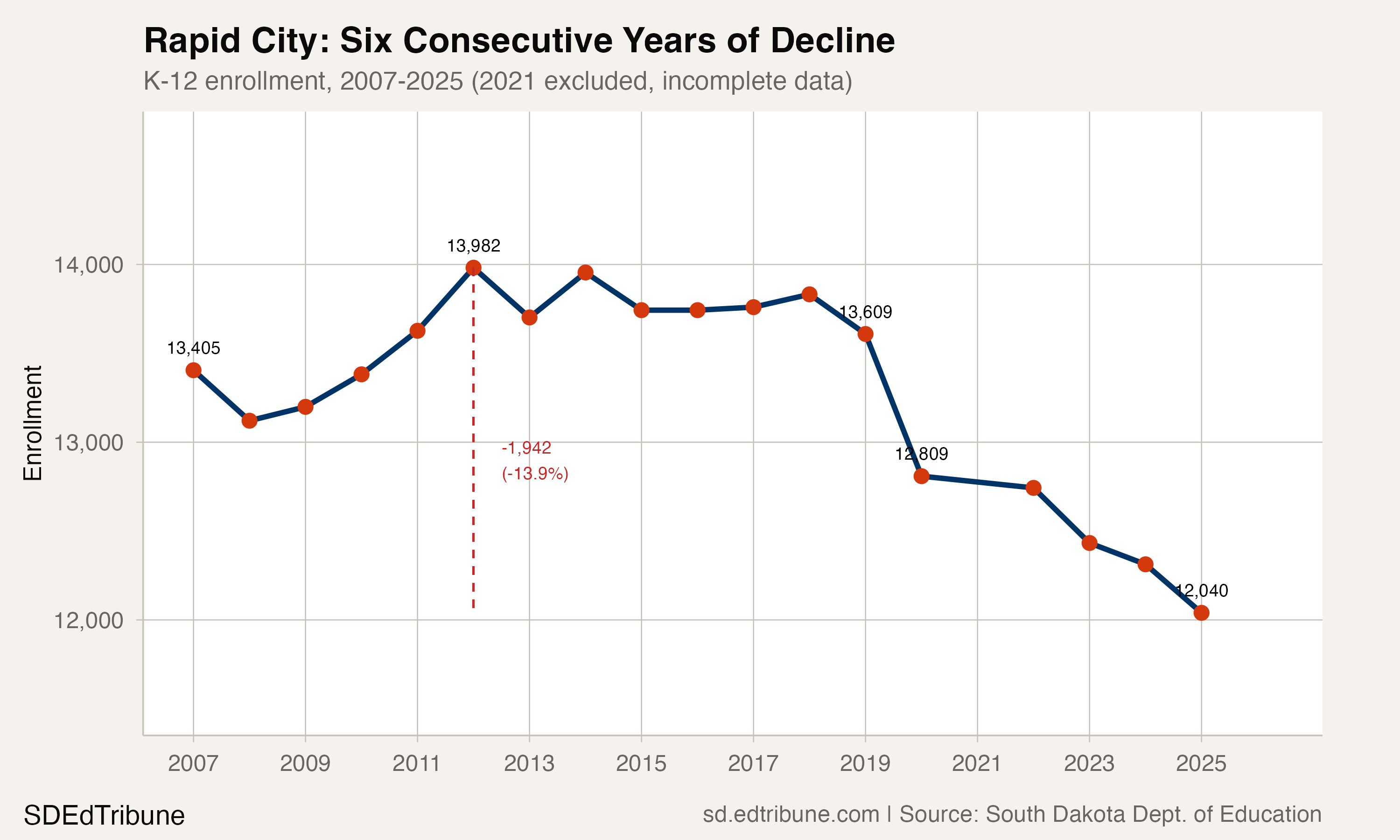
Rapid City peaked at 13,982 students in 2012-13 and has been unable to recover. The district has lost students in six of the past seven years. It lost 800 students in the single year from 2019-20 to 2020-21, gained 38 in 2021-22, then resumed losing at a slower pace: 104, 310, 120, and 273 in the years since.
The losses are not simply a function of population decline. A Rapid City Area Schools board member told the Rapid City Journal that "people are moving here with their families" but "not enrolling in our schools, or they're pulling them out." The district has lost approximately 1,700 students over the past decade while homeschool and private school enrollment has grown.
That pattern is statewide. South Dakota's home-schooled student population rose 143% from 4,333 to 10,536 between 2015-16 and 2023-24, the largest proportional increase of any state reporting data for every year in that range. At roughly $7,000 per student in state funding, the shift represents tens of millions in annual revenue that has moved out of the public system.
Where the growth went
While Rapid City contracted, the Sioux Falls suburban ring exploded. Harrisburg added an average of 260 students per year over the past 18 years, growing from 1,716 to 6,398. It has built nearly one new building every two years to keep pace, at an average construction cost of $166 per square foot, well below the $287 regional average.
Tea Area followed a similar trajectory, more than doubling since 2007-08, and Brandon Valley grew 72.5%. Sioux Falls, by contrast, has grown just 24.2% over the same period and posted its second consecutive year of decline in 2025-26.
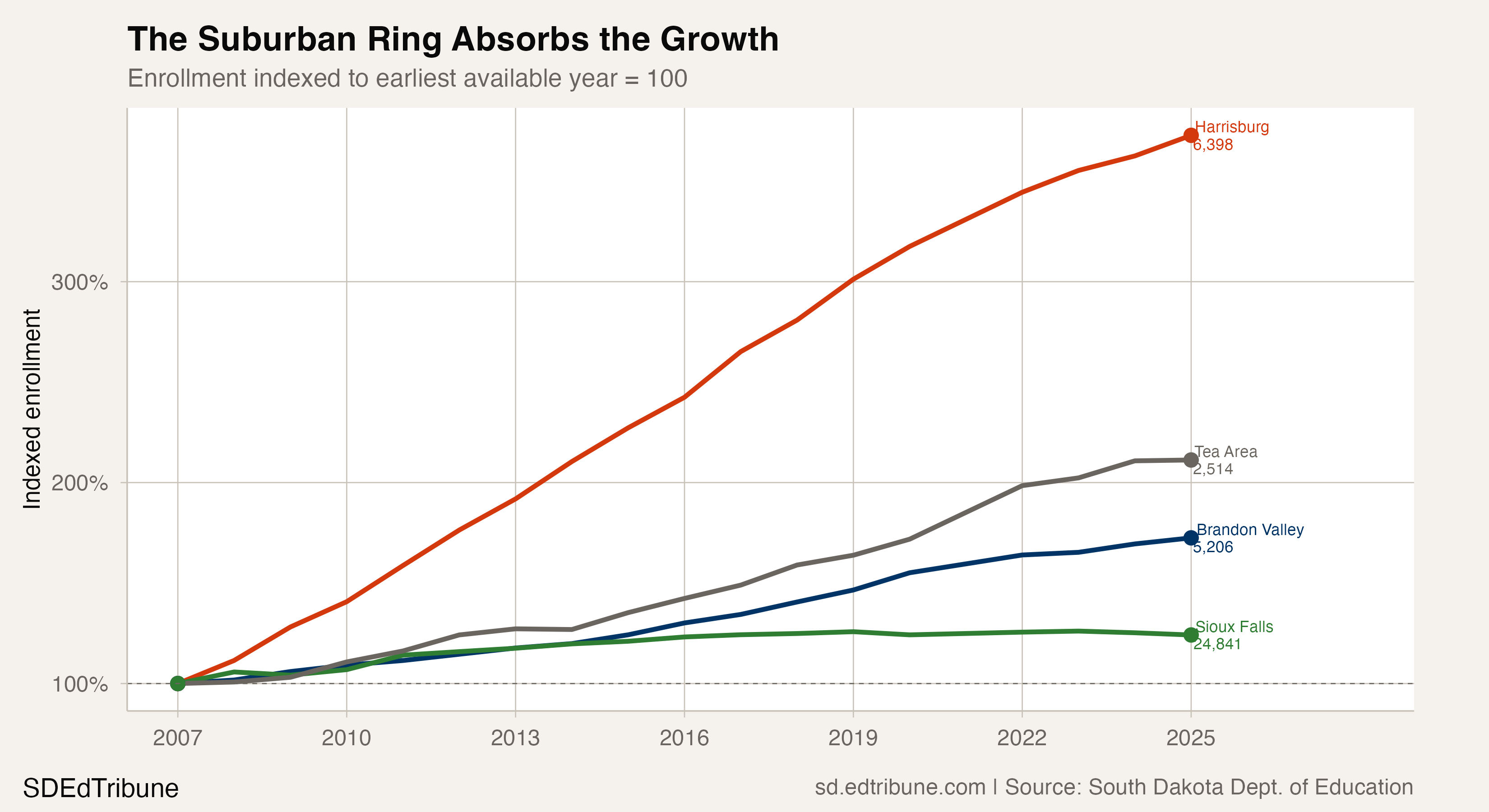
The pattern is a classic suburban donut: the core district plateaus or declines while surrounding communities absorb new residential development. South Dakota's unrestricted open enrollment policy allows families to send children to any public school in the state regardless of residence, which may accelerate the sorting. Families who remain within Sioux Falls city limits can still enroll in Harrisburg or Brandon Valley.
Small districts and reservation schools
The deepest percentage declines are concentrated in districts under 500 students. Lead-Deadwood, the historic Black Hills mining district, has fallen from 894 to 590 students since 2011-12, a 34.0% decline and the steepest among mid-sized districts at record lows. Superintendent Dr. Erik Person attributed the challenges to housing shortages, telling KOTA Territory News that recent population growth in the Lead and Deadwood area "doesn't really help with enrollment" because many newcomers are retirees buying second homes.
Todd County, which serves the Rosebud Indian Reservation, has declined from 2,156 to 1,956 since 2020-21. The district faces compounding challenges beyond enrollment numbers: chronic absenteeism reached 71% in 2023-24, with the median household income of $33,800 less than half the state average. Todd County High School Principal Randy Pirner told Dakota News Now that "COVID set us back 10 years because kids who aren't going to school in kindergarten aren't going to be going to school when we get them in high school."
Watertown, the state's seventh-largest district at 3,425 students, is considering closing one of its five elementary schools as enrollment continues to fall. The district has lost 591 students, 14.7%, since its 2015-16 peak, driven in part by declining birth rates in Codington County.
The acceleration problem
The year-over-year data tells the sharpest story. South Dakota gained between 1,000 and 2,200 students every year from 2010-11 through 2019-20, with smaller gains in the two years before and a dip of 288 in 2020-21. The two-year rebound of 2,275 through 2022-23 looked like a return to form. Instead, the state lost 424 in 2023-24, 418 in 2024-25, and 1,726 in 2025-26. The decline is accelerating: last year's loss was four times larger than either of the two preceding years.
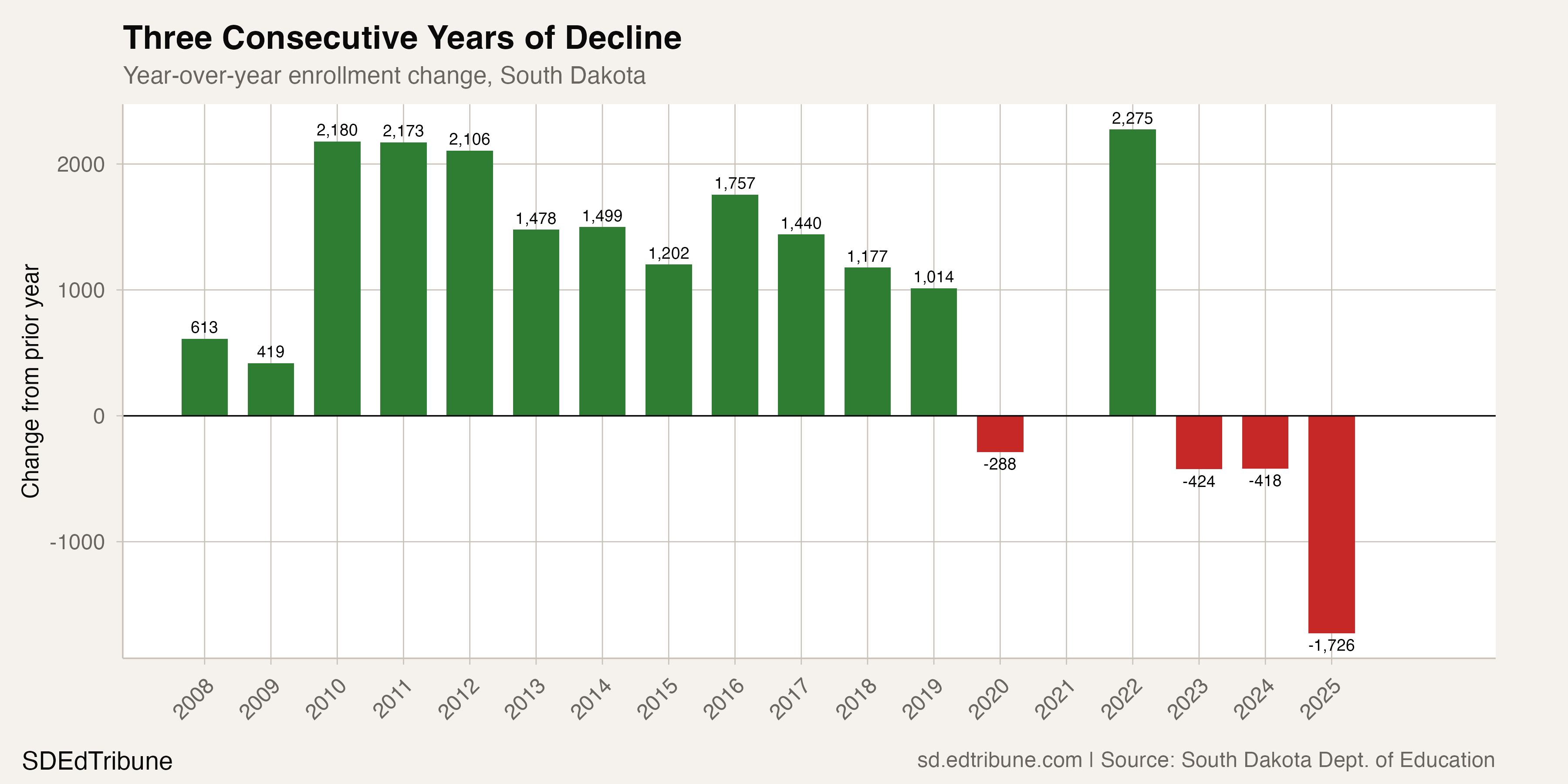
Statewide, exactly half of South Dakota's 146 districts with comparable data declined between 2020-21 and 2025-26 (73 districts), while 72 grew and one was flat. The losses and gains nearly cancel out in aggregate, but the distribution is lopsided: declining districts collectively lost 4,490 students while growing districts gained 4,416. Their net loss of 74 students over five years masks deep geographic divergence.
South Dakota's state demographer, Weiwei Zhang, has projected that children will drop below 20% of the state's population by 2030, while adults over 65 will surpass 20%. The state's birth rate has fallen from 15 per 1,000 in 2007 to 12 per 1,000. Even with relatively high fertility by national standards, the kindergarten pipeline is shrinking.
Redfield↗ET has declined for nine consecutive years. Watertown for five. Rapid City for four. None show signs of turning around. For Bowdle, at 45 students, the arithmetic is existential: one more family leaving could trigger the state's mandatory reorganization planning threshold. For Watertown, at 3,425 and eyeing an elementary school closure, the decisions are about which building goes dark and which bus routes get cut. None of these choices can be reversed easily if the students return. Most will not.
Detailed code that reproduces the analysis and figures in this article is available exclusively to EdTribune subscribers.
Discussion
Sign in to join the discussion.
Loading comments...