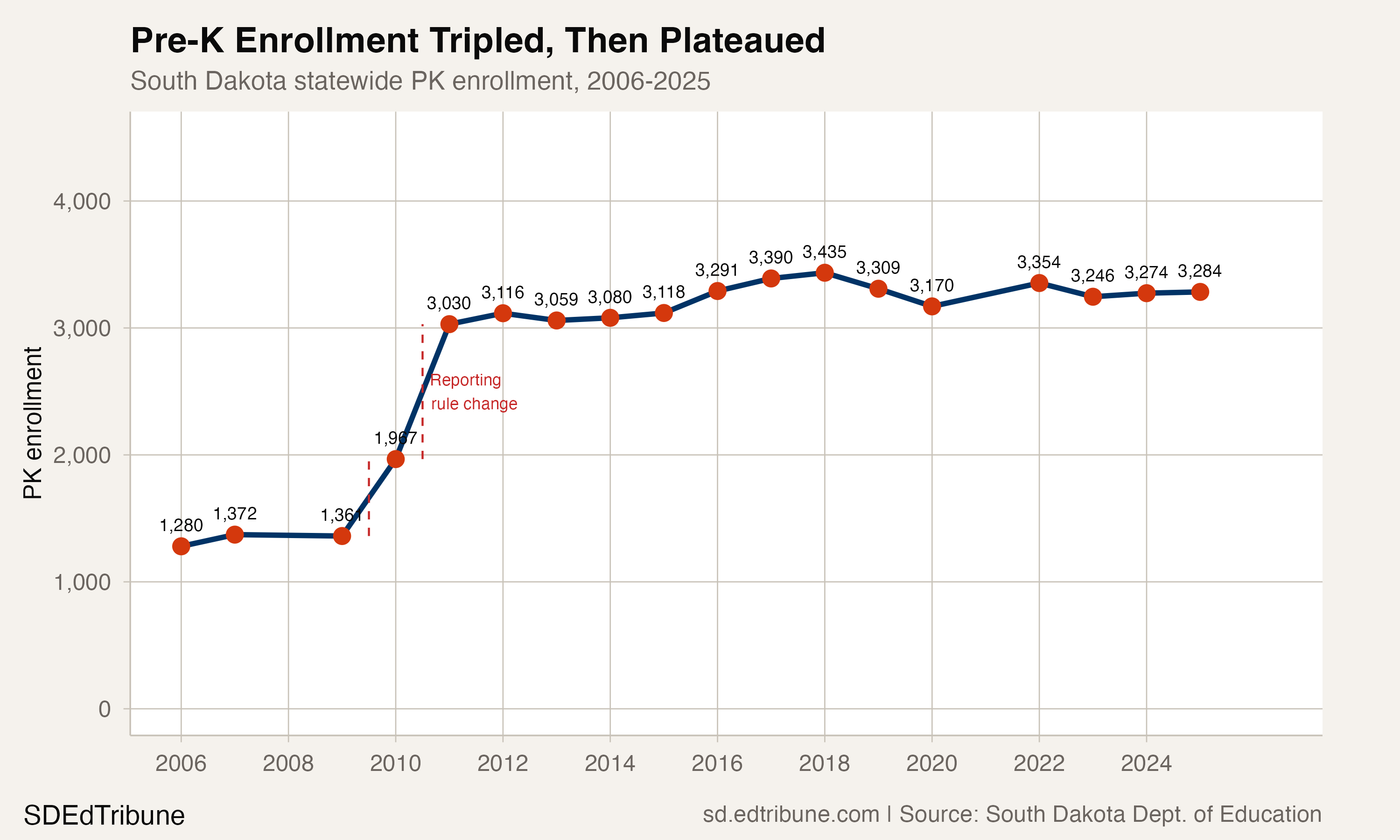
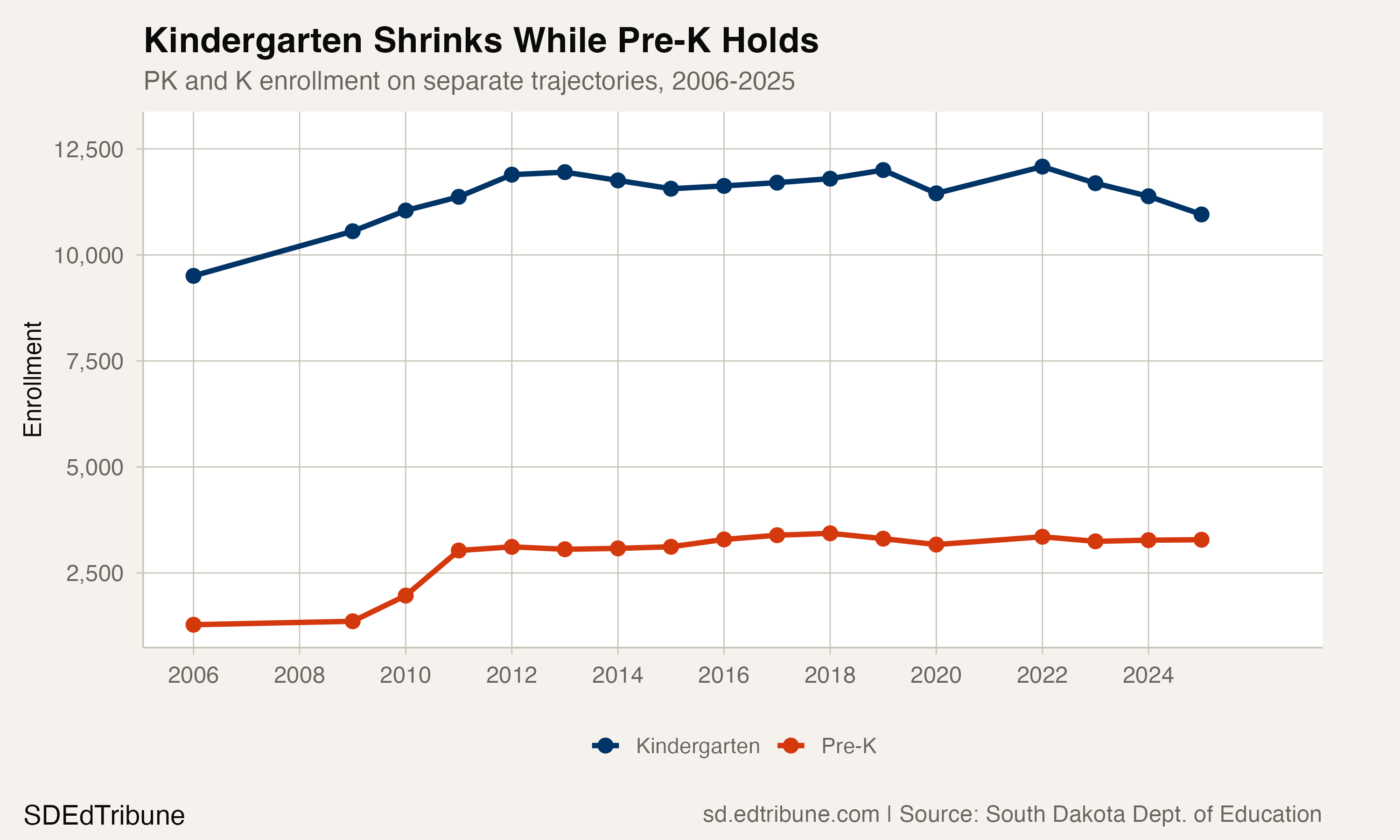
In 2006, South Dakota reported 1,280 pre-kindergarten students across 110 school districts. By 2025, that number had climbed to 3,284, a 156.6% increase that makes PK one of the fastest-growing segments of the state's enrollment ledger.
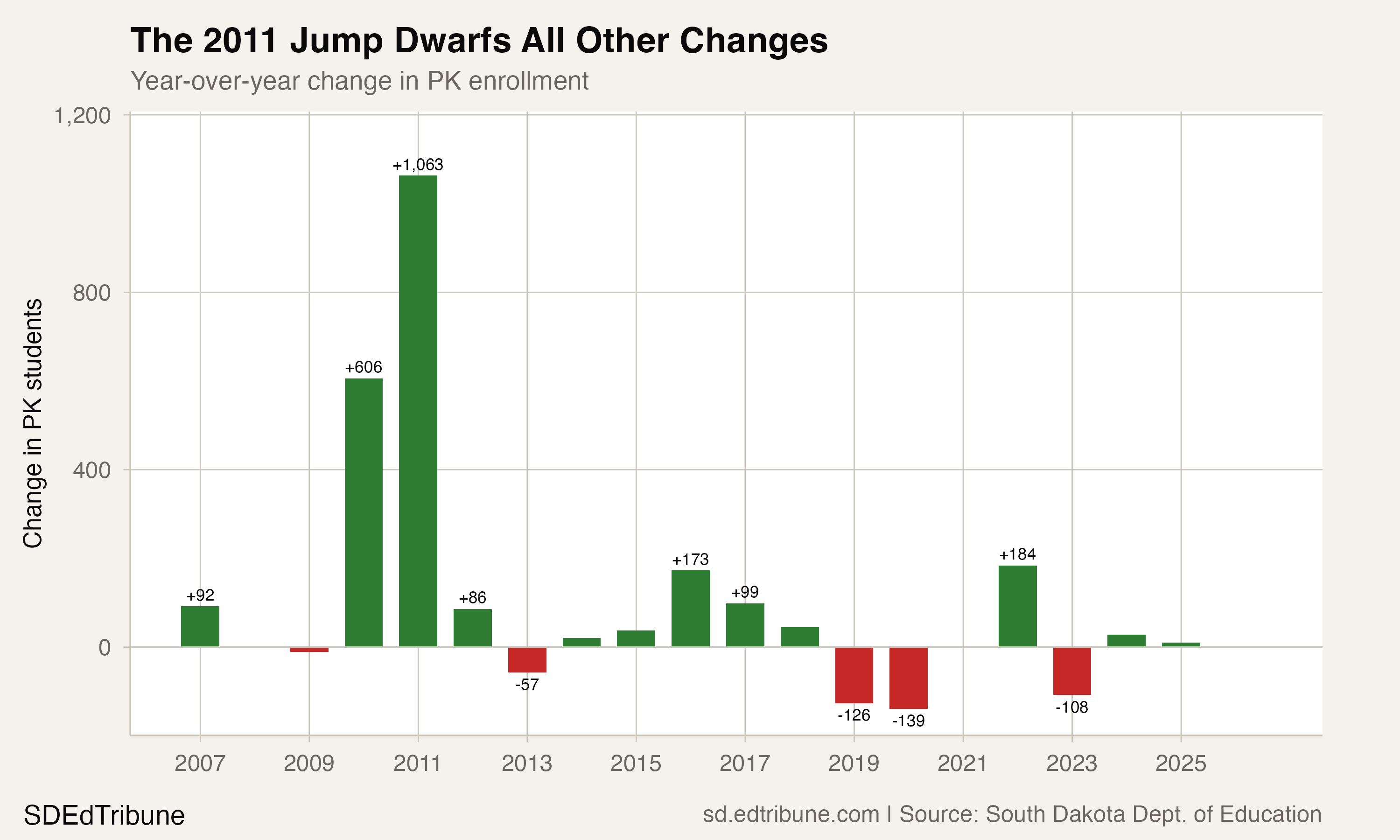
The growth is real. But the timeline tells a more complicated story than "more children in classrooms." More than half the total increase happened in a single year, 2010-11, when enrollment jumped from 1,967 to 3,030. In the 14 years since, PK has barely budged: the coefficient of variation across that entire period is just 4%. South Dakota's pre-K expansion was less a gradual build and more a one-time step change, followed by the flattest plateau in the state's enrollment data.
A rule change, not a classroom boom
The 2011 jump traces directly to a May 2010 decision by the South Dakota Board of Education. In a 6-1 vote, the board approved rules requiring public school districts to submit preschool enrollment data annually to the state Department of Education. It was the first time South Dakota had an official definition of a preschool student in state rules.
The motivation was federal money. Impact aid districts, those receiving federal funding because they serve students on federal or tribal land, wanted to include preschool spending in their federal reimbursement calculations. Education Secretary Tom Oster framed the rules as "intended exclusively for data collection."
Fifteen districts that reported zero PK students in 2010 appeared with nonzero counts in 2011. Sioux Falls↗ET alone went from zero to 834. The state's largest district had been running early childhood programs for years; it simply had not been counted in the state enrollment system.
This distinction matters for interpretation. The 156.6% headline growth from 2006 to 2025 overstates the expansion of actual classroom seats. Some portion of the 2010-2011 jump, and much of the 2009-2010 increase of 606 students (44.5%), reflects programs that already existed being newly counted. The data cannot distinguish newly counted seats from genuinely new ones.
The 14-year plateau
Since 2011, PK enrollment has oscillated within a narrow 405-student band, from a low of 3,030 in 2011 to a high of 3,435 in 2018. That stability is unusual in a state where kindergarten enrollment peaked at 12,082 in 2022 and has since dropped 9.3% to 10,954.
The plateau has a structural explanation. South Dakota is one of six states that spend zero state dollars on pre-kindergarten education. The state's PK programs are funded entirely through a patchwork of federal sources: Title I set-asides, Head Start grants, special education funds, and impact aid. The National Institute for Early Education Research reported 3,265 Head Start children (ages 3-4) in South Dakota, a number strikingly close to the 3,284 PK students in the enrollment data.
Without state funding, program capacity is capped by whatever federal dollars districts can secure. When Head Start allocations are flat and Title I formulas change slowly, PK enrollment stays flat. The plateau is not districts choosing not to expand; it is a ceiling imposed by the funding architecture.
Where the students are
Sioux Falls dominates. The state's largest district enrolls 791 PK students, 24.1% of the state total, even though it accounts for roughly 16% of total K-12 enrollment. Yankton↗ET (196), Rapid City Area↗ET (165), and Wagner Community (105) round out the four districts with 100 or more PK students. Together, those four serve 38.3% of the state's pre-kindergartners.
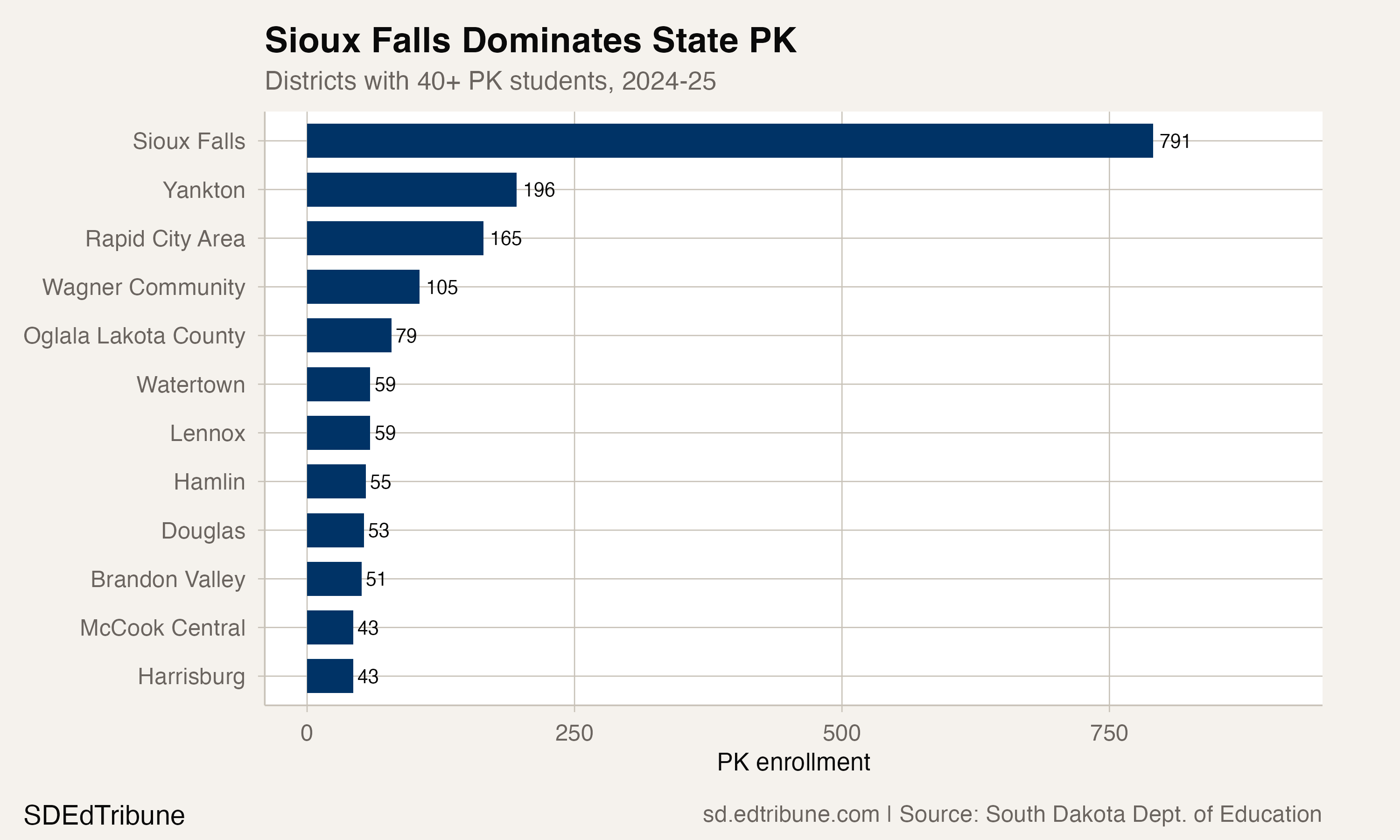
At the other end, 75 of 107 PK-serving districts enroll fewer than 25 students. Twenty districts serve fewer than 10. These are not pre-K "programs" in any conventional sense; many are a single classroom or even a few students integrated into an early childhood special education setting. Another 40 districts, more than a quarter of the state's 147, report no PK students at all.
The presence of Wagner Community and Oglala Lakota County↗ET among the largest PK programs points to a geographic pattern. Both serve communities on or near tribal land. Federal impact aid, the same funding stream that motivated the 2010 reporting rule, flows disproportionately to these districts, enabling PK programs that smaller districts without a federal land connection cannot sustain.
A ratio that keeps rising for the wrong reason
The PK-to-K ratio, which measures how many pre-kindergartners exist relative to incoming kindergartners, has climbed from 13.5% in 2006 to 30.0% in 2025. One PK student for every three kindergartners.
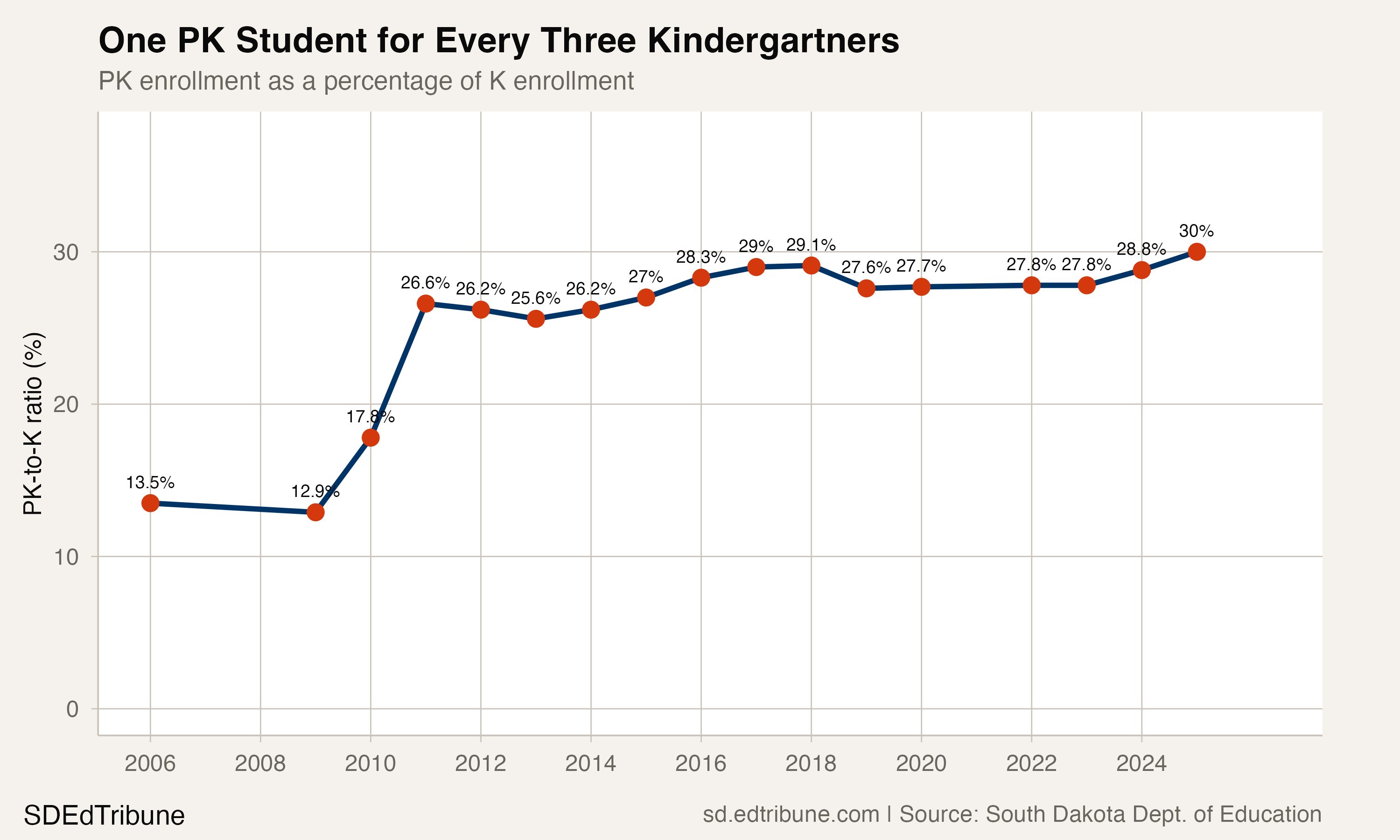
But the ratio is rising for an unflattering reason. It is not that PK is growing; PK has been essentially flat since 2018. Kindergarten enrollment is shrinking. K fell from 12,001 in 2019 to 10,954 in 2025, a decline of 1,047 students (8.7%) in six years. The PK-to-K ratio reached 30% not because the numerator grew but because the denominator contracted.
South Dakota still leads the nation in fertility rate, recording 65.6 live births per 1,000 women aged 15-44 in 2023, the highest of any state. But even that rate represents a decline from 78.1 in 2013. The kindergarten pipeline is narrowing despite South Dakota's relative demographic advantage, and a stable PK enrollment of 3,284 will represent an ever-larger share of an ever-smaller entering class.
What a shrinking K class means for a capped PK system
The divergence between PK and K enrollment raises a question that South Dakota's funding model is not designed to answer. If kindergarten classes are shrinking because fewer children are being born, demand for PK seats is presumably also falling. A fixed number of federally funded PK slots serving a smaller cohort means a higher percentage of four-year-olds have access to public pre-K, even without any policy action.
But the data cannot confirm whether PK programs are at capacity with waiting lists or running below capacity with empty seats. The Sioux Falls School District's PK enrollment has fallen 23.1% from its 2018 peak of 1,028 to 791 in 2025, a trajectory that could reflect either declining demand from smaller birth cohorts or deliberate program contraction. Without program-level capacity data, the distinction is invisible.
For the 40 districts with no PK program at all, the math is simpler: their four-year-olds enter kindergarten without any public early learning option. South Dakota remains one of six states that spend zero state dollars on pre-K. Until that changes, the federal patchwork is the ceiling, and 3,284 is roughly where it will stay.
Detailed code that reproduces the analysis and figures in this article is available exclusively to EdTribune subscribers.
Discussion
Sign in to join the discussion.
Loading comments...