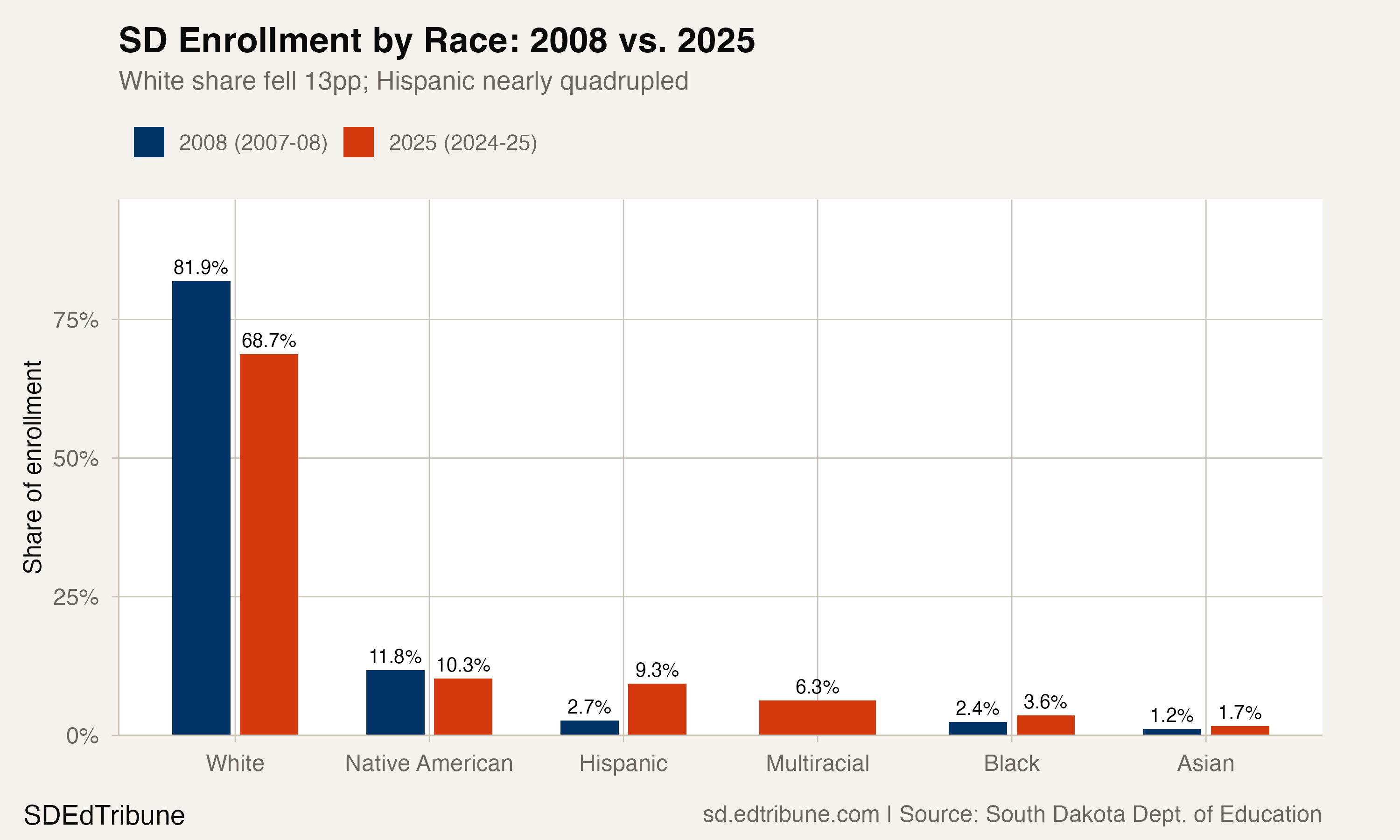
In the 2007-08 school year, roughly 82 of every 100 students in South Dakota's public schools were white. By 2024-25, that figure had fallen to 69. The 13.2 percentage-point drop did not happen because white families left the state en masse. It happened because South Dakota's schools added 15,864 students overall while white enrollment fell by 5,275, and every other racial group grew.
The transformation registered most sharply in the state's two anchor cities. Sioux Falls↗ET, the largest district, dropped from 77.1% white to 54.1%. In Huron↗ET, a small city 110 miles to the northwest, white share plummeted from 80.2% to 38.3%, driven by Karen refugees from Myanmar and Hispanic meatpacking workers who turned a shrinking prairie town into one of the most diverse school districts in the Northern Plains.
Where the Growth Came From
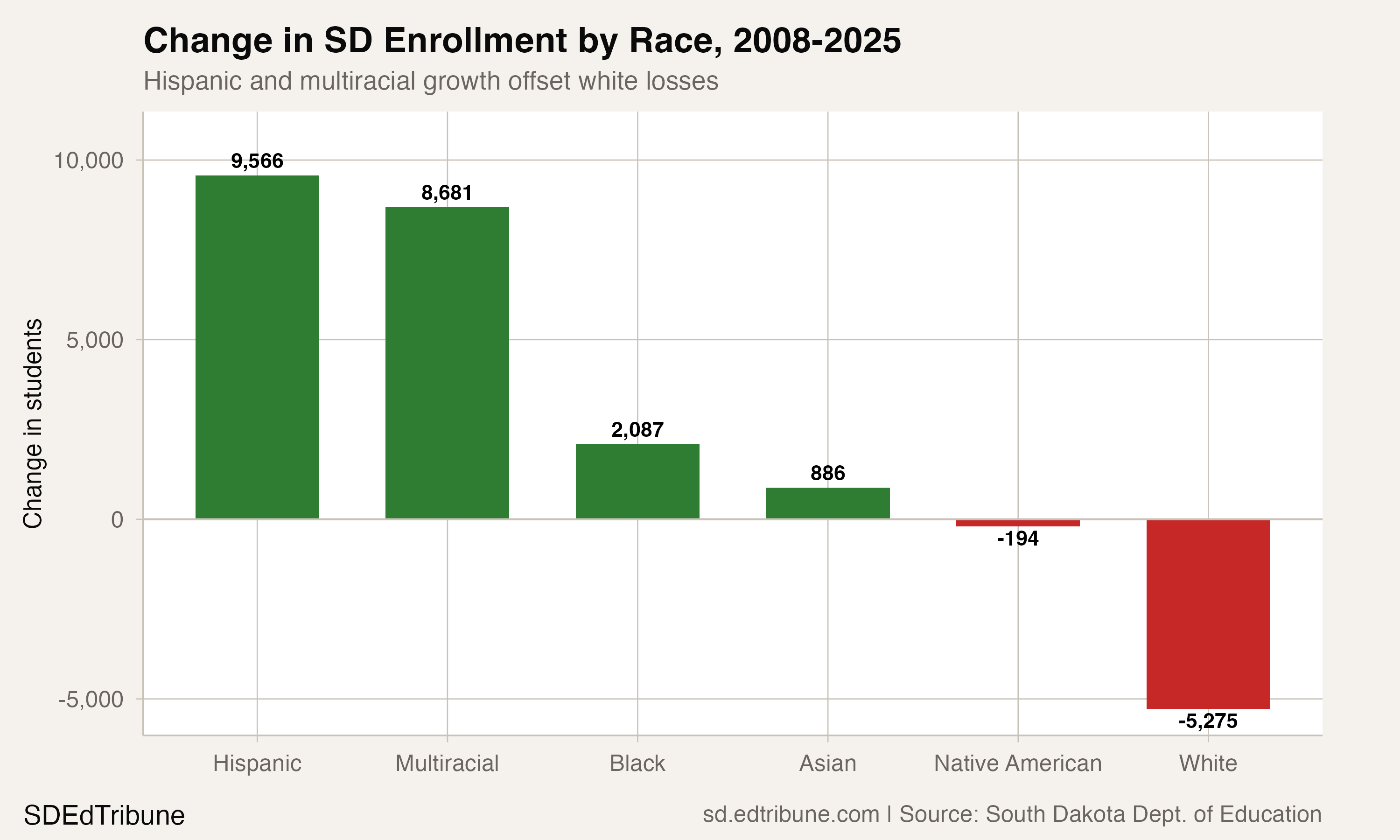
Hispanic enrollment nearly quadrupled, rising from 3,279 students in 2007-08 to 12,845 in 2024-25, a gain of 9,566 students and a 291.7% increase. Hispanic students now compose 9.3% of enrollment, up from 2.7%. Multiracial enrollment, a category that did not exist in the 2007-08 reporting, reached 8,681 students and 6.3% of total enrollment. Black enrollment rose 70.4%, from 2,964 to 5,051. Asian enrollment grew 62.3%, from 1,422 to 2,308.
Native American enrollment, long the state's largest minority group at 11.8% of total enrollment in 2007-08, held essentially flat in absolute terms, declining just 194 students to 14,283. But its share slipped to 10.3% as other groups grew around it. Hispanic enrollment, at 9.3%, is now just one percentage point behind Native American enrollment as the state's second-largest demographic group.
The multiracial surge deserves a caveat. The 2020 Census recorded a 170% increase in South Dakotans identifying as multiracial, a jump that state demographer Weiwei Zhang attributed to both interracial families and changes in how people choose to identify. In school enrollment data, the multiracial category appeared after 2008 and cannot be traced before then. Some portion of the 8,681 multiracial students in 2024-25 would have been counted in a single-race category under the earlier reporting system, meaning the white decline and the multiracial rise are partly linked by reclassification rather than new arrivals.
The Sioux Falls Shift
Sioux Falls enrolled 24,841 students in 2024-25, up 17.4% from 21,157 in 2007-08. The district grew, but the composition of that growth was lopsided. Hispanic enrollment tripled from 1,319 to 4,213, gaining 2,894 students. Black enrollment nearly doubled, adding 1,544 students to reach 3,339. Multiracial enrollment added 2,055 students. White enrollment, meanwhile, fell by 2,866 to 13,445.
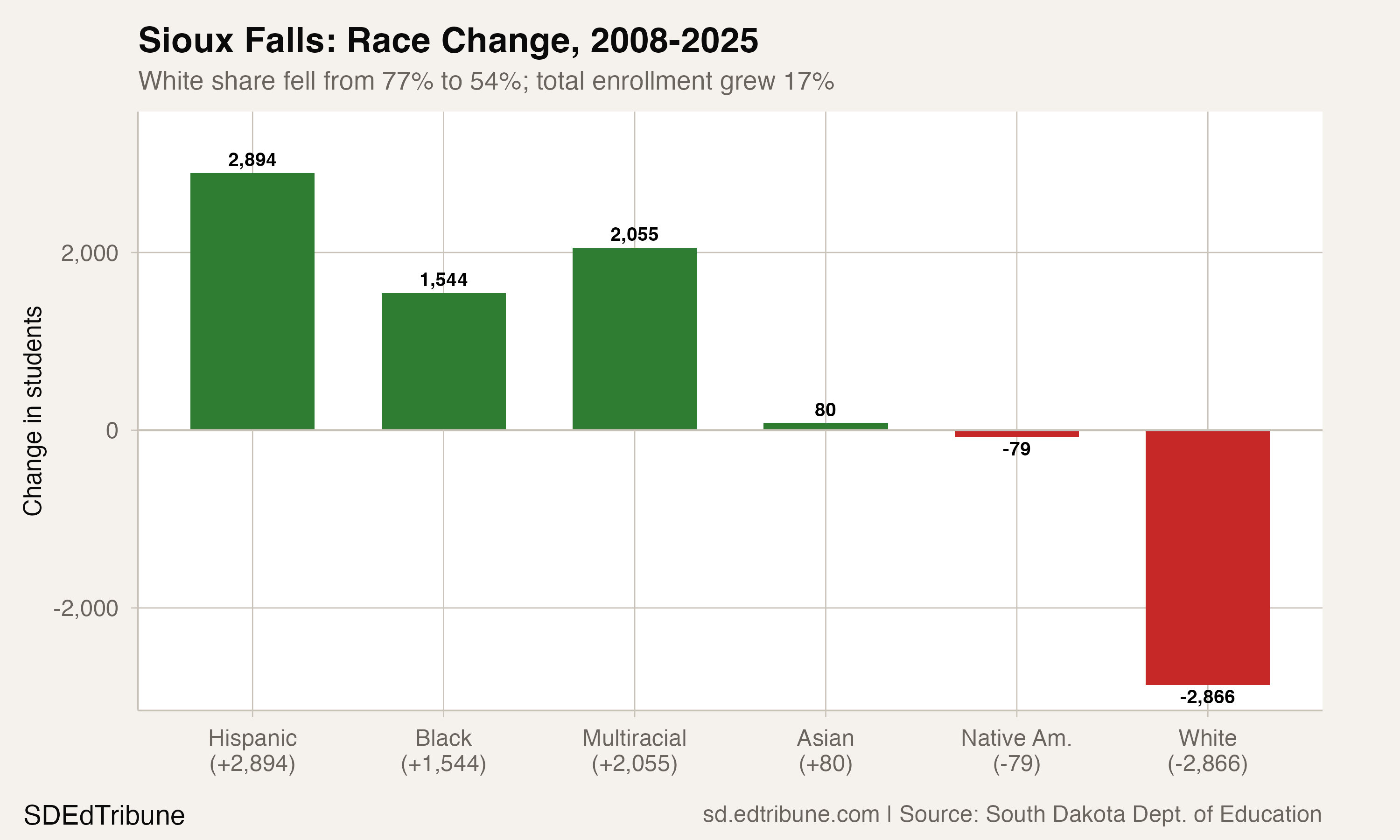
The result: Sioux Falls went from a district where more than three in four students were white to one where barely more than half are. DeeAnn Konrad, the district's community relations coordinator, told Sioux Falls Live that diversity has increased "each year now for over 20-plus years." The district now reports more than 100 languages spoken across its schools and more than 3,000 students learning English as a second or third language.
Part of the white decline in Sioux Falls reflects not departure from the region but movement within it. Harrisburg↗ET, a fast-growing suburb south of Sioux Falls, gained 3,164 white students over the same period, the largest white enrollment increase of any district in the state. Brandon Valley↗ET, another Sioux Falls suburb, added 1,288. Tea Area↗ET gained 855. The Sioux Falls metro is not losing white families. It is sorting them.
The Huron Exception
Huron's transformation is different in kind. The district enrolled 2,150 students in 2007-08 and 3,042 in 2024-25, growing 41.5% while most rural South Dakota districts shrank. White enrollment fell from 1,724 to 1,164, but what replaced it was not suburban spillover. It was international migration.
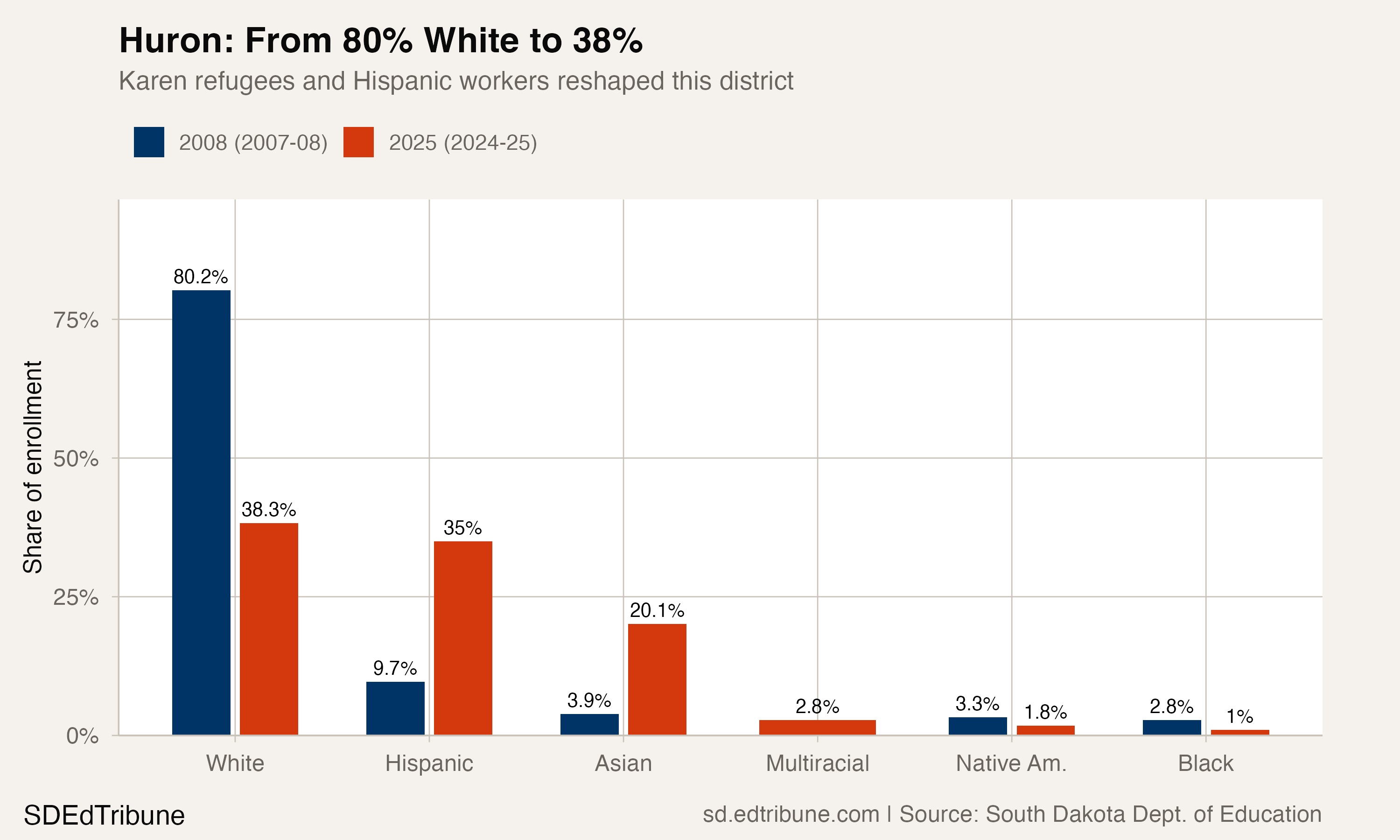
Asian enrollment in Huron surged from 83 to 610, a 634.9% increase driven almost entirely by Karen refugees from Myanmar. When Dakota Provisions opened a turkey processing plant in 2005, the company began recruiting Karen refugees from the Twin Cities to fill jobs. The community chose to embrace the newcomers.
"Do we want to embrace this and try to make our community survive and thrive ... or just stay the status quo?" -- Mayor Paul Aylward, SDPB, 2015
Mark Heuston, the plant's HR director, told PBS NewsHour that "without the Karen people, we probably would not be able to run the turkey plant." The facility processes 20,000 turkeys daily. Hispanic enrollment rose simultaneously, from 209 to 1,066, as food processing jobs attracted Latino workers alongside the Karen community. By 2024-25, 35.0% of Huron's students were Hispanic and 20.1% were Asian. Only 38.3% were white.
Sixteen districts statewide now have majority-minority enrollment, up from 12 in 2007-08. Most are on or adjacent to Native American reservations: Oglala Lakota County↗ET (0.8% white), Todd County↗ET (1.0%), Eagle Butte (1.4%), McLaughlin (1.5%). Huron stands out as the only district whose flip was driven primarily by immigration rather than proximity to a reservation. It also flipped faster than any other, dropping 42 percentage points of white share in 17 years.
A Statewide Pattern with Local Engines
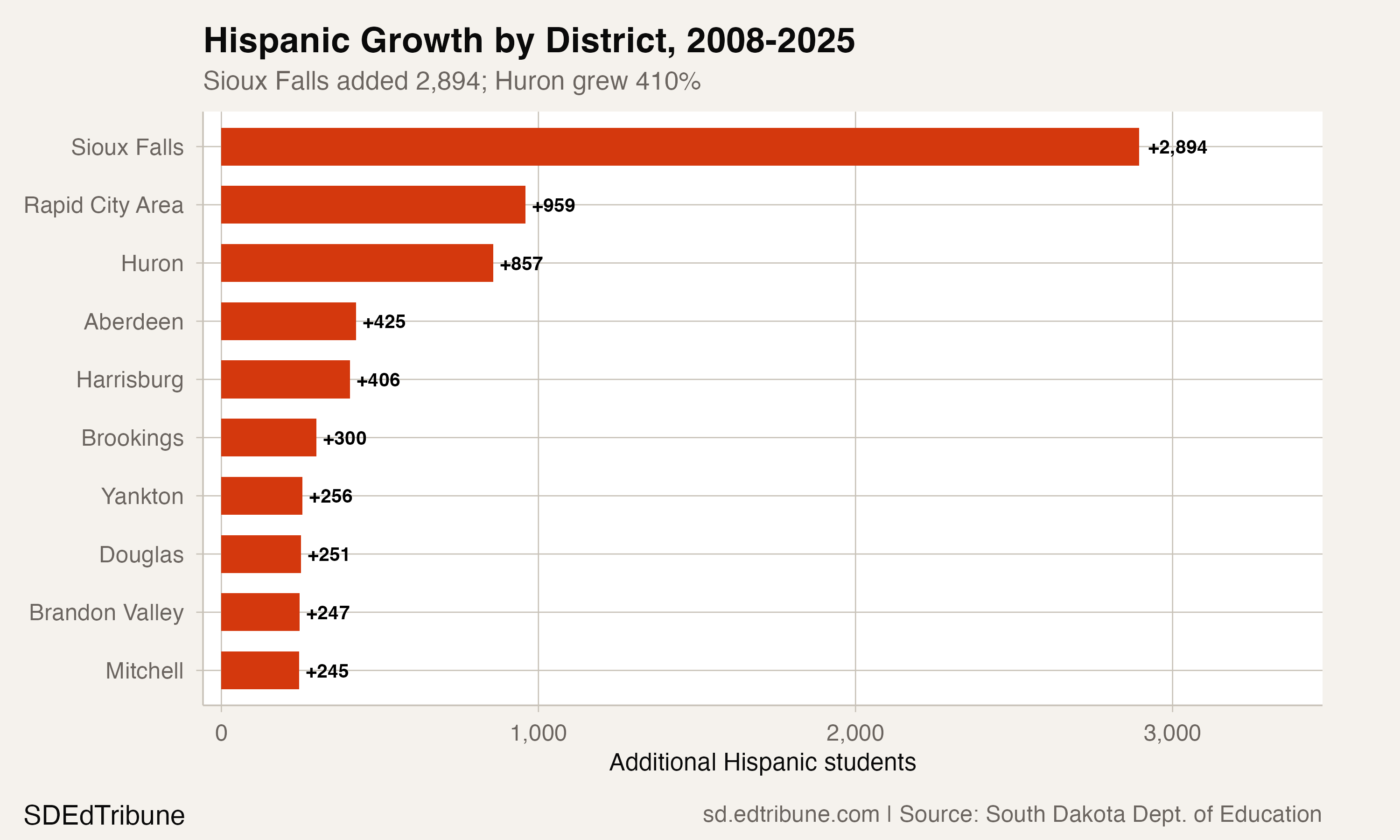
Hispanic growth concentrated in predictable locations: Sioux Falls added 2,894 Hispanic students, Rapid City Area↗ET added 959, and Huron added 857. But smaller communities saw proportionally larger changes. Aberdeen↗ET's Hispanic enrollment grew from 46 to 471, a 923.9% increase. Harrisburg went from 16 Hispanic students to 422. Mitchell went from 58 to 303.
These patterns track national trends of Hispanic population growth in rural Midwestern communities anchored by food processing and agriculture. South Dakota's birth rate has fallen from 15 per 1,000 in 2007 to 12 recently, with white women's fertility rate (62.2 per 1,000 women of childbearing age) running lower than rates for Hispanic women (83.4) and Native American women (92.4), according to March of Dimes data. Differential birth rates, combined with immigration-driven population growth in meatpacking communities, are the most likely drivers of the enrollment share shift.
White enrollment losses, meanwhile, concentrated in the state's established cities. Rapid City Area lost 3,128 white students, the most of any district. Sioux Falls lost 2,866. Watertown↗ET lost 814. But these losses were partly offset by suburban white gains in Harrisburg (+3,164), Brandon Valley (+1,288), and Tea Area (+855), suggesting geographic redistribution rather than net out-migration from the state.
What the Data Cannot Show
South Dakota's race data has a significant gap: no race or ethnicity information is available at any level for the years 2011 through 2020. The comparison here relies on 2007-08 as a starting point and 2024-25 as an endpoint, with no visibility into whether the shift was gradual or concentrated in particular years. The 2022 and 2023 school years are also incomplete, missing Native American and Pacific Islander counts at the state aggregation level, which makes year-over-year tracking within the recent window unreliable for those groups.
The multiracial category introduces additional uncertainty. Students who might have checked "white" and one other box in 2008 could now be counted as multiracial, which would amplify both the white decline and the multiracial rise without any actual change in who is attending school. The degree of this reclassification effect is impossible to quantify from enrollment data alone.
The Service Question
The demographic shift carries operational weight regardless of its causes. When Sioux Falls reports that 44.6% of students come from diverse backgrounds and enrolls more than 3,000 English language learners, the instructional model is structurally different from a district that is 82% white. English learner programs, multilingual family outreach, and culturally responsive instruction all carry per-pupil costs that exceed general education. Sioux Falls is already facing a $1.5 million budget shortfall as total enrollment plateaus while demand for specialized services continues to rise.
Sioux Falls is already facing a $1.5 million budget shortfall as total enrollment plateaus while demand for ELL services rises. It has 100 languages in its buildings and 3,000 students learning English. Harrisburg went from 16 Hispanic students to 422 in 17 years and is diversifying faster than any suburb in the state. The demographic shift is not arriving. It arrived. What has not arrived, in most districts, is the staffing and programming to match it.
Detailed code that reproduces the analysis and figures in this article is available exclusively to EdTribune subscribers.
Discussion
Sign in to join the discussion.
Loading comments...