Most states lost students during the pandemic. South Dakota added them.
Between the 2019-20 and 2021-22 school years, public school enrollment in South Dakota grew by 2,275 students, a 1.6% gain, at a time when national public school enrollment fell 2.7%. Eighty-seven of the state's 149 districts gained enrollment. The Sioux Falls↗ET suburbs boomed. The state's long growth streak, which had already added 17,058 students over the prior 12 years, appeared to have survived a shock that broke enrollment trajectories in nearly every other state.
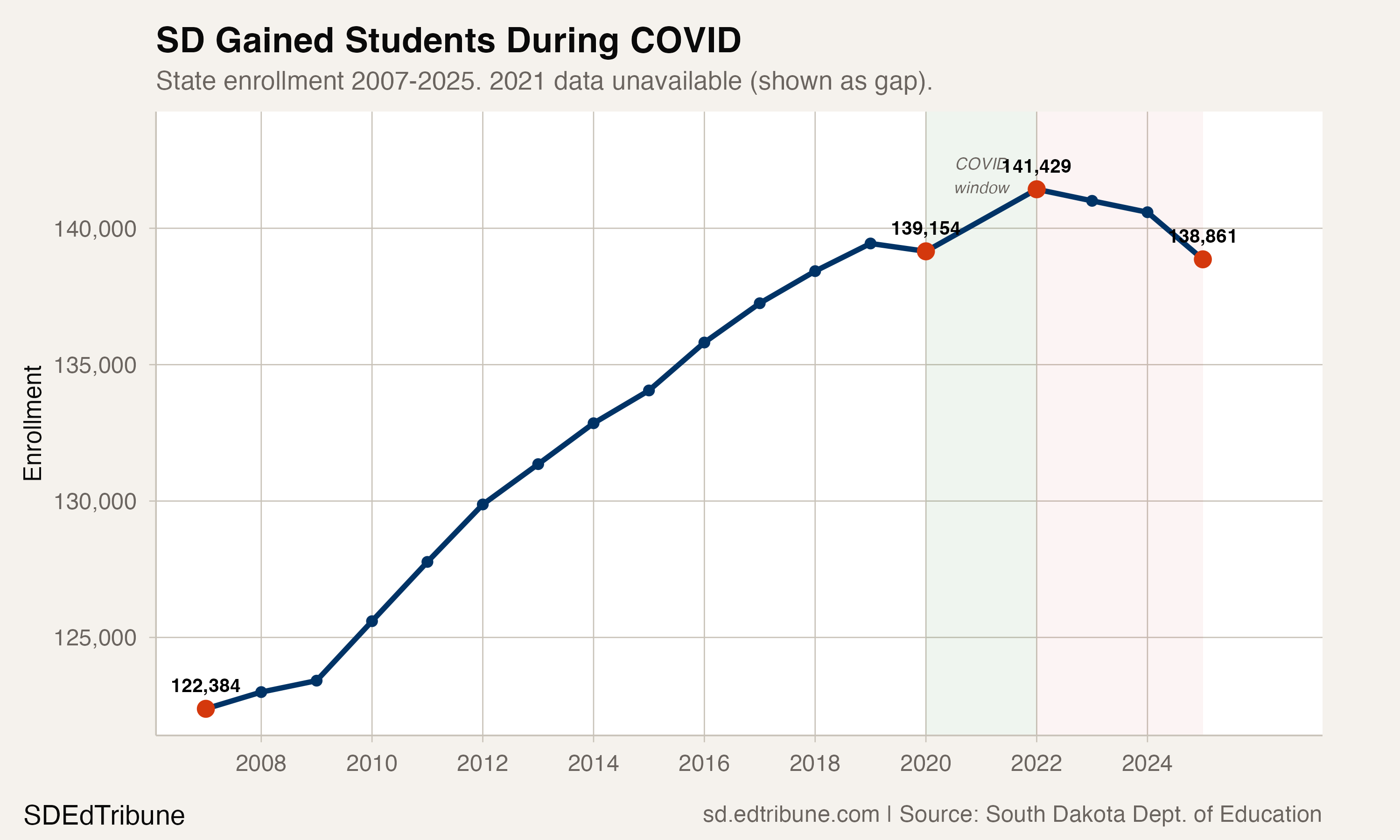
That growth has now reversed. South Dakota hit a peak of 141,429 students in the 2021-22 school year and has declined every year since, falling to 138,861 in 2024-25. The 2024-25 loss of 1,726 students is the largest single-year decline in the dataset, more than double the two prior years' losses combined.
The growth that wasn't supposed to end
South Dakota grew in 12 consecutive years from 2007-08 through 2018-19, adding an average of 1,420 students per year. The only interruption before the current decline was a minor 288-student dip in 2019-20. Through COVID, enrollment surged to a new high of 141,429.
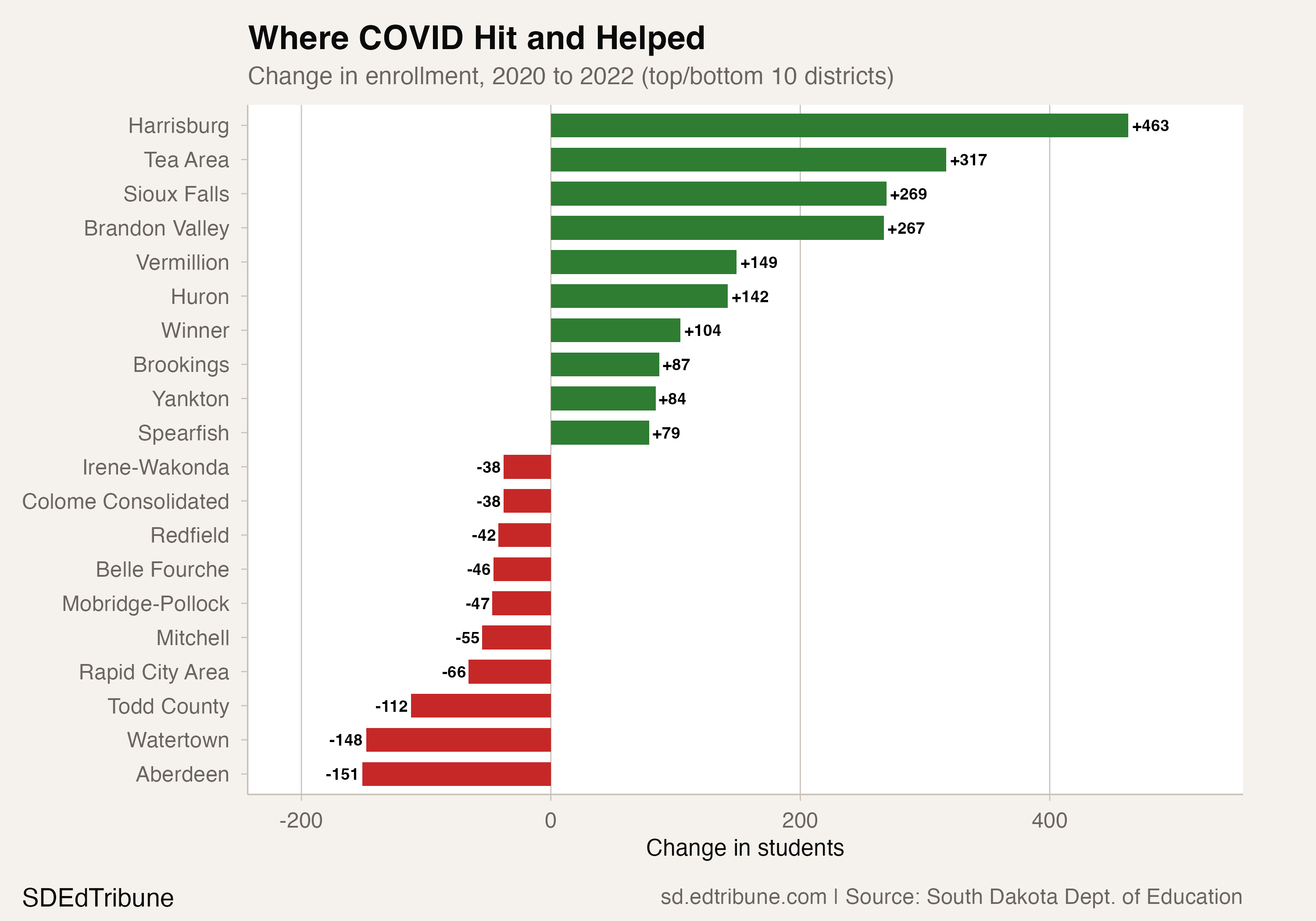
The source of that gain was concentrated. The ten-district Sioux Falls metro area accounted for 1,398 of the 2,275-student statewide increase, or 61.5% of the total. Harrisburg↗ET alone added 463 students. Tea Area↗ET gained 317. Brandon Valley↗ET added 267. The Sioux Falls School District, already the state's largest at 24,855, grew by 269.
On the losing side, the declines were scattered among smaller communities. Aberdeen↗ET lost 151 students. Watertown↗ET lost 148. Todd County↗ET, home to the Rosebud Sioux Reservation, lost 112. Rapid City Area Schools↗ET, the state's second-largest district, shed 66 students during the COVID window, continuing a decline that began years earlier.
A suburban engine and a rural drag
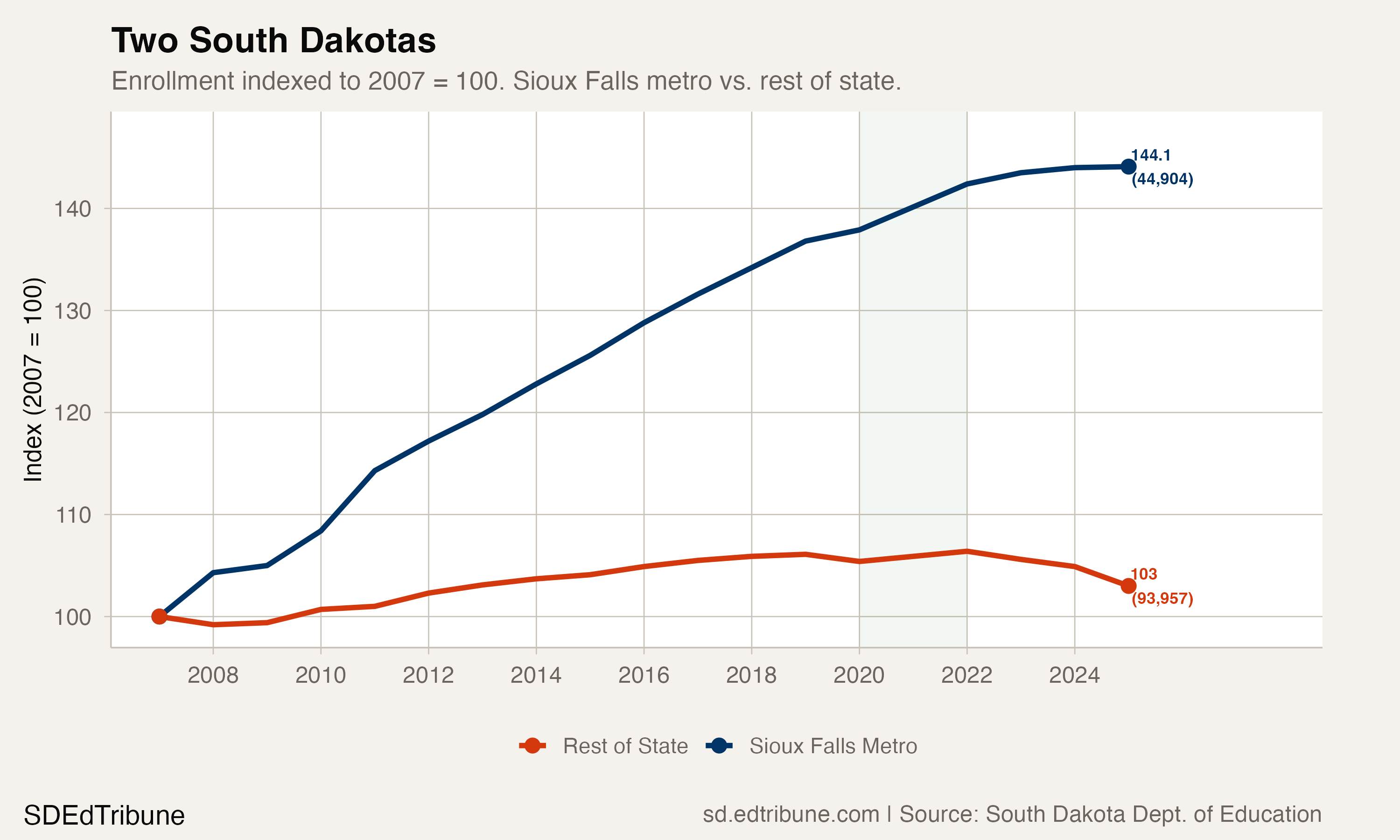
The divergence between metropolitan and rural South Dakota long predates COVID, but the pandemic sharpened it. Since 2007, the Sioux Falls metro has grown 44.1%, adding more than 13,000 students. The rest of the state has grown just 3.0%.
Harrisburg's trajectory captures the dynamic in miniature. The district enrolled 1,716 students in 2007. By 2024-25, it reached 6,398, a 272.8% increase over 18 years. It is now the third-largest district in the state and, according to the Sioux Falls Chamber of Commerce, "has for years been the fastest-growing school district in the state."
Rapid City, by contrast, peaked at 13,982 in 2012 and has declined in nine of the 13 years since, falling to 12,040 in 2024-25. That is a loss of 1,942 students, or 13.9%, over a period when the state as a whole was still growing. Homeschooling registrations in the Rapid City district tripled from 481 to 1,681 between 2013 and 2023.
What pulled families in
South Dakota's COVID-era enrollment gain tracked a broader population surge. The Dakota Institute found that the state gained roughly 6,300 net domestic migrants between 2020 and 2021, along with $450 million in additional income from those households. Between 2021 and 2022, net domestic migration reached 8,424, and the state's population growth rate hit 1.52%, four times the national average and fifth-fastest in the country.
The timing coincides with South Dakota's approach to the pandemic. While schools did close in spring 2020, the state prioritized face-to-face instruction for the 2020-21 school year. By September 2020, most schools were operating in person, and by June 2021 all schools had returned to in-person learning. In-migration from states with longer school closures is a plausible contributing factor, though enrollment data alone cannot distinguish between new arrivals and families who might otherwise have left.
South Dakota also entered the pandemic with demographic tailwinds that most states lacked. The state's total fertility rate is the highest in the nation and the only one close to the replacement rate of 2.1 children per woman. Births have remained "fairly stable" even as national birth rates fell, ranking behind only Utah and Texas.
The reversal: 2,568 students gone in three years
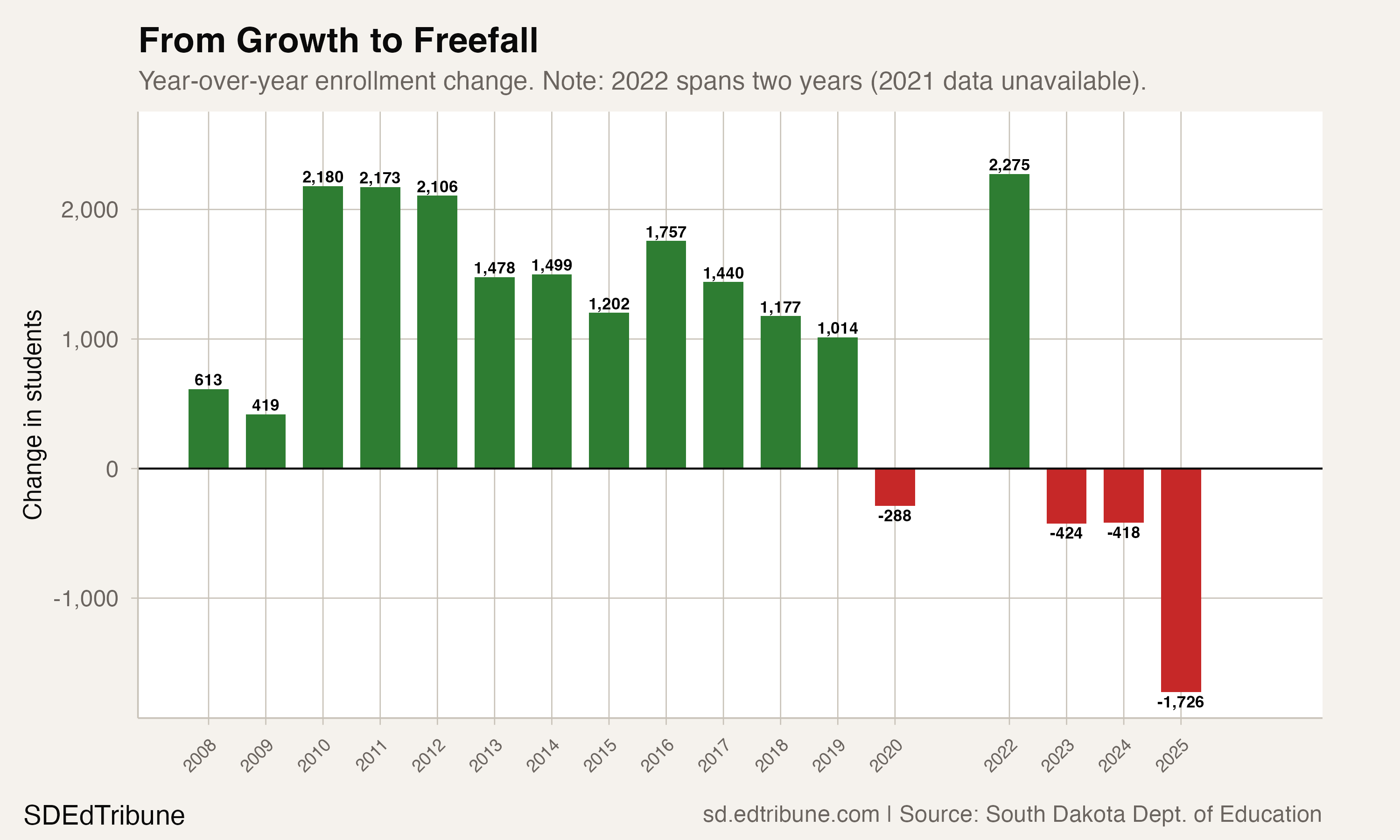
The post-2022 decline has accelerated sharply. The state lost 424 students in 2022-23, another 418 in 2023-24, and then 1,726 in 2024-25. That final figure is larger than any annual gain the state posted during the growth era except for 2010-12 and 2016.
Two forces are converging. The migration boom that fed suburban growth has cooled. Net domestic migration dropped from over 3,000 in 2021-22 to roughly 600 in 2023-24, a decline of more than 80%. Fewer families are moving in.
At the same time, alternative instruction is pulling students out. South Dakota's alternative instruction enrollment hit 12,433 in 2025-26, up from roughly 5,342 before the pandemic, a 130% increase. That 12,433 figure represents 7.6% of all school-age children receiving an education in the state. Governor Larry Rhoden framed the shift as a feature: "Regardless of where they receive their education, my goal as governor is to support innovation."
Kindergarten is the leading indicator
The clearest signal of what comes next is in the kindergarten numbers. South Dakota's K enrollment rebounded from a COVID-year dip of 11,452 (2019-20) to a high of 12,082 (2021-22), then fell in each of the next three years, reaching 10,954 in 2024-25. That is 498 fewer kindergartners than during the COVID year itself, and the lowest K enrollment since 2009.
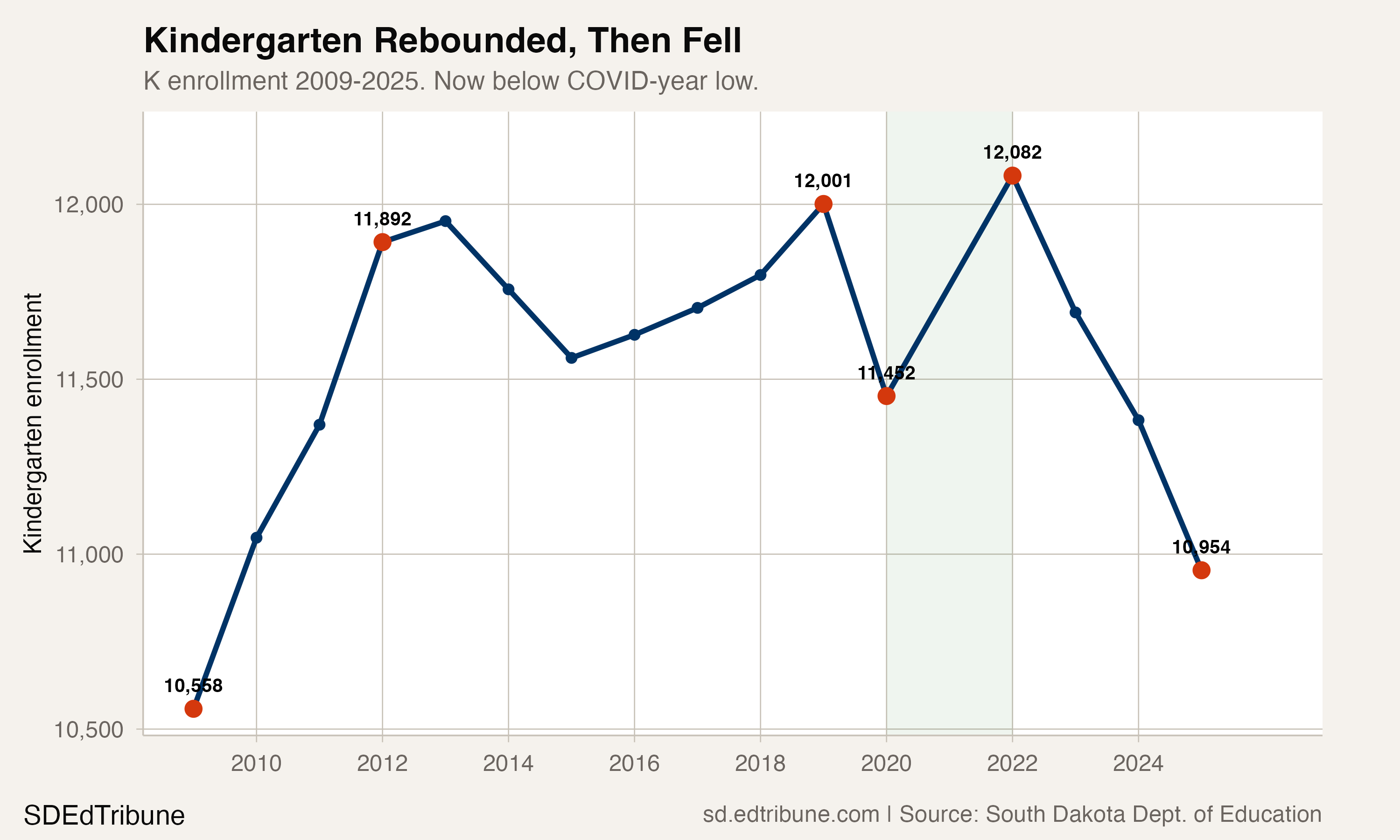
South Dakota's birth rate, while still the highest in the nation, fell to 12.2 per 1,000 population in 2023, the lowest in the state's recorded history. Each kindergarten cohort that enters smaller than the 12th-grade class it eventually replaces locks in further total enrollment decline. In 2024-25, the state enrolled 10,954 kindergartners but graduated 12th-grade classes of comparable or larger size, a pipeline contraction that compounds every year.
What the COVID exception cost
South Dakota's COVID-era gain bought time, but it may have also masked a structural transition. The state's growth era was never primarily about natural increase. It was powered by in-migration, concentrated in one metro area, during a period of unusual national disruption. When migration slowed, the underlying arithmetic reasserted itself.
In-migration has dropped from over 3,000 net domestic arrivals in 2021-22 to roughly 600 in 2023-24. Alternative instruction adds another 1,000 students per year to the non-public rolls. Harrisburg and Tea Area are still growing, but they are running out of room to offset what the rest of the state is losing.
South Dakota watched its neighbors hemorrhage students during COVID and thought it had dodged the national trend. The last three years carry a blunt message: the state did not avoid the enrollment decline. It delayed it.
Detailed code that reproduces the analysis and figures in this article is available exclusively to EdTribune subscribers.
Discussion
Sign in to join the discussion.
Loading comments...