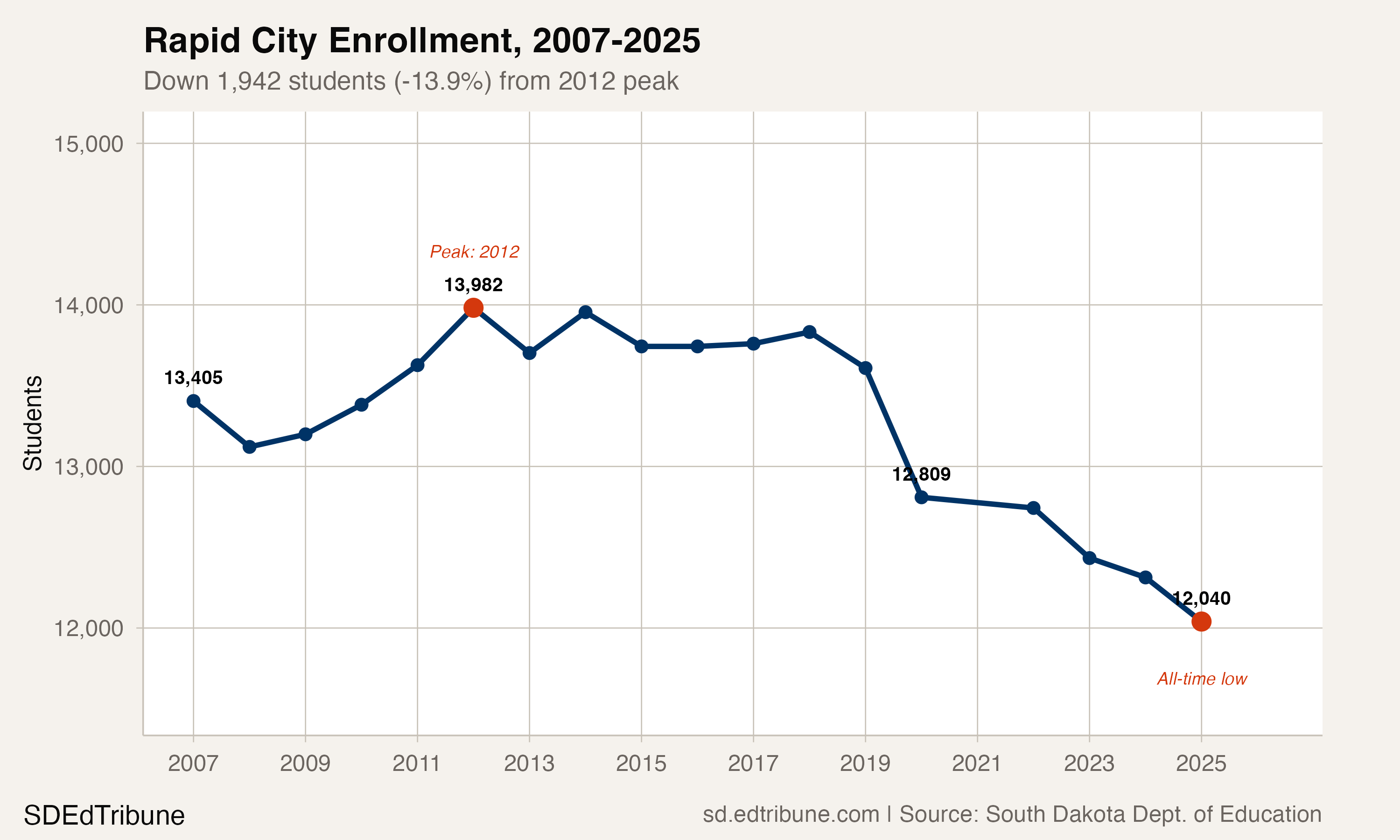
In the 2024-25 school year, South Dakota's statewide enrollment stood 6.9% higher than it did 13 years ago. Its second-largest school district moved in the opposite direction. Rapid City Area Schools↗ET enrolled 12,040 students in 2024-25, the lowest figure in at least 19 years of state data and likely the lowest in more than three decades, according to a community demographic analysis that tracked the district back to 1991-92. The gap between Rapid City and the state it anchors has never been wider.
Since its 2012 peak of 13,982 students, the district has shed 1,942, a 13.9% decline. Six consecutive years of losses have erased any ambiguity about the trajectory: this is not a COVID dip that will self-correct. It is a structural contraction fed by a collapsing kindergarten pipeline, a bus system that cannot get students to school, and a community grappling with a federal civil rights investigation that found the district discriminated against its Native American students.
A decline the state did not share
What makes Rapid City's trajectory so unusual is the backdrop. South Dakota added 8,986 students between 2012 and 2025, a 6.9% increase. Rapid City lost 1,942 over the same period. Its share of statewide enrollment fell from 10.8% to 8.7%. In 2012, roughly one in nine South Dakota students attended Rapid City schools. Now it is closer to one in 11.
The divergence is even sharper among peers. Harrisburg↗ET, a Sioux Falls suburb, more than doubled (+111.4%). Brandon Valley↗ET grew 50.5%. Huron↗ET, powered by refugee resettlement, added 31.0%. Among the state's eight largest districts, only Watertown↗ET also declined, and its 11.6% loss was smaller than Rapid City's.
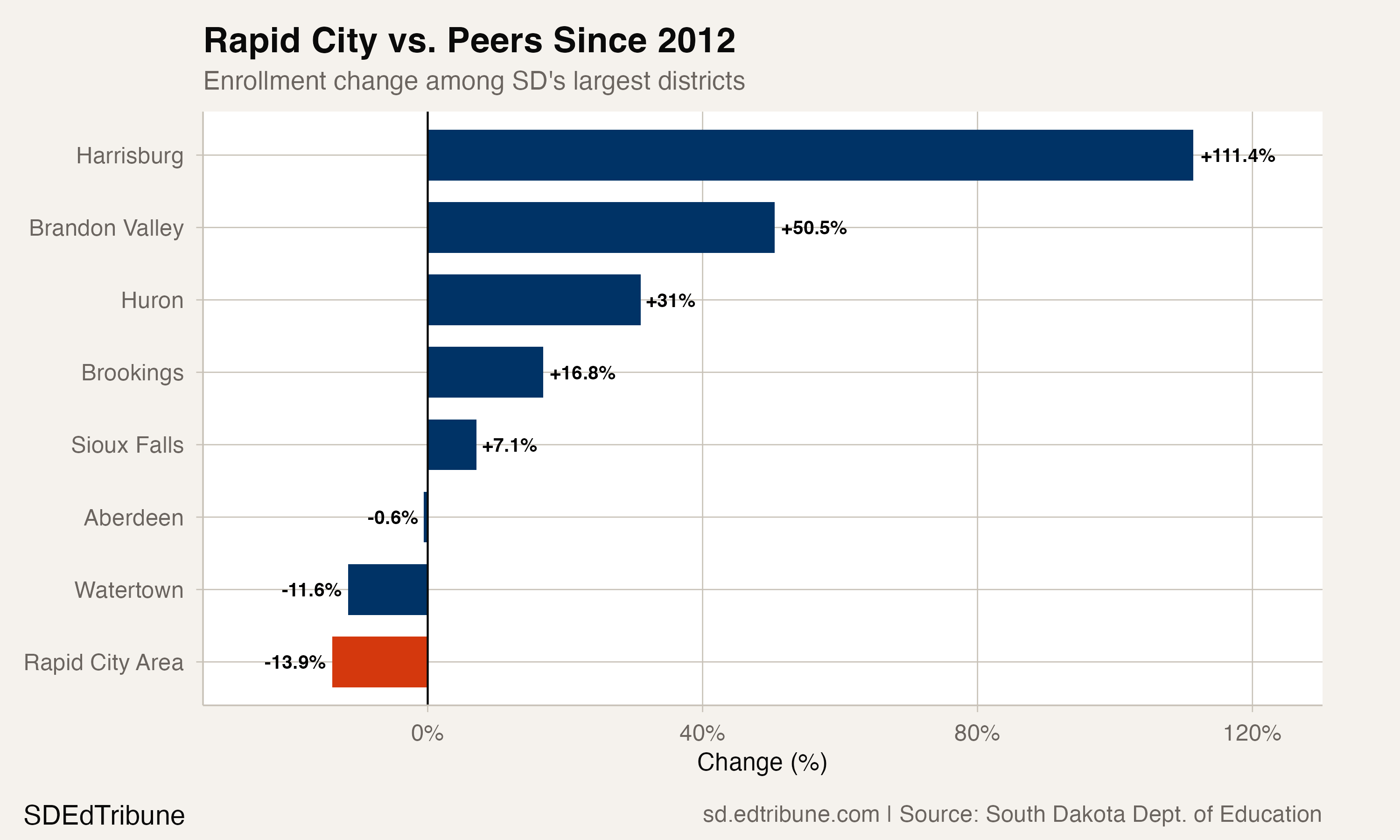
Sioux Falls↗ET, the state's largest district, now enrolls more than twice as many students as Rapid City. In 2007, Rapid City was 67% of Sioux Falls' size. By 2025 it had fallen to 48.5%.
Six years of red ink
The year-over-year pattern makes the structural nature of the decline visible. The district has not posted a single year of growth since 2018, when it added 72 students. The 2020 loss of 800 students, the single worst year in the dataset, coincided with the pandemic. But the bleeding continued: losses of 66, 310, 120, and 273 followed in successive years.
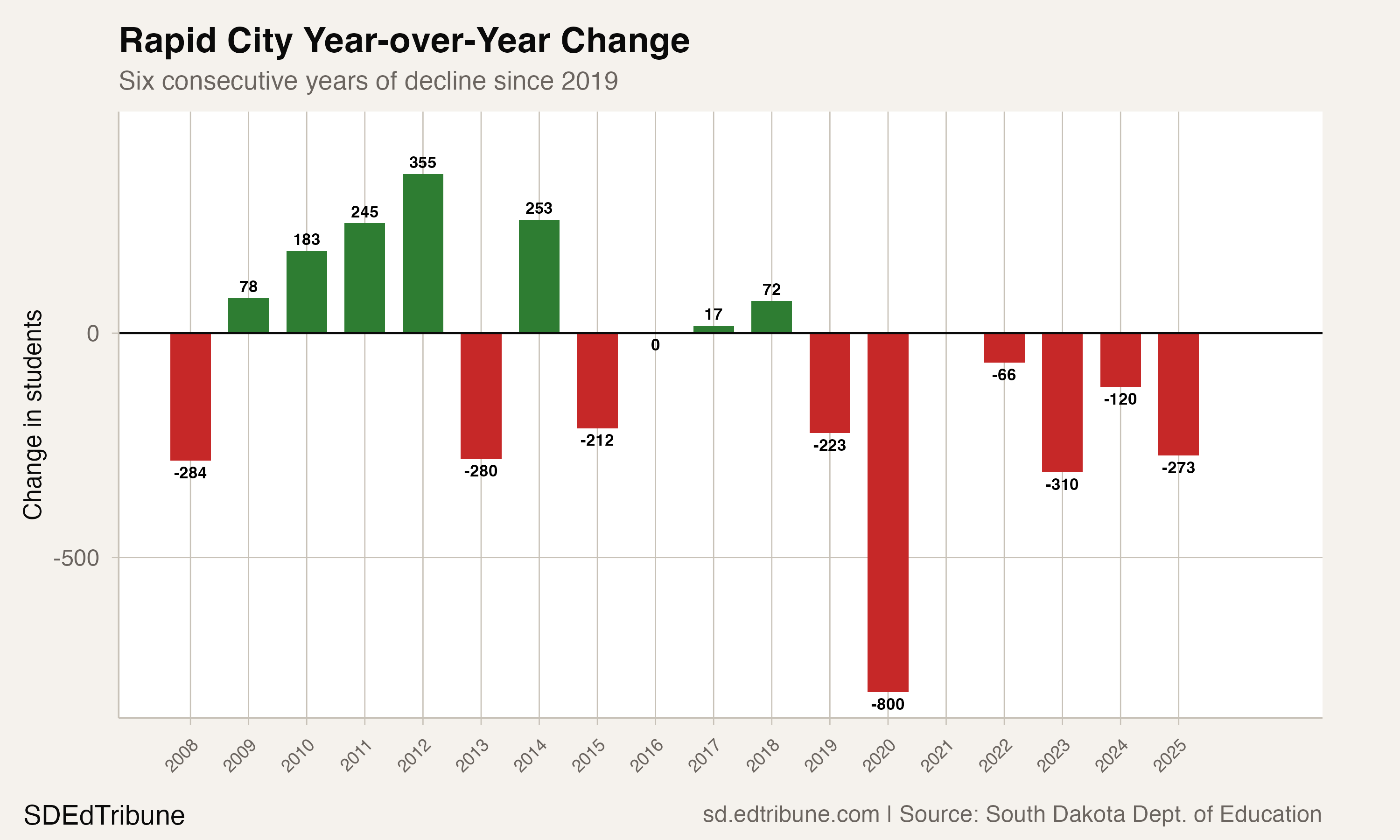
The six-year streak is the longest sustained decline in the dataset. Before 2019, Rapid City's pattern was cyclical. It fell for two years, then rose for two or three. That pattern broke in 2019 and has not returned.
The bottom is falling out of the pipeline
The most consequential number in the dataset is not the all-time low itself. It is the kindergarten class. In 2012, 1,262 children entered Rapid City kindergarten. In 2025, that number was 814, a 35.5% decline. The district now enrolls fewer kindergartners than 12th graders (814 vs. 850), a K-to-12 ratio of 95.8 that signals the decline has not finished working through the system.
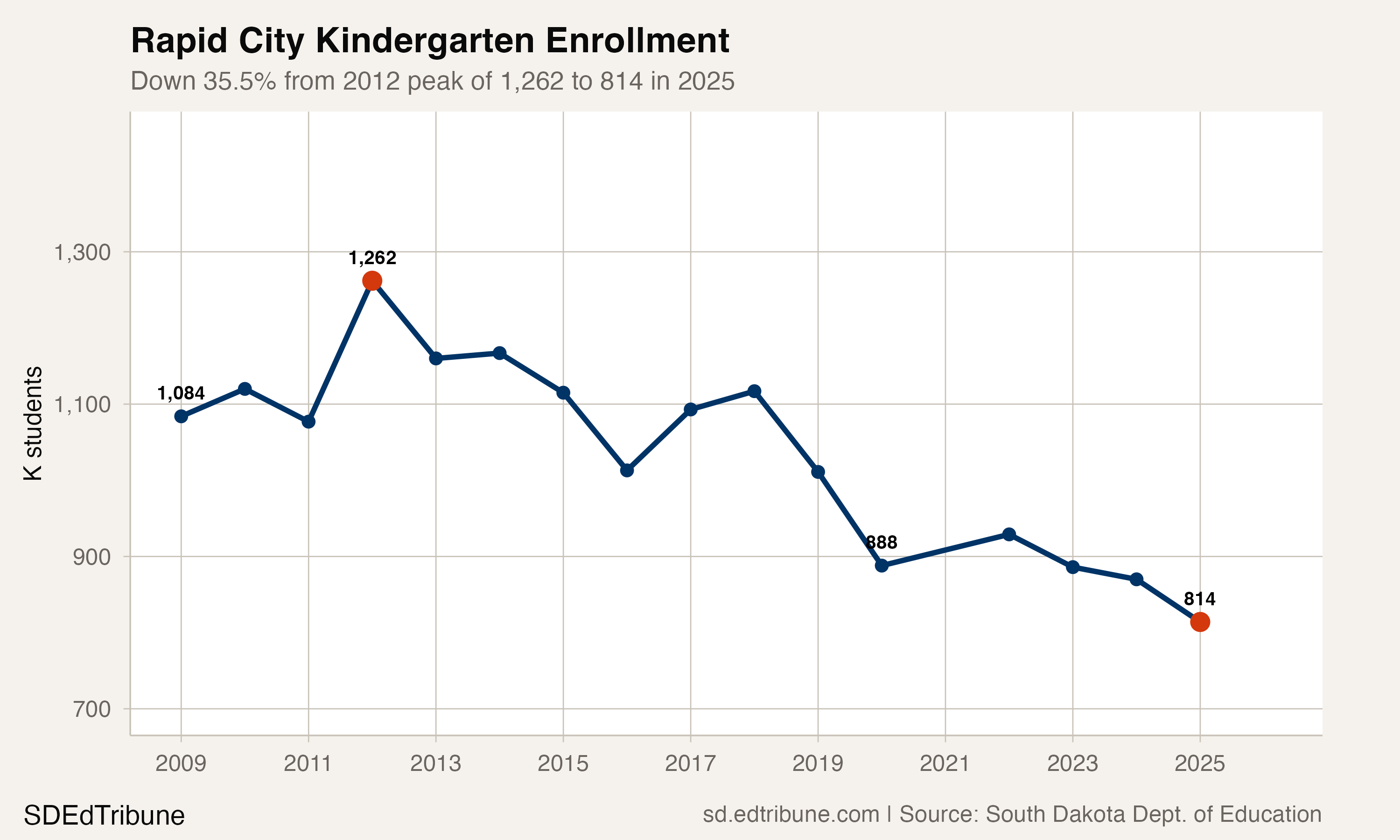
The grade-by-grade pattern is a textbook pipeline collapse. Every grade lost students between 2012 and 2025, but the losses are steepest at the youngest grades and taper as you move up: kindergarten fell 35.5%, first grade 28.9%, second grade 25.5%, third grade 22.8%. By the time you reach the middle school grades, losses are in the single digits. Grade 12 actually grew by 1.2%, reflecting the larger cohorts that entered the system a decade ago and are now aging out.
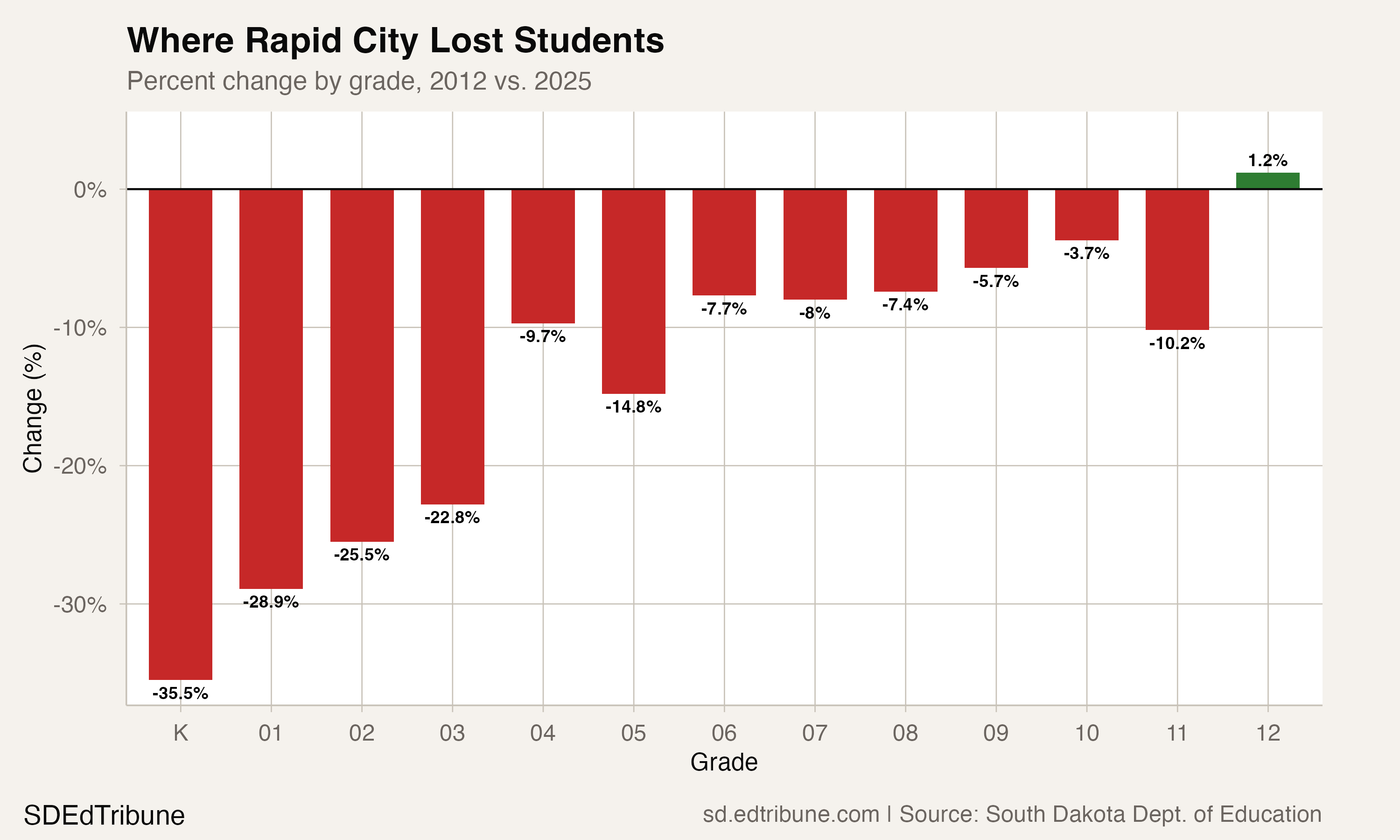
Elementary enrollment (PK through fifth grade) dropped by 1,518 students, a 21.9% decline that accounts for 78% of the district's total losses. Middle school enrollment fell 7.7%. High school enrollment fell 4.7%. When the 2024-25 kindergarten cohort reaches high school, the district will be substantially smaller than it was in 2024-25.
Where the students went
The RCAS Forward demographic study, an independent community analysis, identified five destinations for departing students: homeschooling, private schools, transfers to nearby public districts, early graduations, and dropouts. South Dakota allows open enrollment transfers between any public districts in the state, and the neighboring Douglas↗ET and Meade↗ET districts have both grown in recent years.
Former Assistant Superintendent Dave Janak offered a demographic explanation that the community analysis highlighted: while Rapid City's overall population has grown, much of that growth comes from retirees rather than families with school-age children. Pennington County added residents in 2023-24, but the Dakota Institute found the rate of growth slowed substantially compared to prior years, with Pennington and Minnehaha counties together adding just 2,320 residents versus 4,682 the year before.
Transportation may also be pushing families away. The district is 12 bus drivers short of full staffing and eliminated more than 100 bus stops for the 2025-26 school year, with many buses operating at just 50% capacity. SDPB reported that the district's attendance rate stands at 92.87%, with North Middle School, Central High School, and alternative programs falling below 90%. Chronic absenteeism has nearly doubled statewide since 2019, and Pennington County officials have shifted to intervention over punishment, citing housing instability and transportation barriers as root causes.
A civil rights shadow
The enrollment data cannot isolate how many families have left because of the district's racial climate. But the timeline is suggestive. A U.S. Department of Education Office for Civil Rights compliance review, initiated in December 2010, found in May 2024 that Native American students faced pervasive discipline disparities: they were 4.83 times more likely to be suspended out of school than white peers and 5.84 times more likely to be arrested. Only 2.48% of advanced learning middle school students were Native American, despite Native American students representing 18% of the middle school population.
"The agreement exists because the Rapid City Area school board needed to be held accountable." — Nick Tilsen, founder of NDN Collective, quoted by DRG News
The district agreed to hire a discipline equity supervisor and an advanced learning coordinator, establish a standing committee with Native American community members, and revise its discipline and truancy policies. In April 2025, the Trump administration withdrew from the resolution agreement, citing that it was "wrongly rooted in efforts to promote diversity, equity and inclusion."
Native American students make up 17.8% of Rapid City's enrollment, roughly 2,139 students. The district's demographic composition, with 57.1% white students, 12.1% multiracial, and 10.6% Hispanic, makes it one of the most diverse in a state where many districts enroll overwhelmingly white student bodies. Whether the federal withdrawal changes the district's implementation of the reforms it had agreed to is an open question.
The fiscal arithmetic
South Dakota's school funding formula is built on a target teacher salary and student-teacher ratio, which means enrollment losses translate directly into reduced state aid. Each student who leaves shrinks the district's formula allocation, while the fixed costs of buildings, bus fleets, and administrative staff remain.
The operational bind is visible in the grade data. Elementary schools have lost more than a fifth of their students, but buildings, heating systems, and administrative staff do not scale down proportionally. Meanwhile, Superintendent Jamie Jo Thompson noted that some elementary schools are actually at or near capacity, with enrollment increases at schools like Valley View even as the district total falls. The decline is not uniform across buildings, which makes consolidation decisions politically and logistically complex.
What to watch
The 814 kindergartners who entered Rapid City schools in fall 2024 will determine the district's enrollment trajectory for the next 13 years. If the kindergarten class continues to shrink at its recent pace, the district could fall below 11,000 students within three to four years, potentially triggering facility closures or consolidations that no school board welcomes.
The bus driver shortage and chronic absenteeism may be compounding the enrollment decline, or they may be symptoms of a community where fewer families see the public schools as their default choice. Either way, Rapid City is growing as a city while its school district is not. That gap, now in its sixth consecutive year, is the central fact any incoming superintendent, school board candidate, or state legislator must contend with.
Detailed code that reproduces the analysis and figures in this article is available exclusively to EdTribune subscribers.
Discussion
Sign in to join the discussion.
Loading comments...