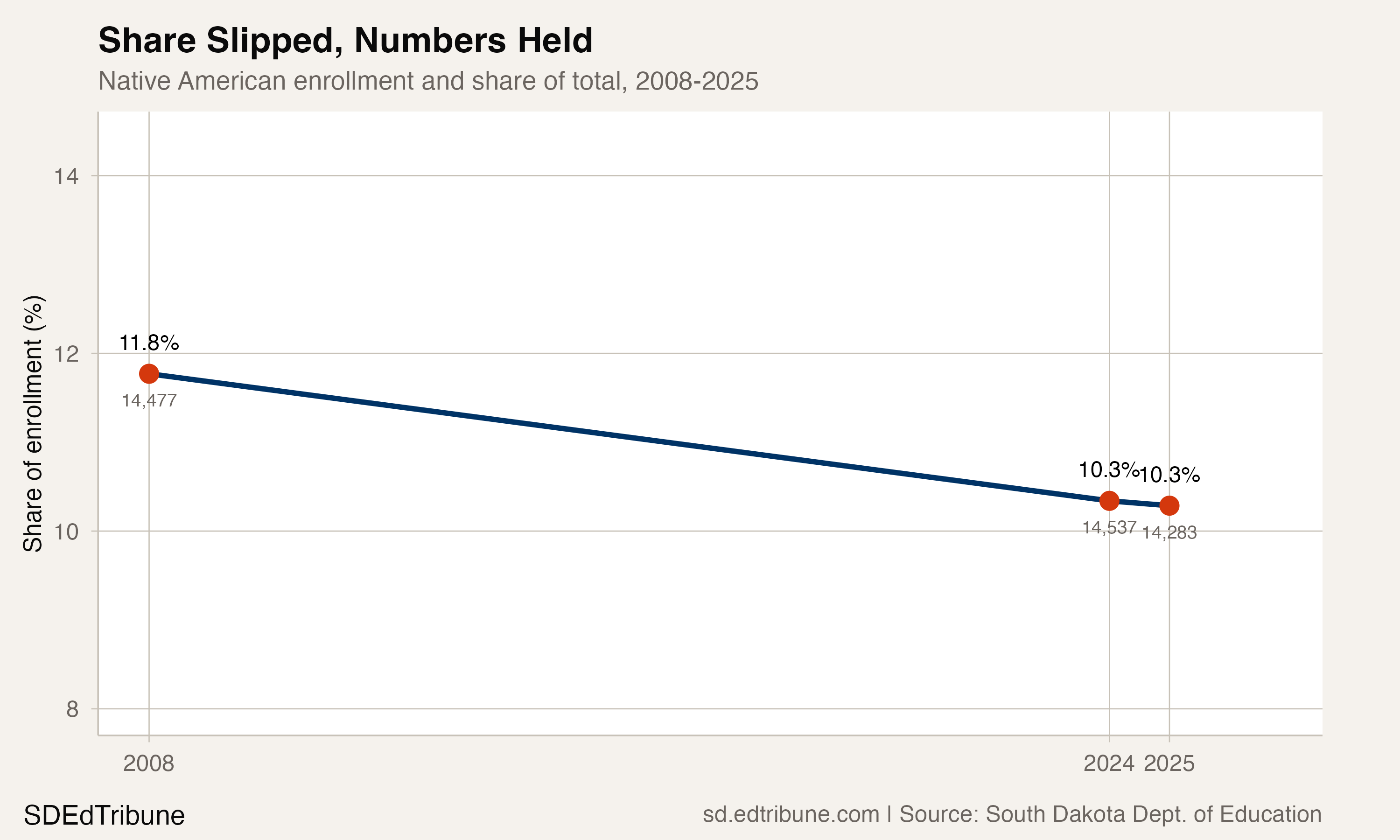
South Dakota enrolled 14,477 Native American students in 2008. In 2025, the number was 14,283. That is 194 fewer students over 17 years, a decline of 1.3%.
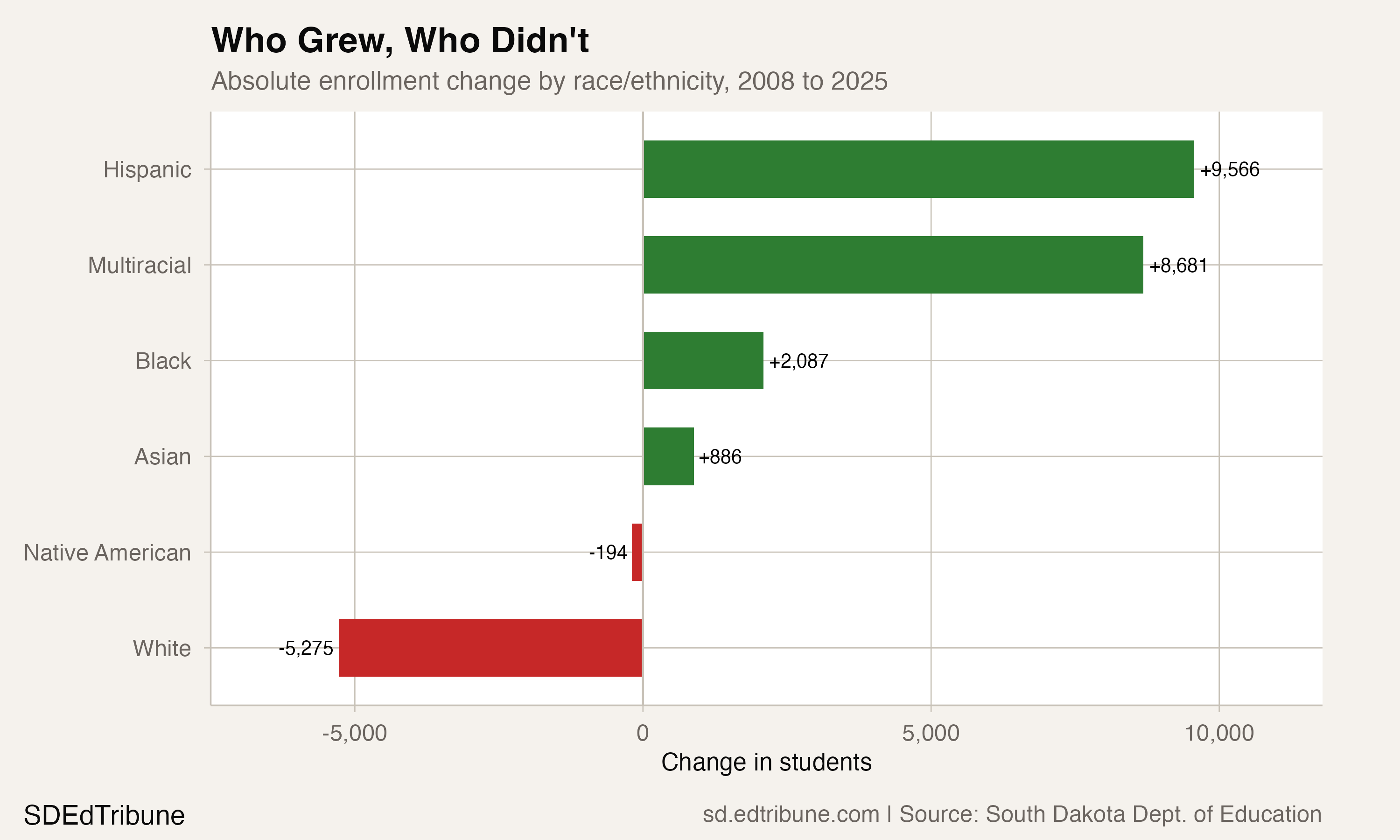
In the same period, Hispanic enrollment nearly quadrupled, rising from 3,279 to 12,845. Black enrollment grew 70.4%. A multiracial category that did not exist in 2008 now accounts for 8,681 students. The state's total enrollment climbed 12.9%. Native American enrollment did none of these things. It held steady while the demographic ground shifted beneath it.
The invisible erosion
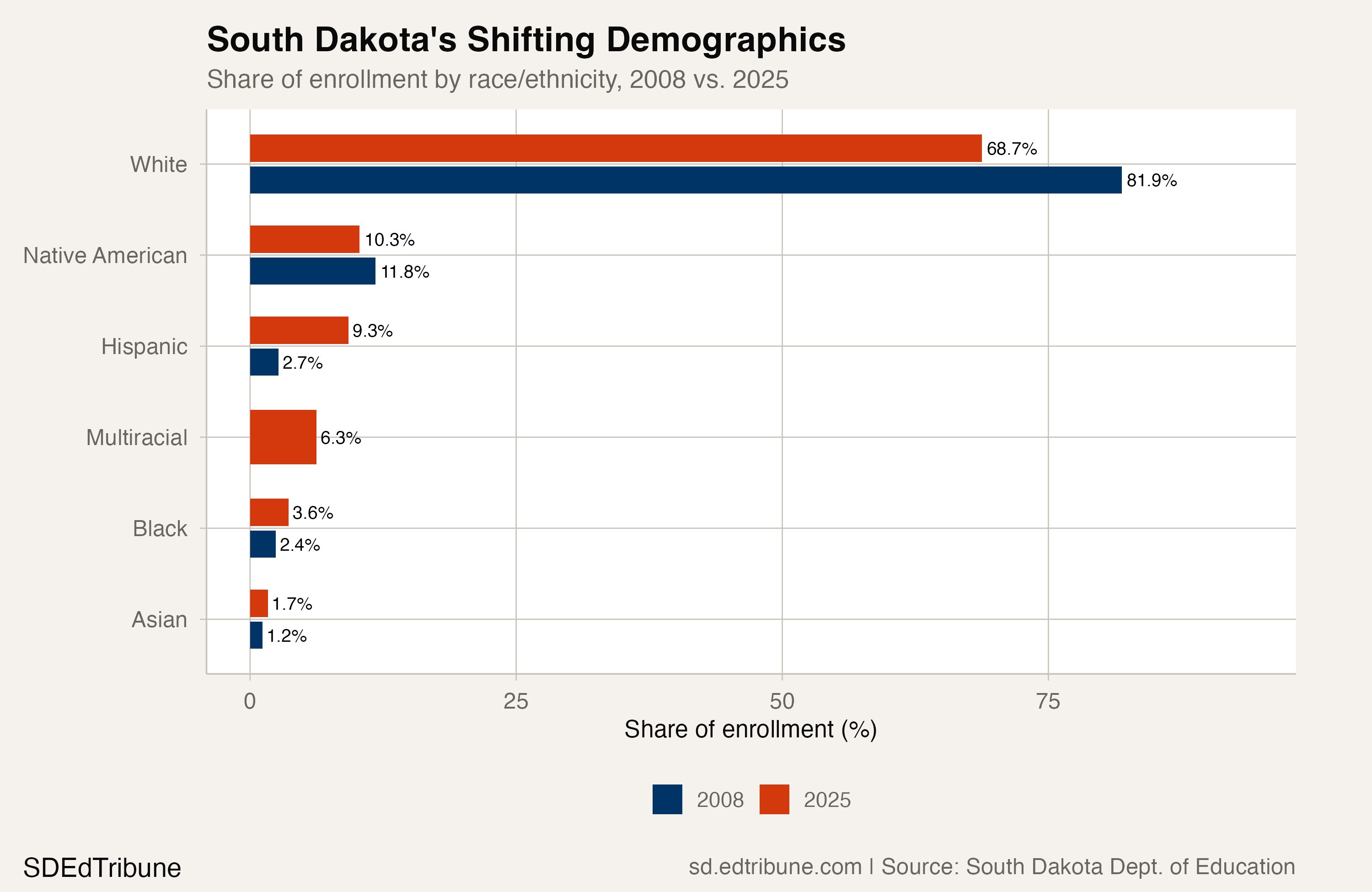
The flatline is deceptive. In 2008, Native American students were the second-largest demographic group in South Dakota's public schools at 11.8% of enrollment. By 2025, that share had fallen to 10.3%, and Hispanic students, at 9.3%, had nearly closed the gap.
The share did not drop because Native families left. It dropped because everyone else's numbers grew. South Dakota added 15,864 students between 2008 and 2025. Hispanic enrollment contributed 9,566 of that growth. The multiracial category added 8,681. Black students added 2,087. Asian students added 886. Native American enrollment contributed negative 194.
A caveat on the data: South Dakota's race/ethnicity enrollment records have a 13-year gap, with data available only for 2008 and then 2022 through 2025. The comparison here spans the full window but cannot show what happened in between. It is also possible that some students counted as Native American in 2008 would identify as multiracial in later records. But the multiracial category added 8,681 students by 2025, far more than any plausible reclassification from Native American enrollment alone.
White enrollment also fell, losing 5,275 students, a 5.2% decline. But white students still make up 68.7% of the total. The Native American position is structurally different: a small population that is not growing in a state where the overall student body is diversifying rapidly.
A tale of concentration
The stagnation is not evenly distributed. Native American enrollment in South Dakota is concentrated in a small number of districts, most of them in or near reservation communities. Seven districts are more than 80% Native American. Thirteen are above 50%.
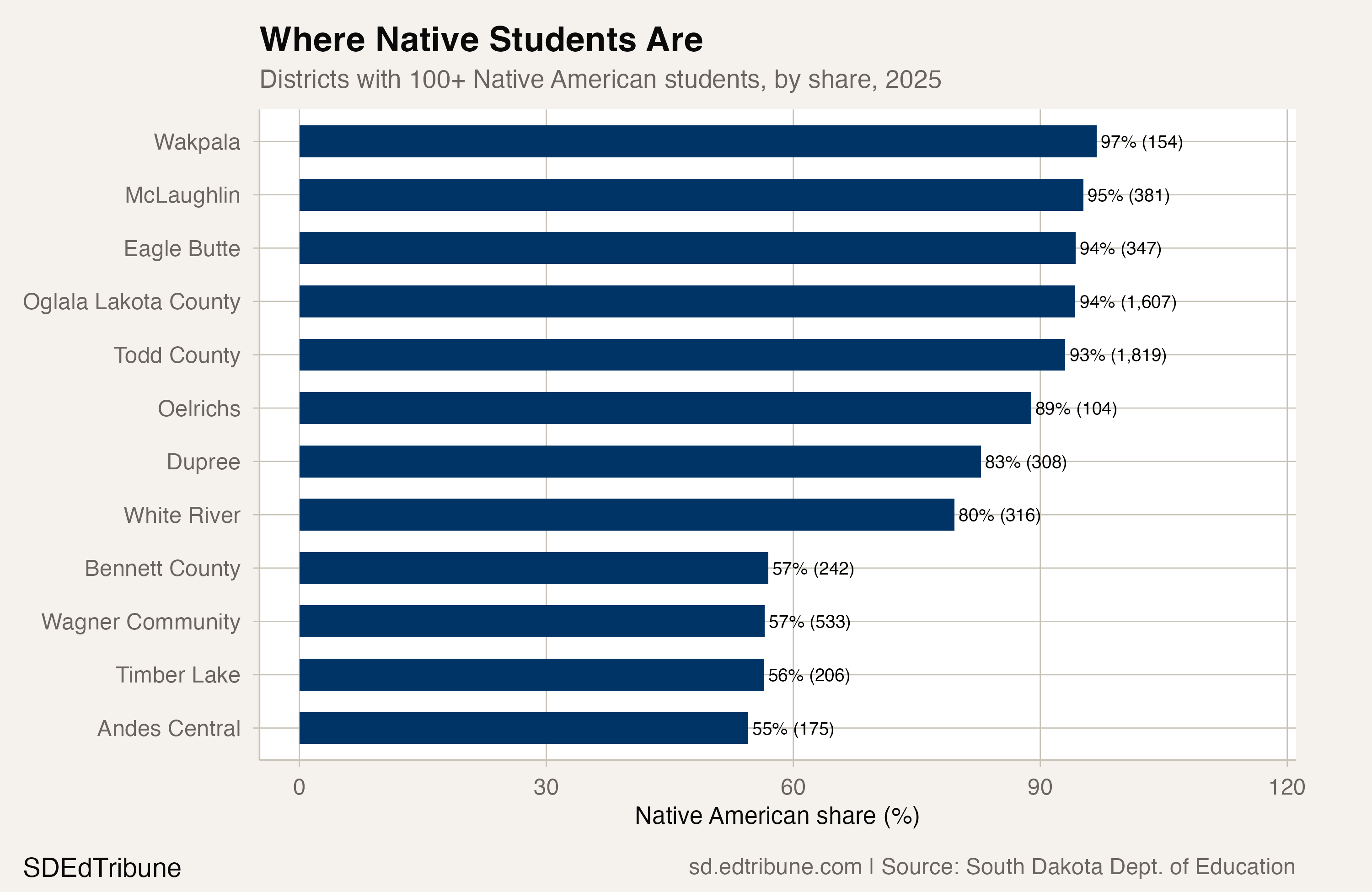
The two largest, Todd County↗ET and Oglala Lakota County↗ET, together enroll 3,426 Native American students, nearly a quarter of the state total. Add Rapid City↗ET and Sioux Falls↗ET, and four districts account for almost half of all Native American public school enrollment in the state.
These districts moved in different directions between 2008 and 2025. Oglala Lakota County, which encompasses the Pine Ridge Reservation, grew by 351 Native American students, a 27.9% increase. Todd County, on the Rosebud Reservation, lost 76, a 4.0% decline. Rapid City, the largest off-reservation concentration, lost 248 Native American students over the full 17-year window, a 10.4% drop. Bennett County↗ET, bordering Pine Ridge, lost 119, a 33.0% decline.
But the long-term numbers can mask recent shifts. Rapid City Superintendent Dr. Jami Jo Thompson told EdTribune that the district's Native American enrollment has grown by more than 300 students since 2020-21, rising from 1,903 to 2,210 and climbing from 15.55% to 18.20% of total enrollment. "We focus on strengthening relationships with our Native families, expanding culturally responsive practices, and ensuring that Native students feel connected, supported, and successful in our schools," Thompson said. The district employs Title VI-funded Graduation Success Coaches to support Native students and incorporates the Oceti Sakowin Essential Understandings into curriculum across the district.
The net effect statewide: reservation-area districts gained 194 Native American students while urban districts lost 327 over the full period. But Rapid City's recent trajectory suggests the urban trend may be reversing — a development the 17-year snapshot cannot show.
Why the number barely moved
The most direct explanation is demographic. South Dakota's birth rate has been declining across all races and ethnicities, falling from 15 per 1,000 in 2007 to 12 in recent years. Reservation counties were hit especially hard by COVID-19: mortality rates in reservation counties increased more than 40% from 2018-19 to 2020-21, and Native American males saw the largest decline in life expectancy in the state, a drop of five years between 2019 and 2020.
A competing factor is attendance. Native American chronic absenteeism in South Dakota public schools reached 51% in the 2023-24 school year, compared to a state average of 21%. In Todd County, chronic absenteeism hit 71%. Only 35% of Todd County students attended regularly. The extent to which chronically absent students are counted in enrollment versus dropping off the rolls entirely is unclear from the data, but the pattern suggests that official enrollment figures may overstate actual participation.
"COVID set us back 10 years because kids missing school in kindergarten won't attend in high school." — Randy Pirner, Todd County High School principal, Dakota News Now, Dec. 2024
A third possibility is that some Native American families are choosing alternatives to public schools. The Bureau of Indian Education operates approximately 183 schools across 23 states, including Flandreau Indian School in South Dakota. Statewide, alternative instruction enrollment has nearly tripled since 2015 to 12,433 students, and McLaughlin↗ET, a district that is 95% Native American, saw its alternative instruction count jump 157% in a single year. Whether that reflects a broader pattern among Native families statewide is not clear from available data.
Meanwhile, Hispanic enrollment transformed the state
The contrast with Hispanic enrollment is stark. In 2008, Hispanic students were a marginal presence at 2.7% of enrollment. By 2025, they had reached 9.3%, nearly matching Native American students.
Much of this growth is tied to South Dakota's meatpacking and food processing economy. South Dakota's foreign-born population grew 45.5% between 2010 and 2022, three times the national average, driven largely by labor demand in towns like Huron↗ET, where a turkey processing plant drew hundreds of Karen refugees from Myanmar and Latin American workers. Huron's school district enrolled 1,066 Hispanic students in 2025. Sioux Falls, the state's largest district, enrolled 4,213.
The recent numbers sharpen the contrast. Between 2022 and 2025, Hispanic enrollment grew 14.0%, Black enrollment grew 9.7%, and multiracial enrollment grew 6.8%. White enrollment fell 4.8%.
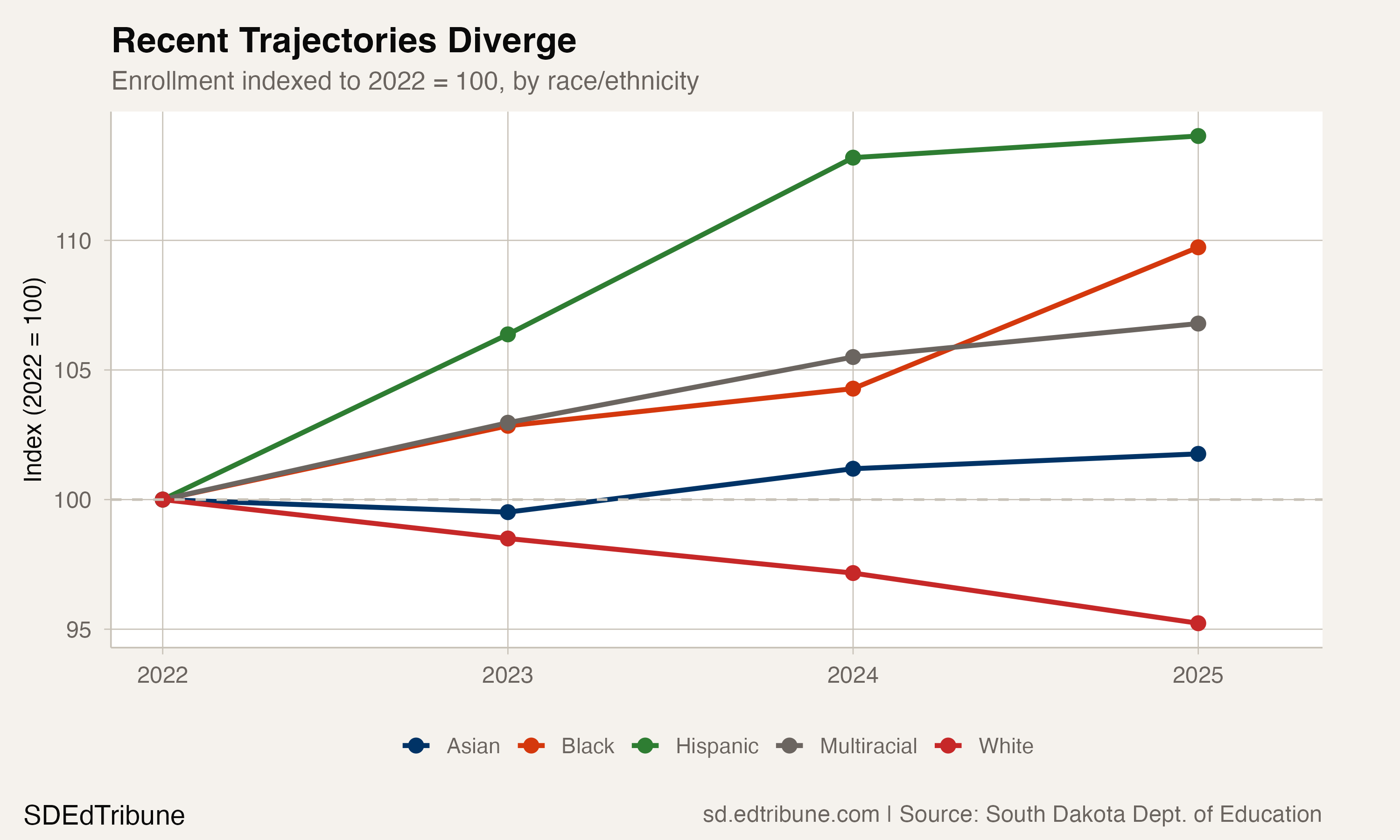
Native American data is not available for 2022 and 2023 at the state aggregation level, but between 2024 and 2025, Native American enrollment fell by 254, a 1.7% decline. The trajectory has not changed.
What the flatline obscures
The statewide number, 14,283, masks real variation. Oglala Lakota County's growth of 27.9% suggests that Pine Ridge's public school system is enrolling more students than it did 17 years ago. But Bennett County's 33.0% decline, in a district bordering Pine Ridge, points to families moving or choosing other options. The data cannot distinguish between the two.
One-third of Native American public school students in South Dakota do not complete high school, and over 80% are not considered college and career ready. Those outcomes have persisted alongside flat enrollment for nearly two decades. At Todd County, 71% chronic absenteeism means that most students counted on the enrollment rolls are not regularly in the building. A system that counts the same number of Native students year after year but loses ground on every other measure is not stable. It is stuck.
At the current rate of Hispanic growth, Hispanic students will surpass Native American students as South Dakota's second-largest demographic group within the next few years. Native Americans have been the state's largest non-white population for as long as anyone has been counting. That distinction may pass without any departure. The enrollment numbers did not have to decline for it to happen. They just had to stay the same.
Detailed code that reproduces the analysis and figures in this article is available exclusively to EdTribune subscribers.
Discussion
Sign in to join the discussion.
Loading comments...