In this series: South Dakota 2025-26 Enrollment.
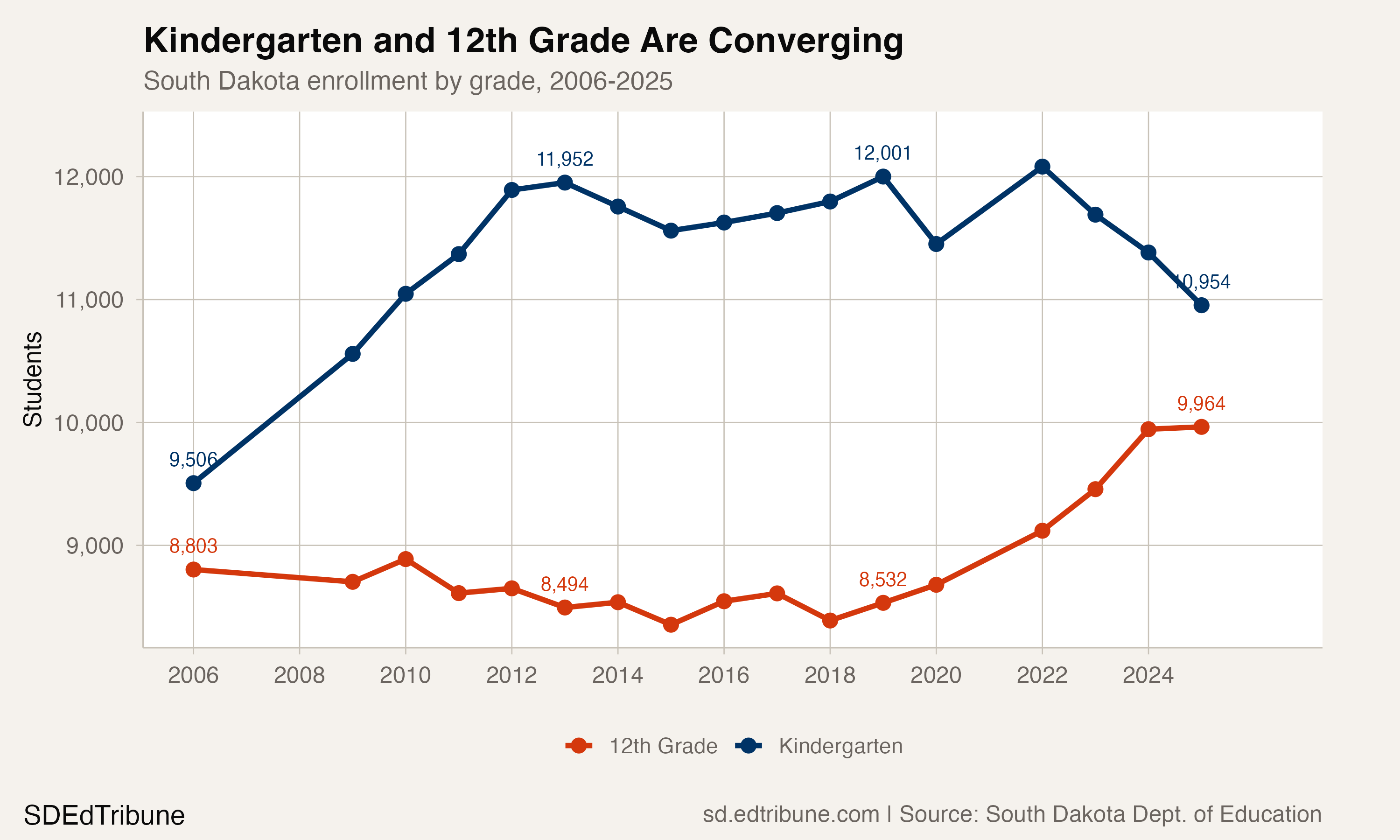
South Dakota's 12th grade class just set a record. At 9,964 students, the class of 2025 is the largest in the state's data history, 14.5% bigger than the 8,703 seniors in 2008-09. In any other context, that would be good news.
It is not good news. Those 9,964 seniors are being replaced at the bottom of the pipeline by a kindergarten class of 10,954, just 10% larger. In 2013, the ratio was 1.41 kindergartners for every 12th grader. By 2025, it was 1.10. And because roughly one in six students who enter 9th grade in South Dakota do not appear in the 12th grade count three years later, that kindergarten class will likely produce only about 9,200 seniors when it reaches graduation in 2038.
The state's enrollment decline, in other words, has barely started.
The bulge moving through the building
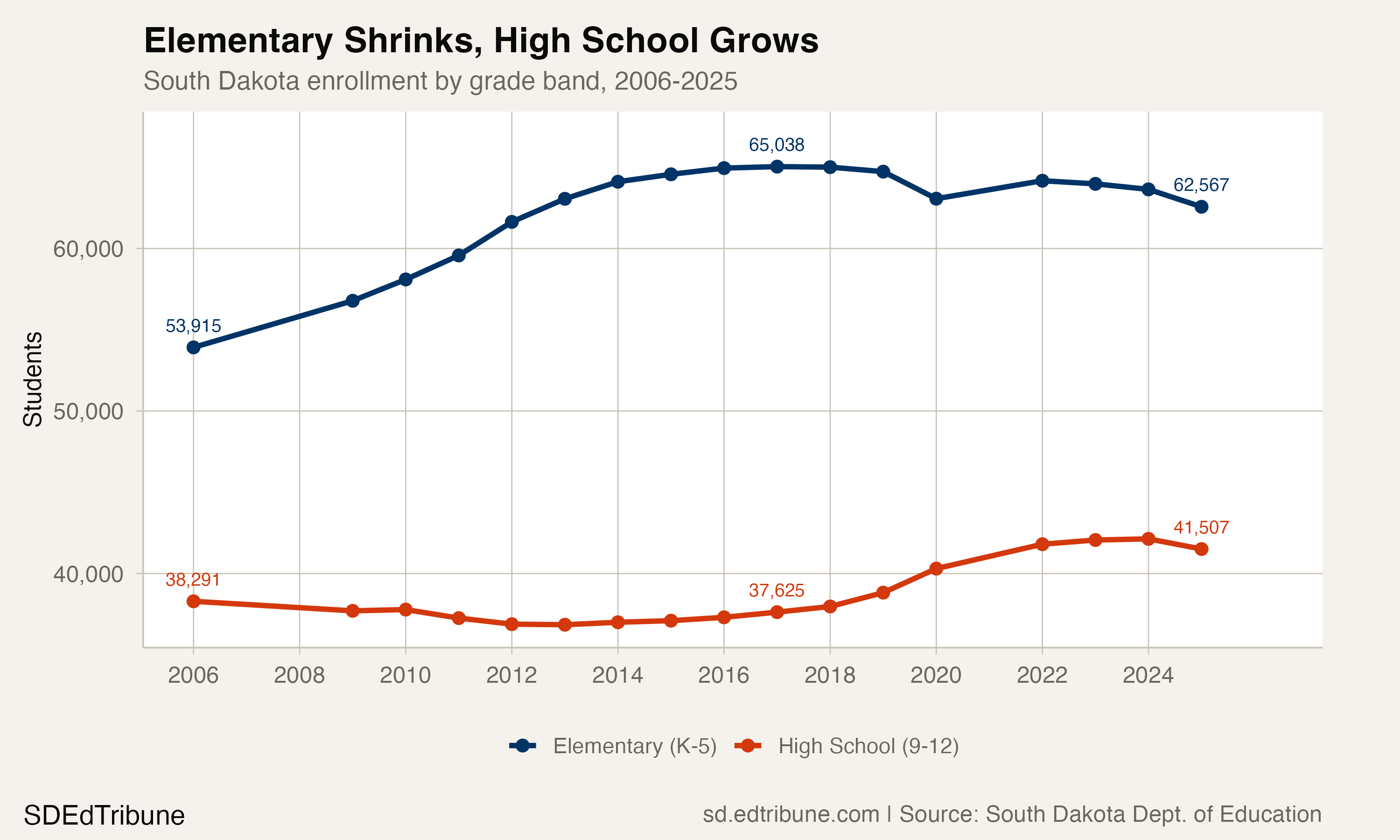
South Dakota's K-5 enrollment peaked at 65,038 in 2017 and has fallen to 62,567, a loss of 2,471 students, or 3.8%. High school enrollment (grades 9-12) moved in the opposite direction over the same period: from 37,625 in 2017 to 41,507 in 2025, a gain of 3,882 students, or 10.3%.
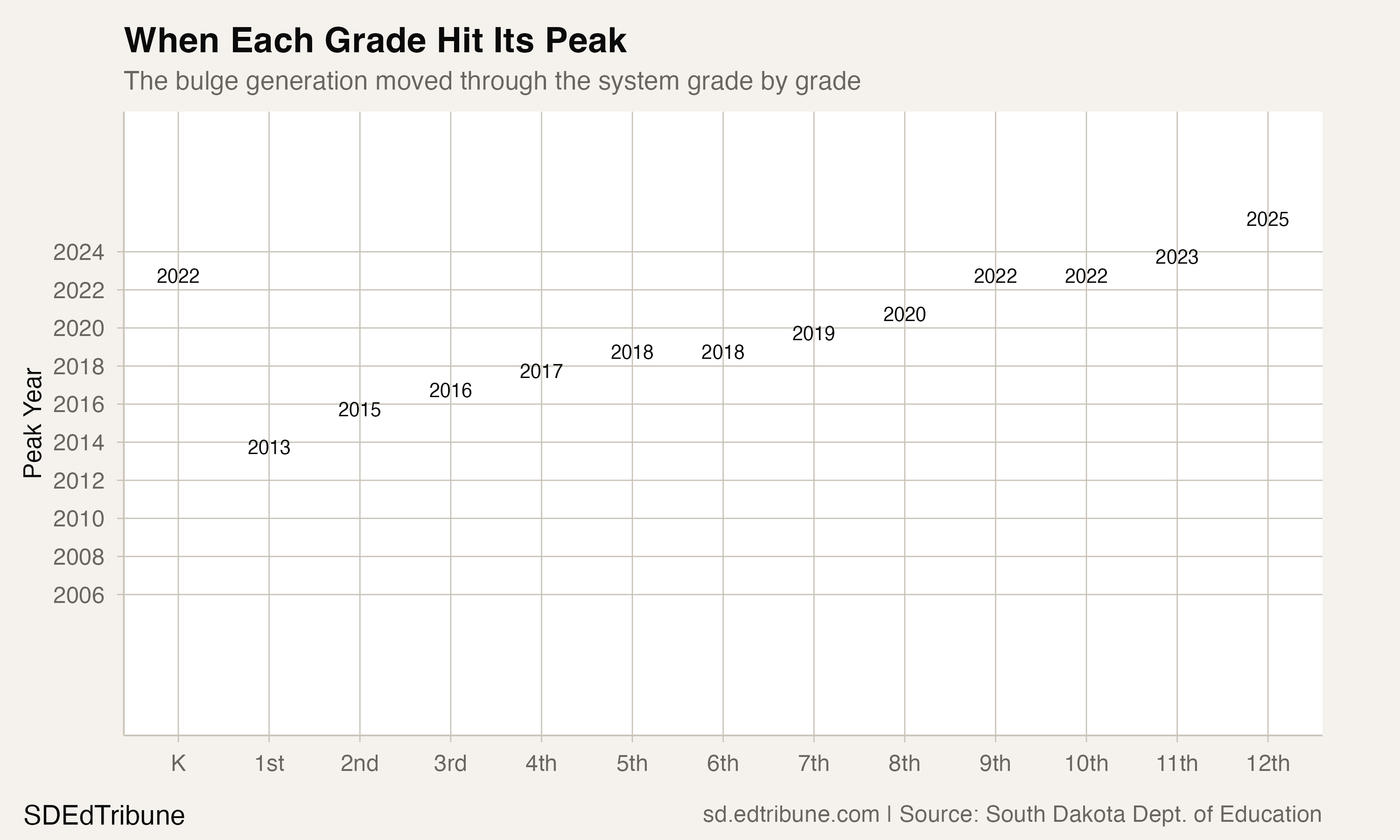
The divergence is not a coincidence. It is the same cohort of students, aged by a decade. First grade peaked at 10,870 students in 2013. That cohort showed up as peak 2nd graders in 2015, peak 3rd graders in 2016, peak 4th graders in 2017, peak 5th graders in 2018, and so on through the system. The cohort hit 8th grade in 2020, 9th grade in 2021, and 11th grade in 2023. It is now producing the record 12th grade class of 2025.
Behind it, every entering class is smaller. Kindergarten enrollment hit 12,217 in 2021 and has dropped to 10,954 in four years, a 10.3% decline. First grade fell from its 2013 peak of 10,870 to 9,847 in 2025, a 9.4% loss. The cohorts now filling elementary classrooms are measurably smaller than the ones filling high school hallways, and each year the gap narrows further.
A ratio approaching parity
The kindergarten-to-12th-grade ratio captures the pipeline imbalance in a single number. In 2013, South Dakota had 1.41 kindergartners for every senior. That meant the system was being replenished faster than it was losing graduates, and total enrollment grew every year from 2006 through 2019.
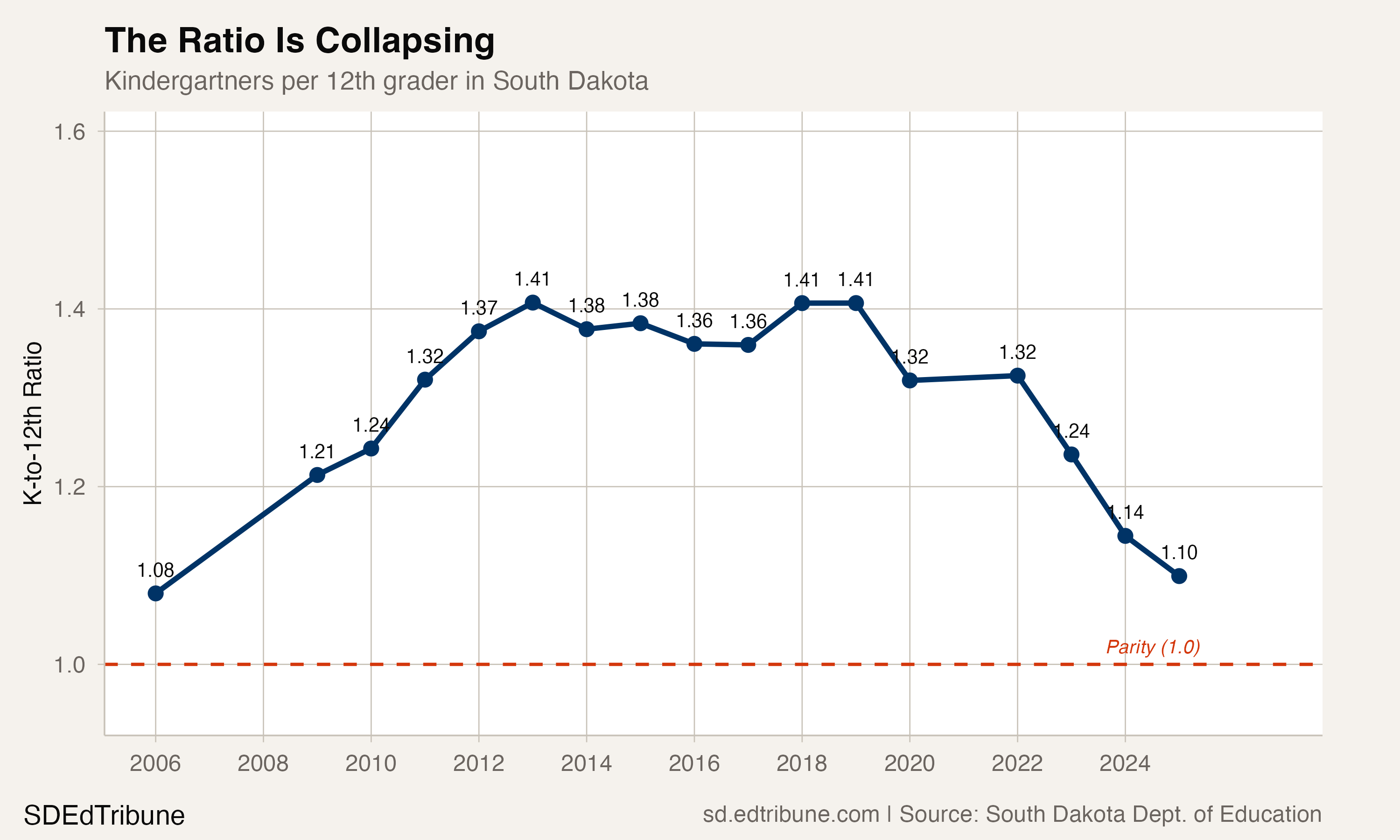
By 2025, the ratio had fallen to 1.10. At that level, the incoming class barely exceeds the outgoing one before attrition. South Dakota loses roughly 15% to 20% of each cohort between 9th and 12th grade, a rate that has held at 80% to 85% persistence over the entire data period. Applied to the 2025 kindergarten class of 10,954, that attrition rate projects a 12th grade class of approximately 9,200 in 2038, about 760 fewer seniors than the state had in 2025.
The math is mechanical: if each entering class is smaller than the one leaving, total enrollment falls. South Dakota peaked at 141,429 students in 2022 and has lost 2,568 in three years. The pipeline says those losses will accelerate.
Birth rates and the kitchen table
The most direct driver is demographic. South Dakota's fertility rate, while still the highest in the nation at 65.6 births per 1,000 women, has fallen substantially from 78.1 per 1,000 in 2013. Fewer births five and six years earlier meant fewer kindergartners in 2025.
But births alone do not explain the full picture. Public school enrollment is also losing ground to alternative instruction, which has nearly tripled since 2015 to 12,433 students, now representing 7.6% of all children receiving education in the state. Governor Larry Rhoden attributed the shift to both declining birth rates and family preference:
"Regardless of where they receive their education, my goal as governor is to support innovation, not to stand in the way." — Dakota News Now, January 2026
The alternative instruction surge disproportionately affects the youngest grades. Families choosing to homeschool typically start at kindergarten entry, not midway through high school. That compounds the birth-rate decline in shrinking the elementary pipeline while leaving the graduating classes largely untouched.
Not every district faces the same squeeze
The pipeline inversion is not uniform. Of 39 districts large enough to analyze (100 or more combined kindergarten and 12th grade students), 11 already have more seniors than kindergartners. Wessington Springs has 19 kindergartners and 83 seniors, a ratio of 0.23. Aberdeen↗ET, the state's third-largest city, has 268 kindergartners for 381 seniors, a ratio of 0.70. Rapid City↗ET, the second-largest district, sits at 0.96, with 814 kindergartners and 850 seniors.
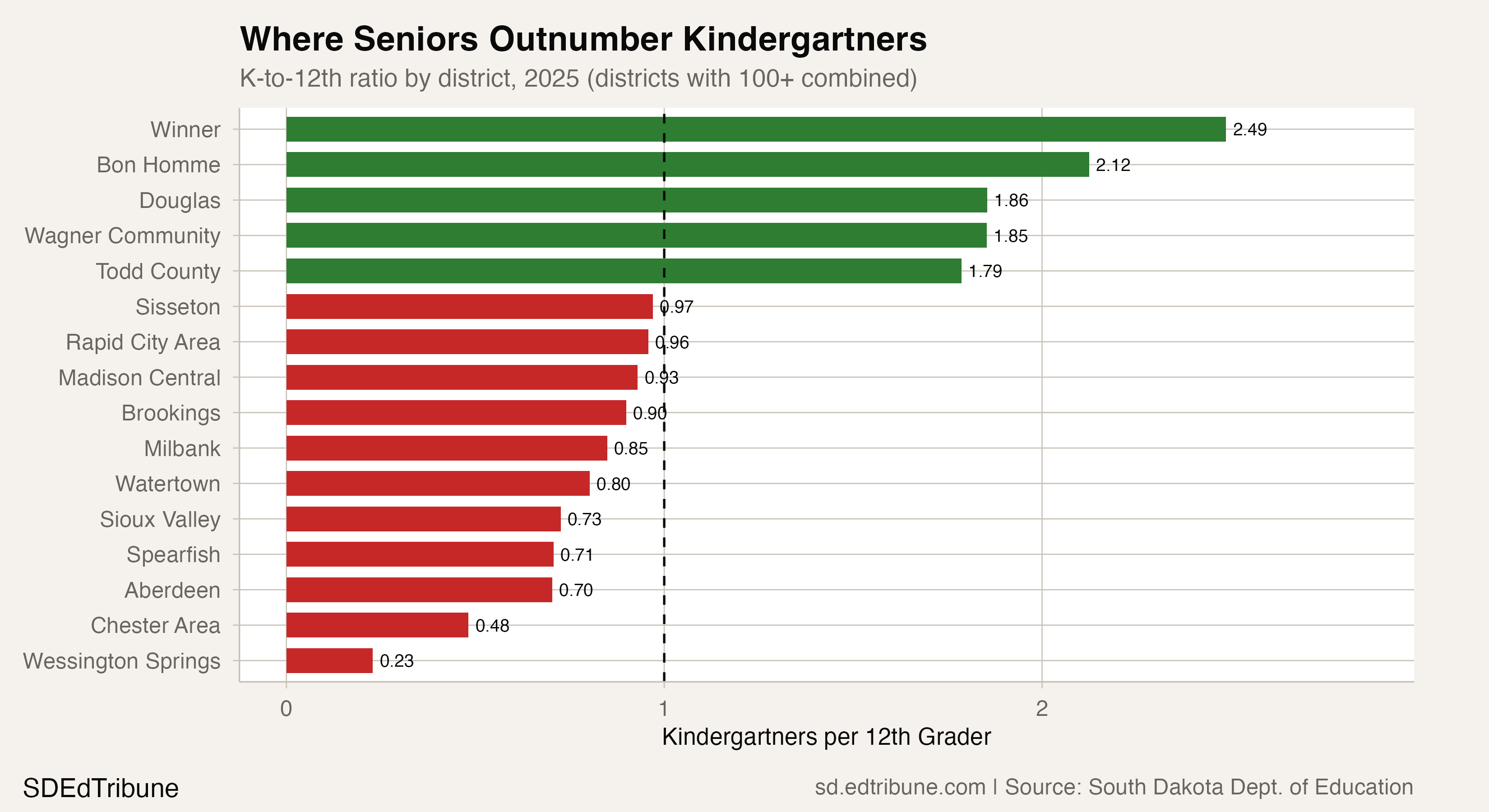
Suburban growth districts tell a different story. Brandon Valley↗ET has 493 kindergartners for 334 seniors, a ratio of 1.48. Tea Area↗ET stands at 1.47. Douglas↗ET, outside Rapid City, registers 1.86. These districts are absorbing families from their urban cores, but that redistribution does not create new students statewide. It moves the decline from one district's ledger to another's.
Rural districts face the sharpest version of this arithmetic. South Dakota law requires reorganization when a district's K-12 enrollment drops to 100 or fewer students unless it qualifies as sparse. The Oldham-Ramona-Rutland district survived a dissolution vote by just four ballots in December 2025, 367 to 363. For small districts where the kindergarten class can be counted on two hands, a pipeline inversion is not a forecast. It is a viability question.
What the pipeline cannot show
The grade-level data establishes the direction and approximate magnitude of the decline ahead. It cannot establish timing precisely, because it does not account for interstate migration, which could accelerate or offset the trend. South Dakota's economy, anchored by agriculture and bolstered by no state income tax, has historically attracted working-age families. Whether that continues at a pace sufficient to offset birth-rate decline is an open question.
The data also cannot distinguish between students who leave the public system entirely and those who transfer between districts via open enrollment. A district with a K-to-12th ratio below 1.0 may be losing kindergartners to a neighboring district rather than to demographic decline. The state-level ratio, however, captures the net effect: fewer children entering the system than leaving it, regardless of where within the system they sit.
The graduating classes ahead
South Dakota's total enrollment of 138,861 sits 2,568 below its 2022 peak, a modest 1.8% decline. The pipeline says that modesty is temporary. In 2025, 1st graders numbered 9,847, 2nd graders 10,201, and kindergartners 10,954. Every one of these classes is smaller than the corresponding high school class it will eventually replace.
South Dakota's per-pupil funding formula means that each lost student reduces a district's state aid allocation. For the 11 districts that already have fewer kindergartners than seniors, the fiscal arithmetic is straightforward: their funding base will shrink every year for the next decade as the record-sized graduating classes leave and the smaller entering classes take their place. Wessington Springs, with 19 kindergartners replacing 83 seniors, will lose three-quarters of its graduating class size in the pipeline. Aberdeen, with 268 kindergartners and 381 seniors, will lose nearly 30%. The pipeline data does not predict these losses. It guarantees them.
Detailed code that reproduces the analysis and figures in this article is available exclusively to EdTribune subscribers.
Discussion
Sign in to join the discussion.
Loading comments...