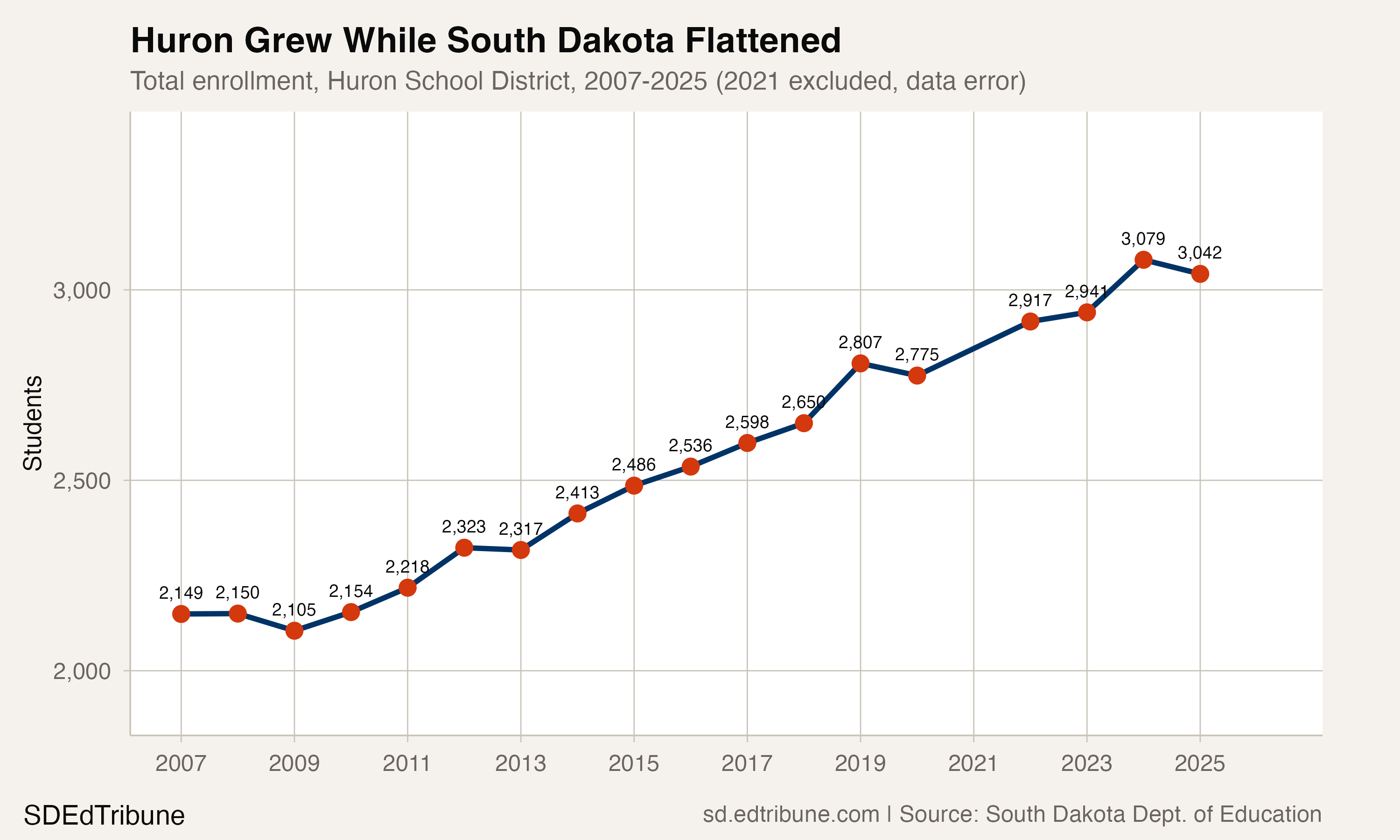
In 2008, four out of five students in the Huron↗ET School District were white. By 2025, white students were a 38.3% minority in their own schools, outnumbered by the combined enrollment of Hispanic and Asian students who now make up 55.1% of the district. Total enrollment grew from 2,149 in 2007 to 3,042 in 2025, an increase of 41.6%, making Huron the third-fastest-growing mid-size district in South Dakota. In a state where 68.7% of all students are white, Huron became an outlier not through decline, but through arrival.
The transformation has a specific origin: a turkey processing plant that opened in 2005 and a refugee pipeline that followed.
A Plant Opens, a City Changes
Dakota Provisions, a turkey processing cooperative formed by Hutterite farming colonies, began operations in Huron in 2005. The plant processes 20,000 turkeys daily, producing 200 million pounds of turkey meat a year. Finding workers in a rural South Dakota city of 13,000 proved immediately difficult.
The solution arrived from the other side of the world. Karen refugees, members of an ethnic minority group fleeing decades of military persecution in Myanmar, began settling in Huron in 2006. What started with three Karen workers in 2007 expanded to more than 600 through word of mouth and family ties. Hispanic workers followed, drawn to the same plant and to other regional employers.
The enrollment data tracks the result. Huron added 893 students between 2007 and 2025, a period when many rural South Dakota districts contracted. Asian enrollment, nearly all Karen families, grew from 83 students (3.9% of enrollment) in 2008 to 610 (20.1%) in 2025, a 635% increase. Hispanic enrollment rose from 209 (9.7%) to 1,066 (35.0%), a 410% increase. White enrollment, meanwhile, fell from 1,724 to 1,164, a loss of 560 students.
The Crossover No One Predicted
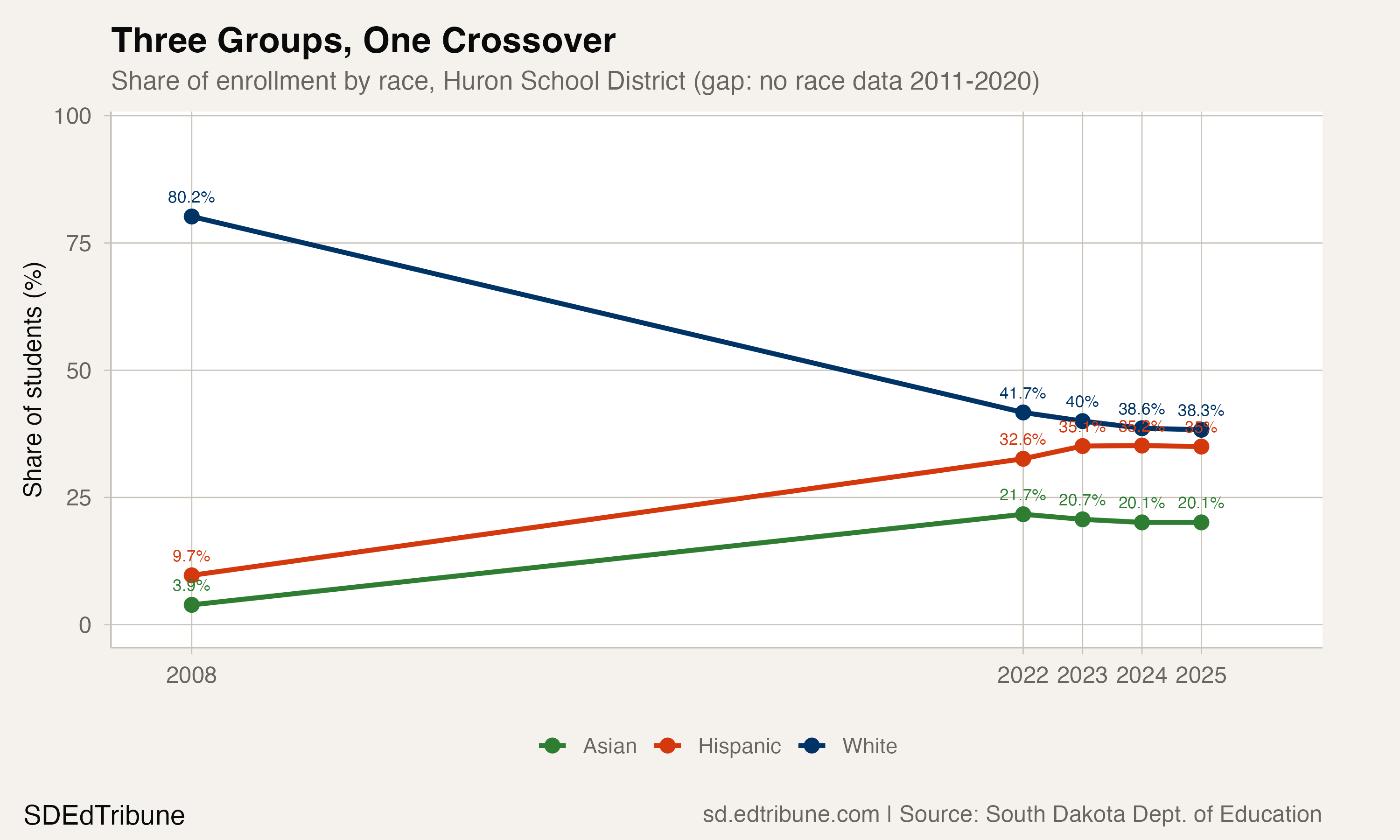
Huron crossed from majority-white to majority-minority at some point between 2010 and 2022. The exact year is invisible in the data: South Dakota's enrollment files have no race data between 2011 and 2020, a decade-long gap that obscures the transition. What is clear is the before and after. In 2008, students of color made up 19.8% of enrollment. By 2022, the first year race data reappears, they were 58.3%. By 2025, 61.7%.
The composition has now stabilized. Over the past four years of available race data (2022-2025), white enrollment has held between 38.3% and 41.7%, Hispanic between 32.6% and 35.1%, and Asian between 20.1% and 21.7%. The demographic transformation is complete. The question for Huron is no longer whether the shift will happen, but how the district serves a student body unlike any other in the state.
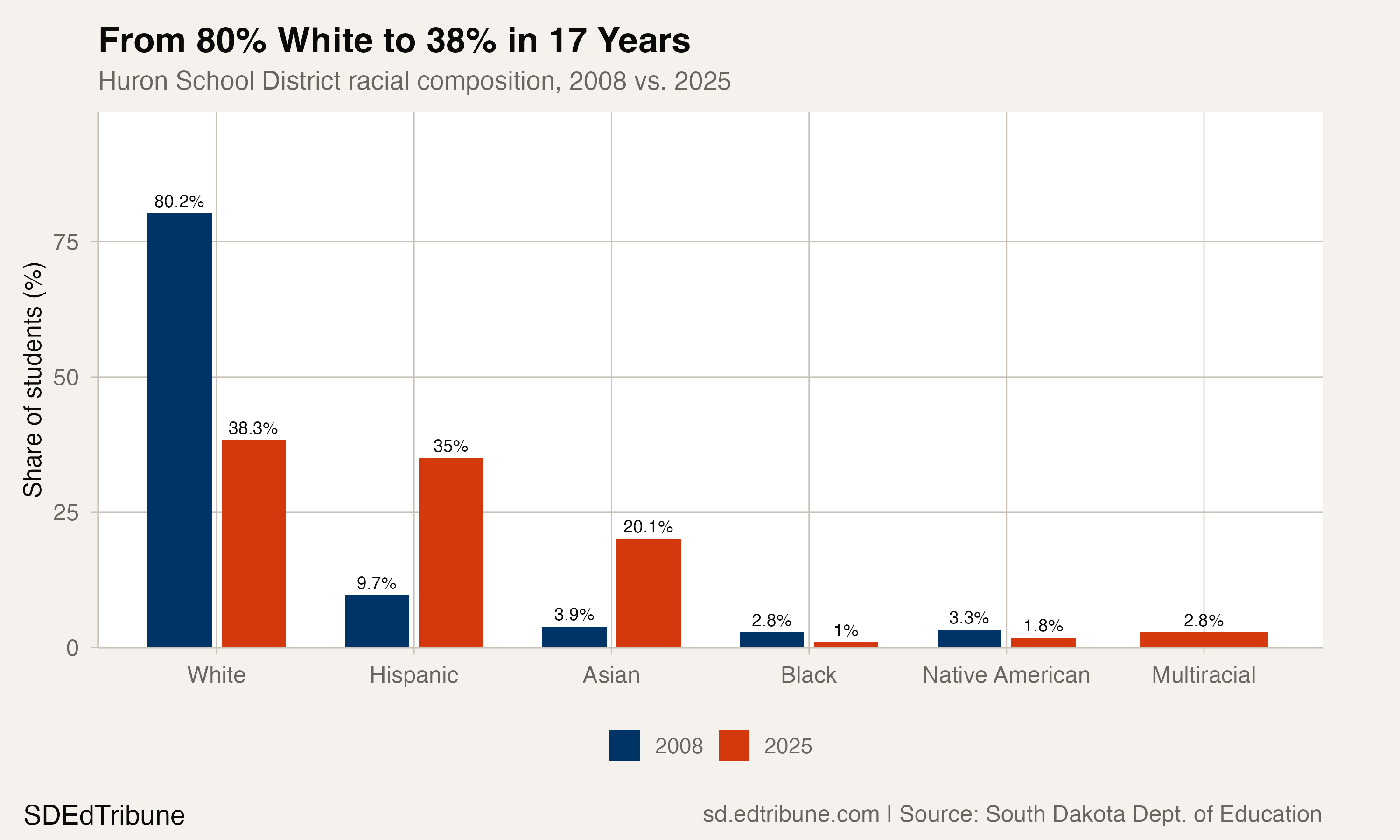
No other district in South Dakota comes close to Huron's Asian enrollment share. At 20.1%, Huron's Asian student population is nearly five times the next-highest district (Aberdeen↗ET at 3.7%) and nearly 12 times the statewide average of 1.7%. This concentration reflects the nature of refugee resettlement: families follow families, and a single community can become the anchor for an entire diaspora.
The Bridge Generation
The Karen families who arrived in Huron came from refugee camps in Thailand where many had lived for more than 20 years. Their children entered American schools speaking S'gaw Karen, a tonal language with its own script, and little or no English.
The district's response scaled rapidly. Huron now employs 13 dedicated ESL teachers and interpreters to support a student body where over 1,000 of nearly 3,000 students have passed through English Language Acquisition programs. Jolene Konechne, Huron's ESL Director, told SDPB in December 2023 that the program's growth was continuous:
"What started out as 100 or 200 kids, we're now over 1,000 ESL students." — SDPB, December 2023
Nearly two dozen Karen paraeducators now work on the Huron School District payroll, many of them part of what South Dakota Searchlight called the "bridge generation": young Karen adults who spent their childhoods translating documents, medical instructions, and their own report cards for parents who never had the chance to learn English. That generation is now cycling back into the school system as staff.
Mark Heuston, the HR director at Dakota Provisions, framed the Karen migration in terms that echo South Dakota's own settlement history:
"The Karen come here for exactly the same reasons that our ancestors came here, and that's to be free." — PBS NewsHour, July 2016
Growth Against the Grain
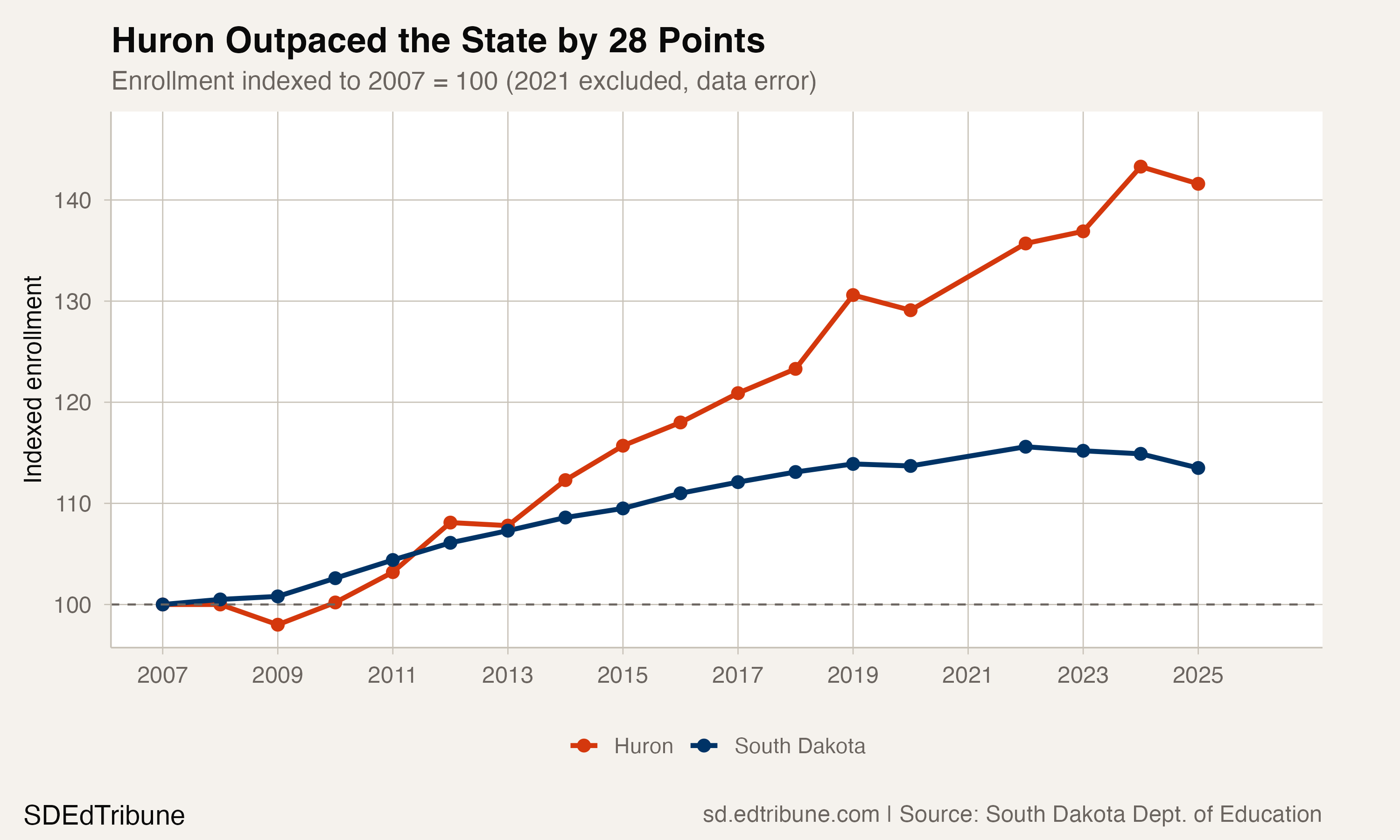
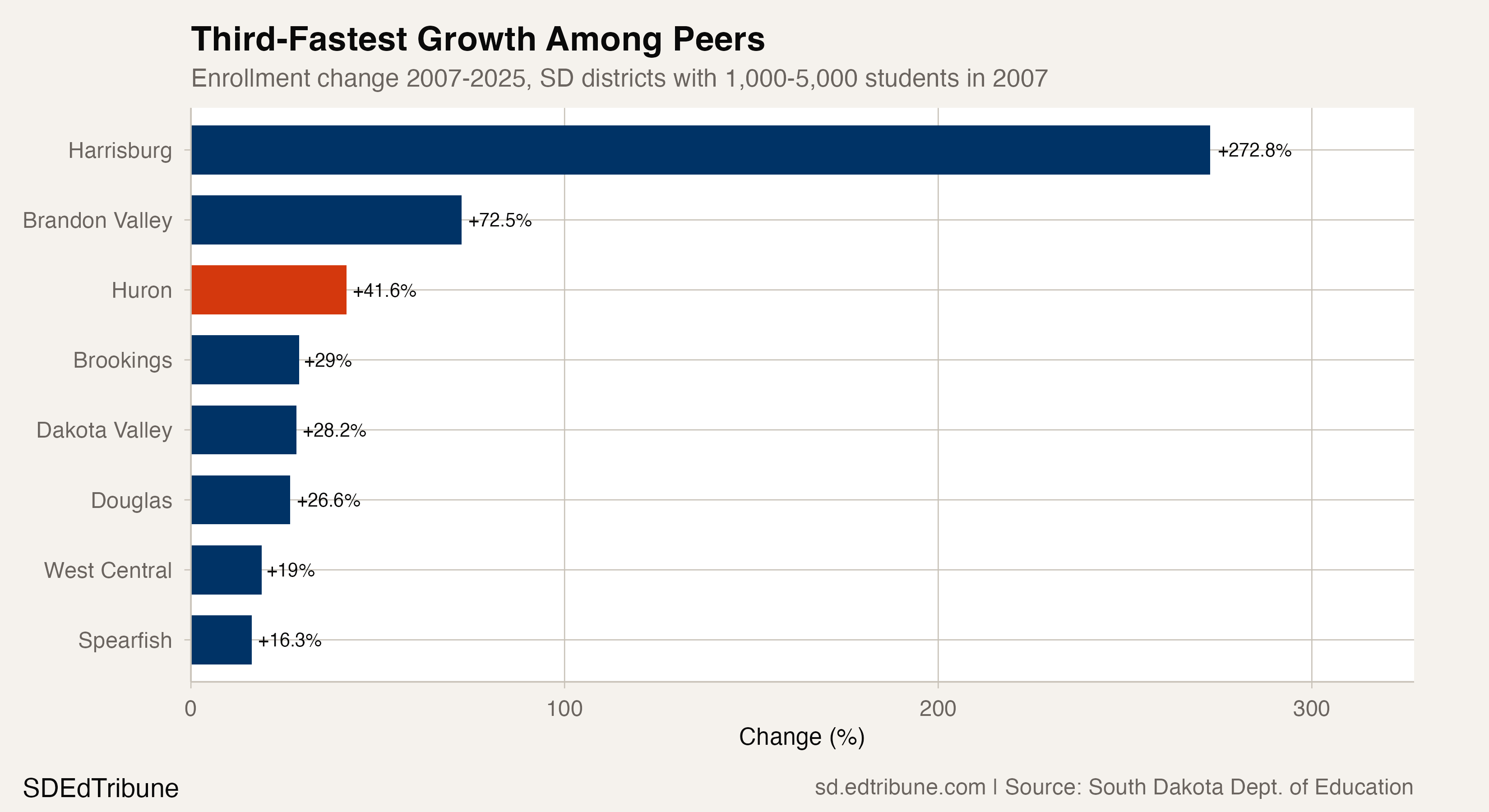
Huron's 41.6% enrollment growth since 2007 is notable on its own. It is striking in context. Statewide, South Dakota enrollment grew 13.5% over the same period, and the state has been declining since its 2022 peak of 141,429. Among mid-size districts (1,000-5,000 students in 2007), only Harrisburg↗ET (+272.8%, a Sioux Falls suburb fueled by new housing) and Brandon Valley↗ET (+72.5%, also suburban spillover) grew faster than Huron. But those districts grew through conventional suburban expansion. Huron grew through immigration to a rural community of 14,000 people.
The growth was not linear. Enrollment dipped in 2009, recovered through 2019, dropped slightly during COVID in 2020, then surged to a peak of 3,079 in 2024. The 2025 figure of 3,042 represents a small pullback of 37 students, or 1.2%. Whether that dip marks a plateau or a one-year fluctuation will depend on whether the migration pipeline that fed Huron's growth for nearly two decades continues to deliver new families.
What the Numbers Cannot Show
Enrollment data measures bodies in seats. It does not measure the fiscal and operational weight of serving a student body where one in three students is learning English as a new language. Bilingual instruction, interpreter services, and family liaison programs carry per-pupil costs that South Dakota's funding formula was not designed for a district of this profile. Statewide, about 5% of students are designated as English Language Learners, representing more than 6,700 students. Huron alone accounts for roughly 15% of that statewide ELL population in a district that enrolls about 2% of the state's students.
The enrollment data also cannot distinguish between newly arrived immigrants and U.S.-born children of immigrant families. The Asian and Hispanic shares in Huron reflect both first-generation refugee arrivals and a growing second generation born in Beadle County. The growth trajectory, which accelerated sharply between 2014 and 2019 (adding 394 students in five years), suggests ongoing in-migration during that period. The recent stabilization in race shares, even as total enrollment ticked down slightly, may signal that the migration wave is giving way to natural generational replacement.
What Comes Next
Huron's kindergarten enrollment offers one signal. In 2025, 249 kindergartners entered the district, up from 155 in 2009. The kindergarten pipeline has been remarkably stable since 2015, fluctuating between 209 and 249 without a sustained decline. That stability suggests the district's growth engine has not stalled, even if it is no longer accelerating.
The American Communities Project described Huron's trajectory as "a model for inclusion" in 2022, noting that school enrollment had recovered from 1,800 in 2005 to 3,000 and city population had risen 13%. The 2025 enrollment data confirms that trajectory held. But Huron's model rests on a single employer processing 20,000 turkeys a day, a federal refugee program whose funding has been cut, and a bridge generation of Karen paraeducators deciding whether to stay in the place that took their parents in. Twenty years ago, 44 Hutterite colonies pooled their resources and bet on a turkey plant. The school district that bet on the families who followed is still winning. How long that lasts depends on forces no superintendent can control.
Detailed code that reproduces the analysis and figures in this article is available exclusively to EdTribune subscribers.
Discussion
Sign in to join the discussion.
Loading comments...