In this series: South Dakota 2024-25 Enrollment.
Correction (August 20, 2026): An earlier version used stale enrollment values for Harrisburg and several matched-tier totals. The evidence package was rebuilt from the current South Dakota Department of Education enrollment release; the figures below reflect that source. Elk Mountain is reported at 16 students, not 20, in the sparse-district discussion.
Elk Mountain↗ET School District educates 16 students across 14 reported grade levels. Four of those grades have zero enrollment. At the other end of the state, Sioux Falls↗ET enrolls 25,060. The ratio between the two is 1,566 to 1.
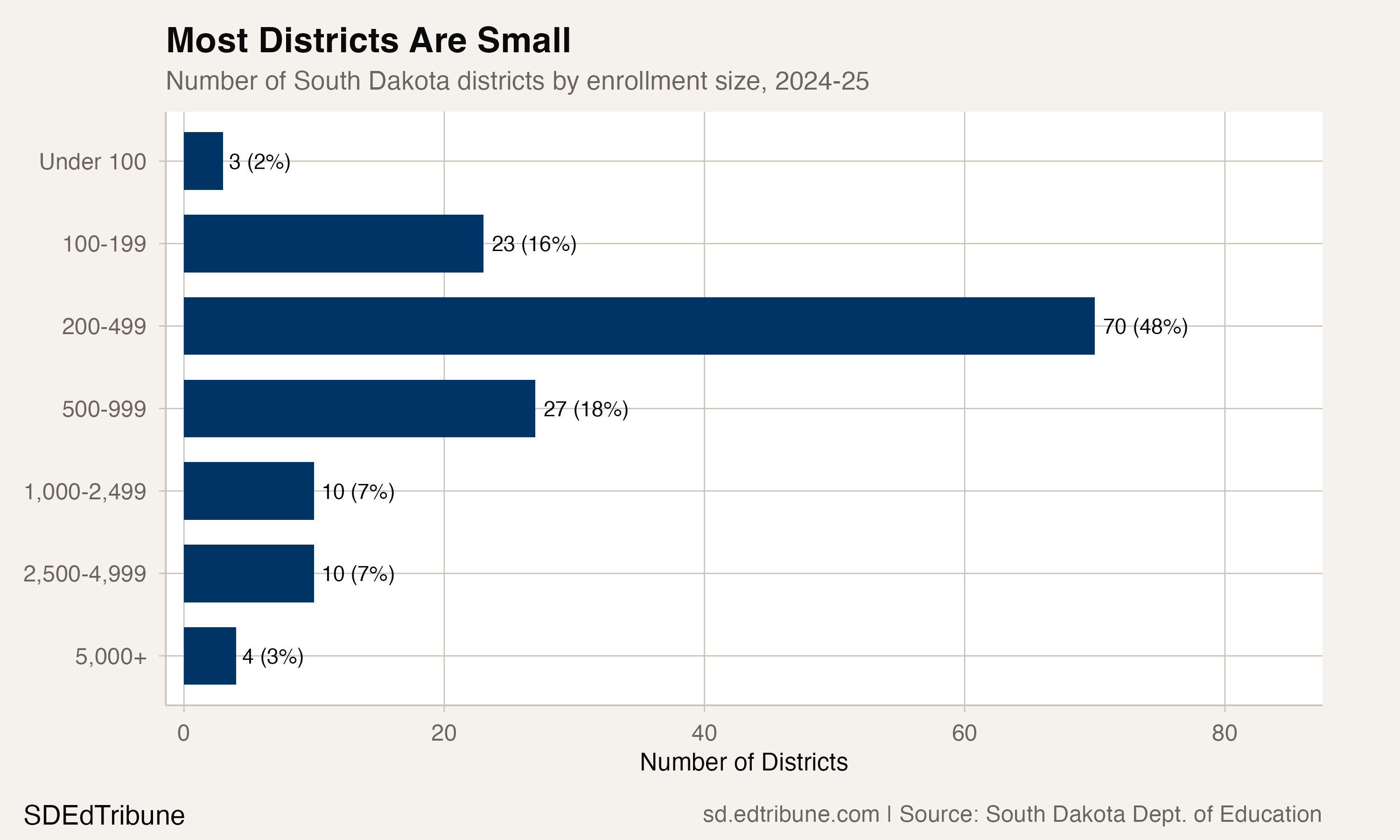
This is not an outlier comparison. It is the defining structural feature of South Dakota public education: a system of 148 districts in which 98, or 66.2%, enroll fewer than 500 students, while nearly half of all students attend the 10 largest districts. The median district serves 359 students. The mean serves 950. That gap between median and mean, a factor of 2.6, captures the skew. Most districts are small. Most students are not in them.
Where the students actually are
Of South Dakota's 140,587 students, the five largest districts hold 37.7%. The top 10 hold 49.3%. Flip the lens: the bottom half of districts, 74 of them, collectively hold 12.2% of statewide enrollment. The bottom 98, every district under 500 students, hold 19.5%.
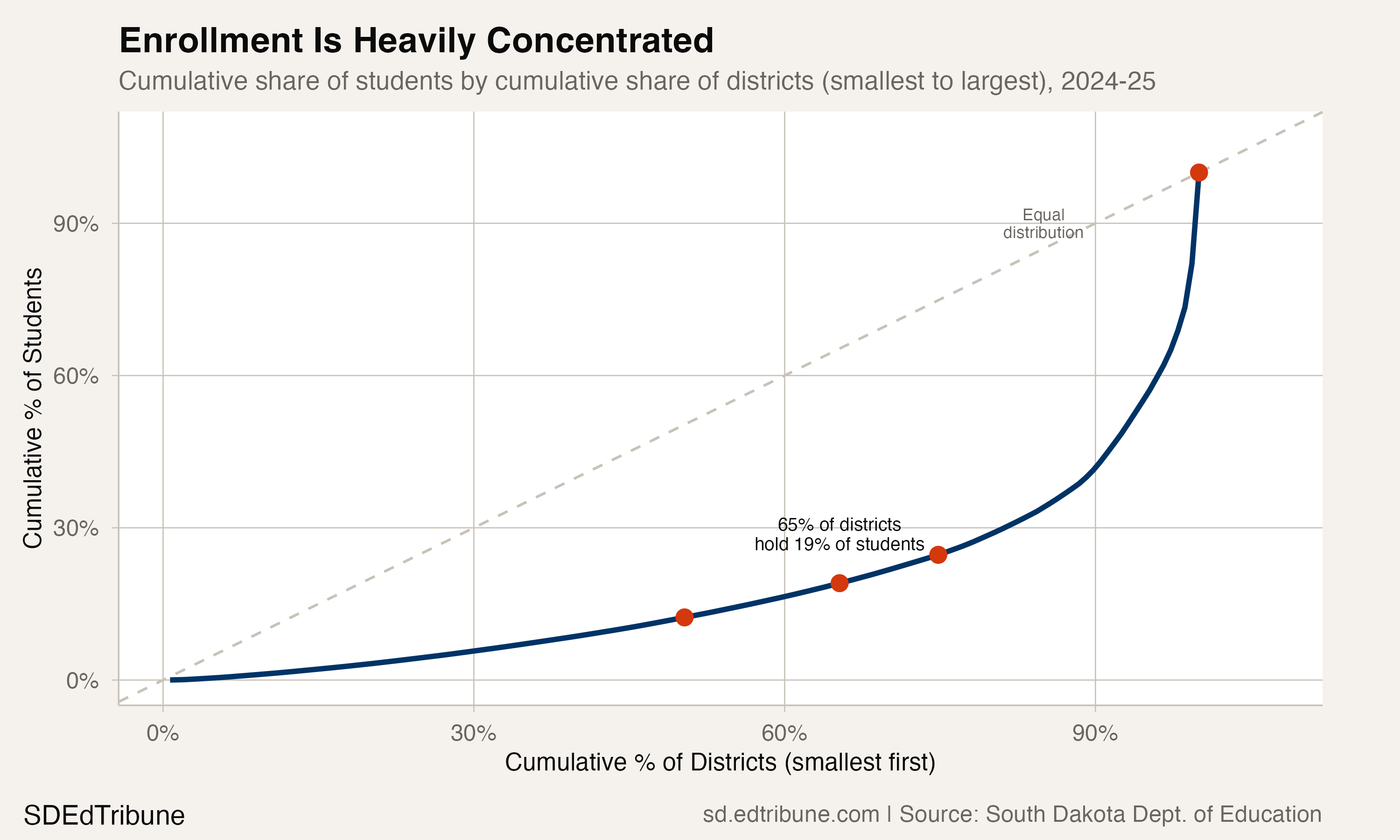
The concentration curve tells the story. In a system where enrollment was evenly distributed, the line would follow the diagonal. Instead, it hugs the bottom axis through most of the distribution, then rockets upward as the handful of large districts pile on. This is not a gentle imbalance. It is a system where the smallest 65% of districts serve 18.8% of the student population.
Twenty-five districts enroll fewer than 200 students. Across those districts, the average reported grade has 10.1 students. Four districts sit below 100: Elk Mountain (16 students), South Central (52), Big Stone City (79), and Bowdle↗ET (90). Elk Mountain has zero enrollment in four reported grades.
Eighteen districts have disappeared since 2006-07
South Dakota had 166 districts in 2006-07. It had 148 in 2024-25. The decline is gradual rather than a single break in the series.
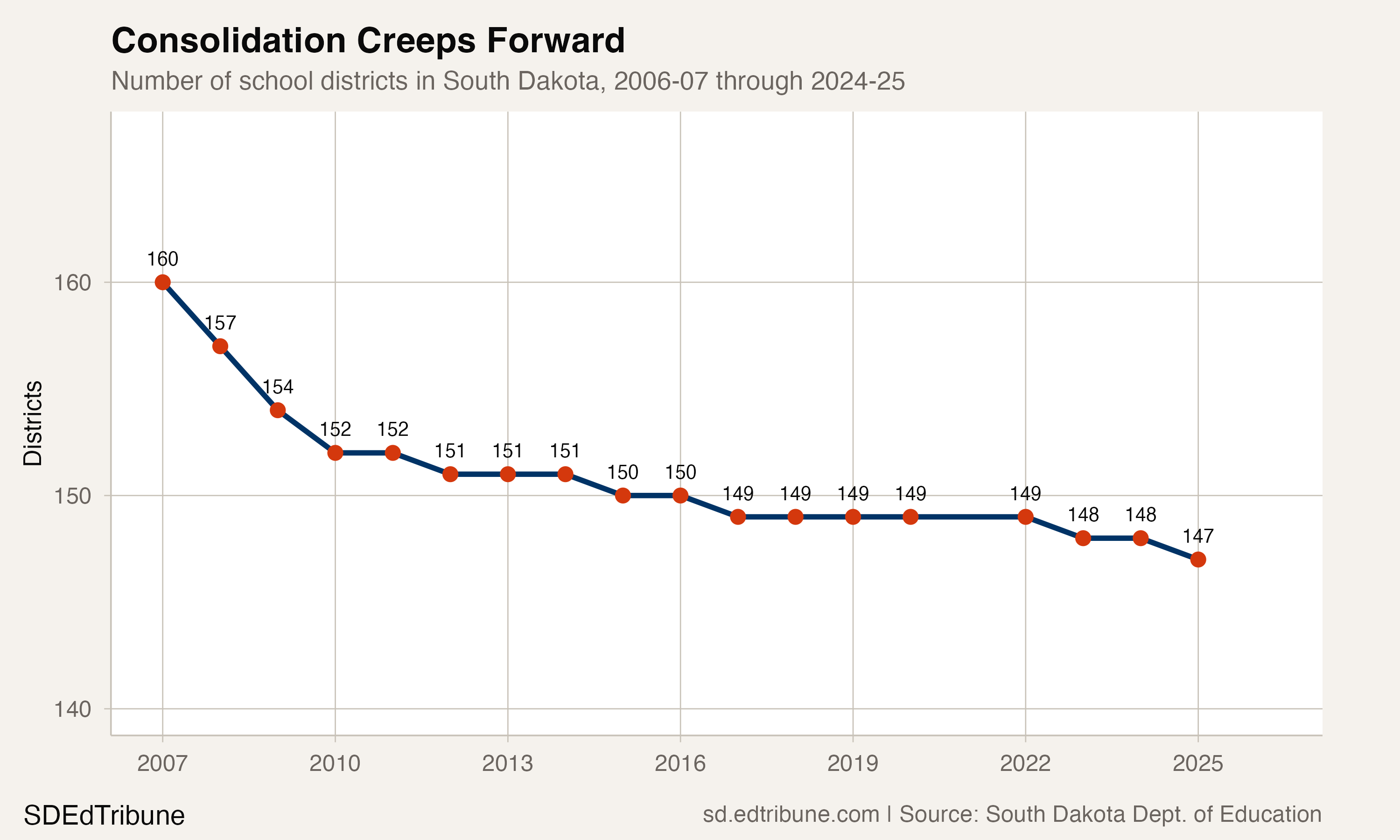
Thirty-three district identifiers present in 2006-07 are absent in 2024-25, but only 18 net districts disappeared. The rest were consolidations that retired two IDs and created one new one.
State law provides both a floor and an exemption. South Dakota's reorganization guidance describes a sparse designation based on density and distance to neighboring schools. That framework helps explain why Elk Mountain remains independent despite its very small enrollment: when the nearest neighboring school is far enough away, the state accepts the cost of keeping the doors open.
Growth concentrates in the suburbs
The state's enrollment grew by 19,029 students from 2006-07 to 2024-25, but district identifiers do not all persist across a consolidation. Among the 133 districts that can be matched in both years, enrollment grew by 19,789 students. Districts that enrolled 1,000 to 4,999 students in 2006-07 absorbed 12,548 of that matched change, 63.4% of the total. The 5,000-plus tier added another 4,489. Mid-sized districts (500-999) grew 1,047 students on net. The smallest districts, under 200, gained a combined 419.
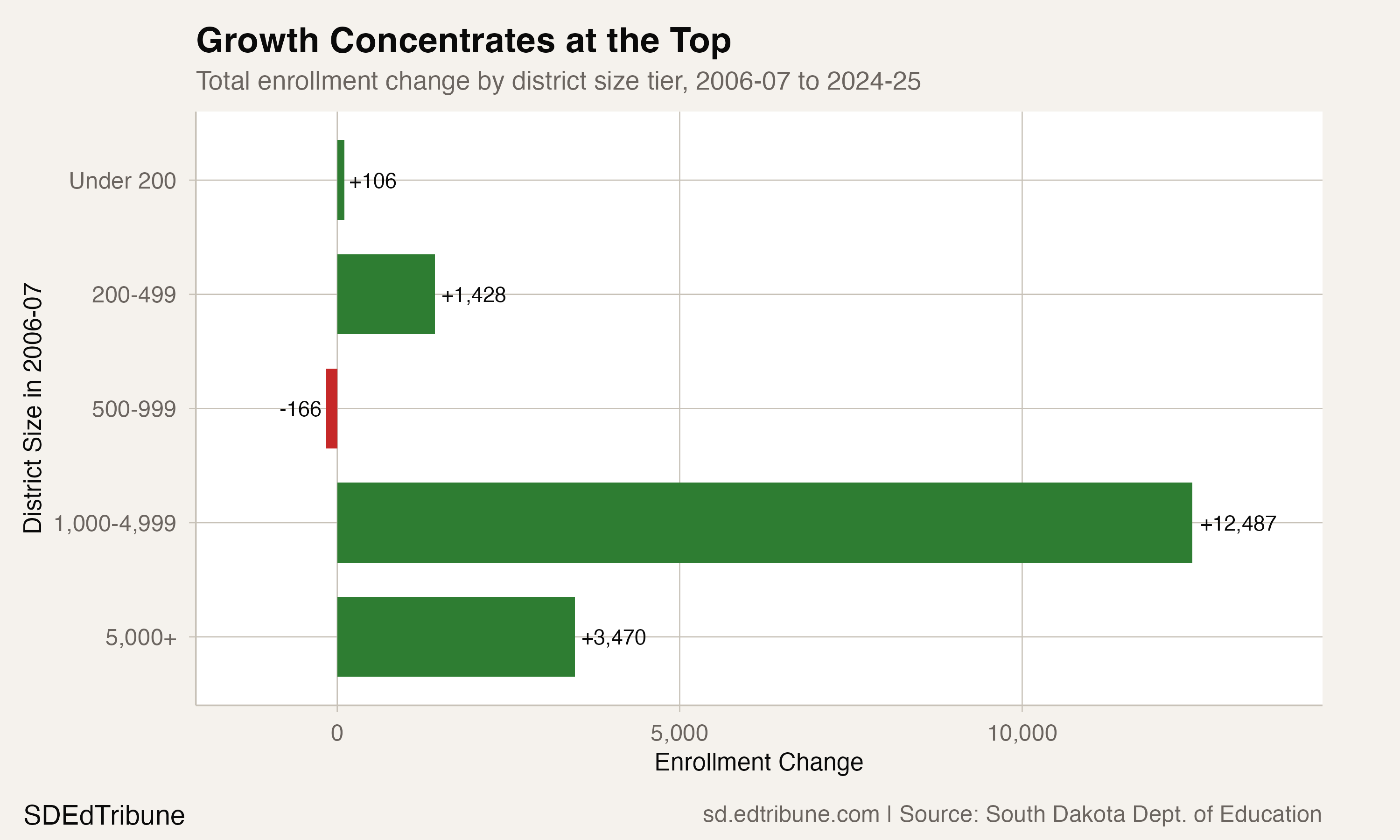
The individual stories behind the tier data are stark. Harrisburg↗ET grew from 1,470 to 6,222 students, a 323.3% increase. Brandon Valley↗ET grew 75.7%. Tea Area↗ET grew 139.4%. Suggestive context: these are the bedroom communities absorbing families priced out of or drawn toward the Sioux Falls metro.
Rapid City↗ET, the state's second-largest district, moved in the opposite direction: 13,063 to 12,313, a 5.7% decline. Among smaller districts, Bowdle lost 28.6% of its enrollment, and Newell↗ET lost 38.2%.
The kindergarten signal
Eight districts enrolled fewer than 10 kindergartners in 2024-25. South Central had eight. Elk Mountain had one. Bison and Oelrichs had five and six, respectively.
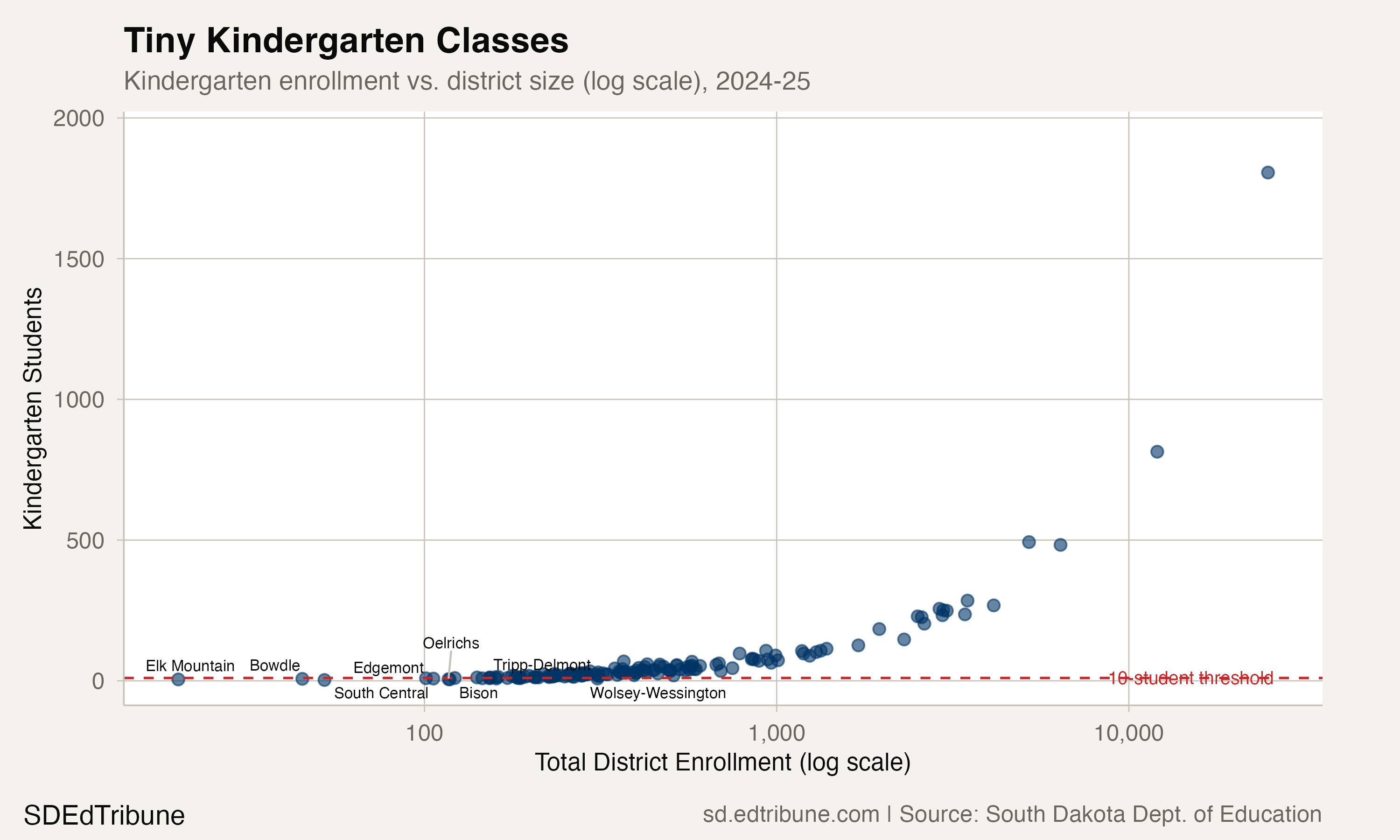
A very small kindergarten class is not just a pedagogical challenge. It is a demographic signal: if the pattern holds, each graduating class will be replaced by an incoming class that is smaller.
For districts under 200 students, the average kindergarten class is 12.4 students. The average across all 14 reported grade levels is 10.1 students per grade. These are districts operating at a scale where losing a few families can visibly hollow out a classroom.
What keeps tiny districts open
Suggestive context: the most likely factor sustaining enrollment in rural South Dakota is geography, not policy preference. The state's sparse-district funding formula provides additional per-pupil support by adjusting target teacher-to-student ratios based on district size, with smaller districts receiving more favorable ratios. Competing explanation: distance can also be decisive. When the next school is far away on a county road, consolidation means bus rides that would consume a child's morning.
Suggestive context: the population dynamics pushing against these districts are well-documented. Rural counties are aging, with more deaths than births, according to state demographer Weiwei Zhang.
"Counties that already had a small population are continuing to lose people." — State demographer Weiwei Zhang, Mitchell Republic
The same reporting describes rural districts facing the combined pressure of population loss and difficult operating choices. Those accounts provide context, not a substitute for the enrollment evidence above.
The cost of smallness
Competing explanation: contemporaneous reporting on the Oldham-Ramona-Rutland consolidation describes operating-cost and salary pressures alongside the geography argument.
The current package shows 18 net fewer districts, with 98 still under 500 students and 25 under 200. The structural gap between small-district overhead and large-district enrollment advantage remains visible in the data.
Unresourced: enrollment data alone cannot establish the relative per-pupil cost of the state's smallest and largest districts. The state formula's sparsity adjustment may narrow that gap, but the cost mechanism requires a separate finance analysis.
What to watch
The smallest enrollment band creates a clear tripwire. Four districts sat below 100 in 2024-25: Elk Mountain (16), South Central (52), Big Stone City (79), and Bowdle (90). Another 21 districts sat between 100 and 200. At the trajectory Bowdle has followed — 126 in 2006-07, 90 in 2024-25 — a district does not gradually approach the line. It loses families one at a time in communities where each departure is noticed.
South Dakota's enrollment grew 15.7% since 2006-07, but that growth was absorbed mainly by a handful of suburban and mid-sized districts. The 98 districts under 500 serve a combined 27,416 students — slightly more than the enrollment of Sioux Falls alone. Rural South Dakota's school map was drawn for a population that no longer exists. The map is slowly catching up.
Detailed code that reproduces the analysis and figures in this article is available exclusively to EdTribune subscribers.
Discussion
Sign in to join the discussion.
Loading comments...