Correction (March 15, 2026): An earlier version of this article stated Sioux Falls had shed 283 students since its 2023 peak of 25,228; the 283 figure was actually the loss since 2022, not the 2023 peak. Additionally, Rapid City's most recent annual loss was 273 students, not 267 as originally reported. School year labels for peak enrollment years have also been corrected.
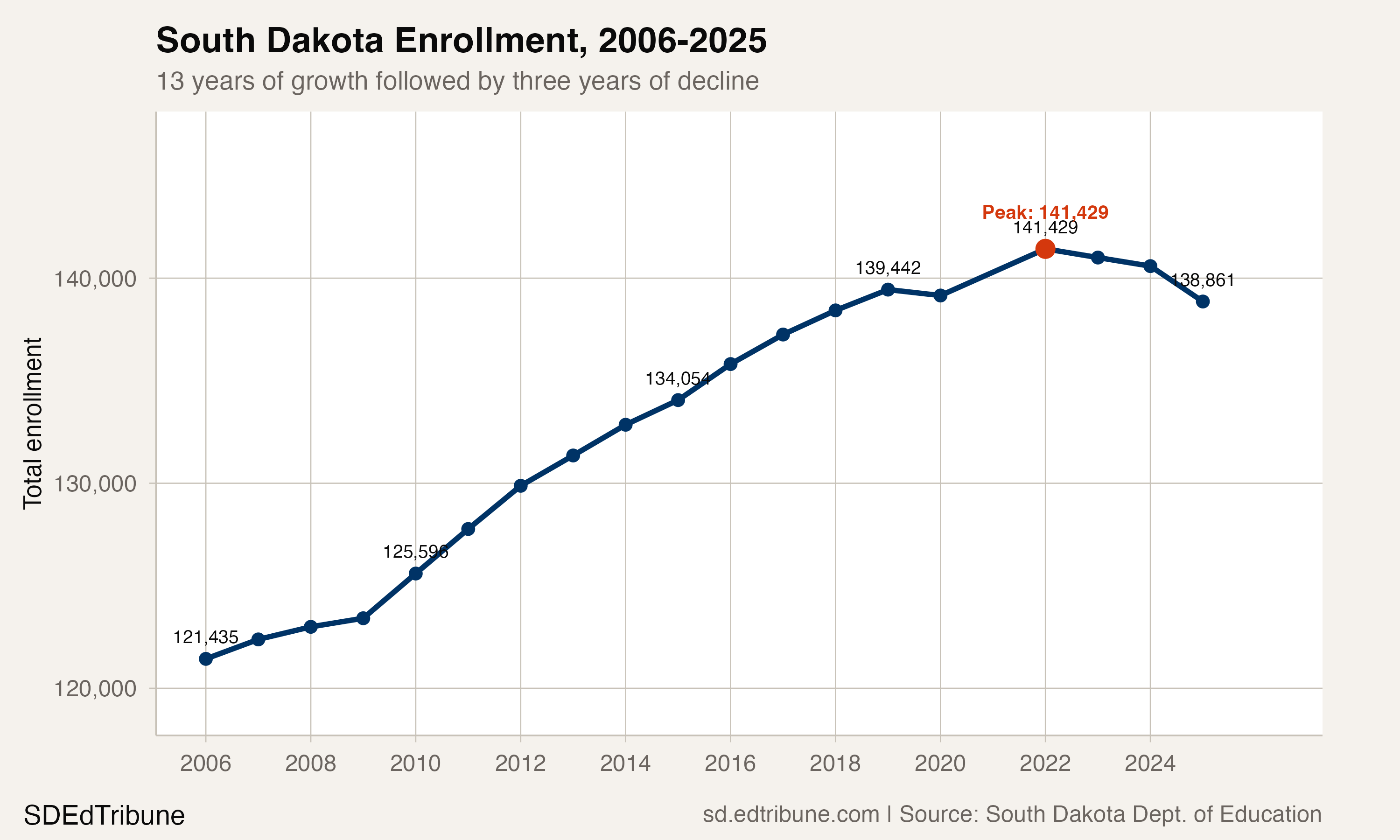
For 13 consecutive years, from 2007 through 2019, South Dakota public schools grew. Every single year. The state added 18,007 students across that stretch, a 14.8% increase that tracked neatly alongside a broader population boom in the Sioux Falls metro, refugee resettlement in meatpacking towns, and a birth rate that remained among the highest in the nation. That era is over.
After a brief post-COVID bounce carried enrollment to a peak of 141,429 in 2022, South Dakota has now posted three consecutive years of decline. The losses started small: 424 in 2023, 418 in 2024. Then 2025 arrived with a loss of 1,726, four times the prior year and six times larger than the COVID dip of 288 in 2020. The state's public schools now enroll 138,861 students, 2,568 below the peak and 581 fewer than in pre-pandemic 2019.
The acceleration problem
The raw numbers matter less than the trajectory. A loss of 400 students per year in a state with 141,000 is a rounding error, the kind of fluctuation that can be absorbed without closing a school or cutting a position. A loss of 1,726 is not. That is 1.2% of total enrollment in a single year, in a state where per-pupil funding follows students and ranks seventh-lowest nationally at $12,005.
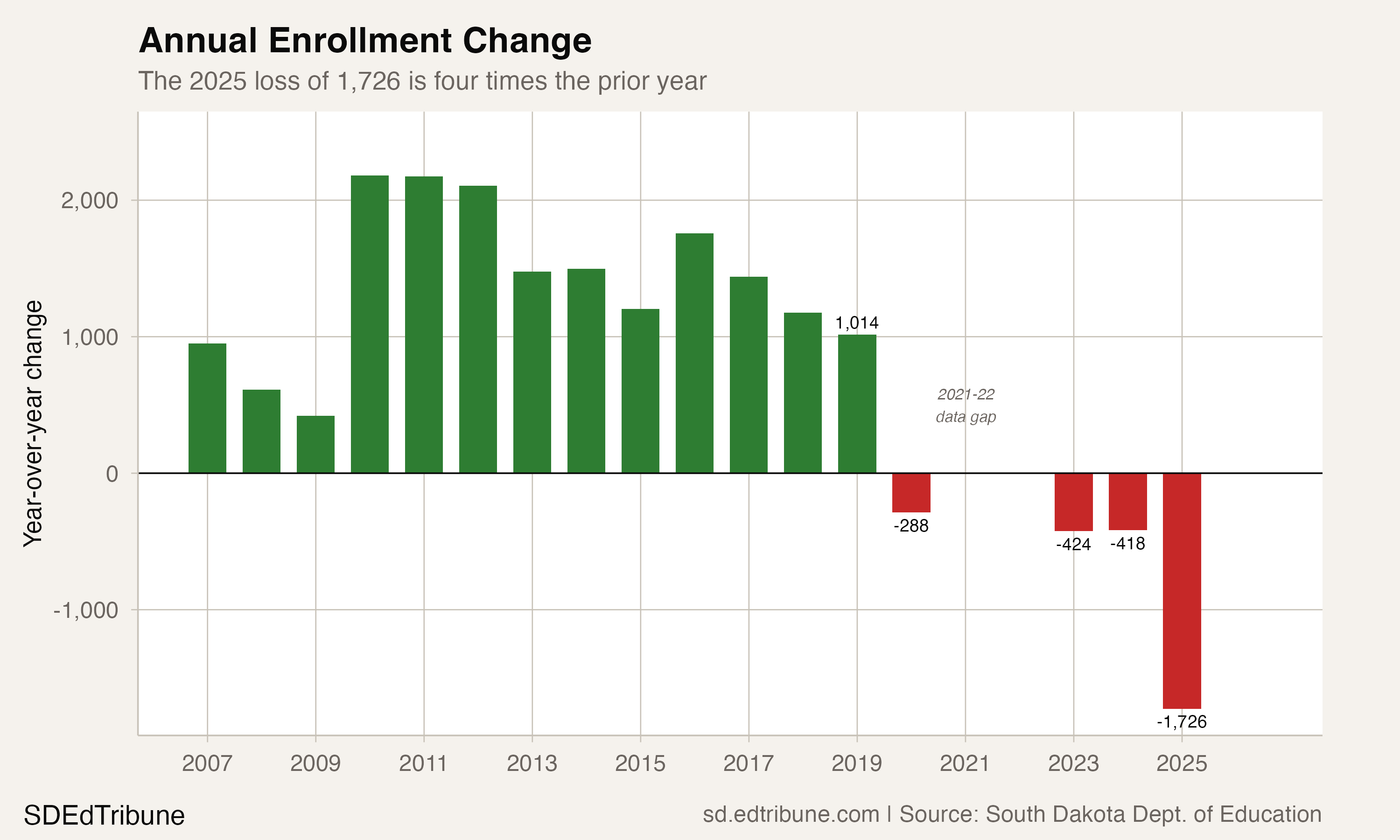
The year-over-year chart reveals two distinct periods. From 2010 through 2012, South Dakota was adding more than 2,000 students annually. Growth then decelerated through the rest of the decade, averaging 1,348 per year from 2014 to 2019, before COVID pushed enrollment negative in 2020. The post-COVID rebound was real but brief. South Dakota has now entered a phase where losses are not only persistent but compounding.
Fewer children entering, more graduating out
Kindergarten enrollment peaked at 12,082 in 2022. By 2025, it had fallen to 10,954, a decline of 1,128 students, or 9.3%. Over the same period, 12th grade enrollment rose from 9,119 to 9,964, a gain of 845. The state is losing students at the front of the pipeline faster than it is gaining them at the back.
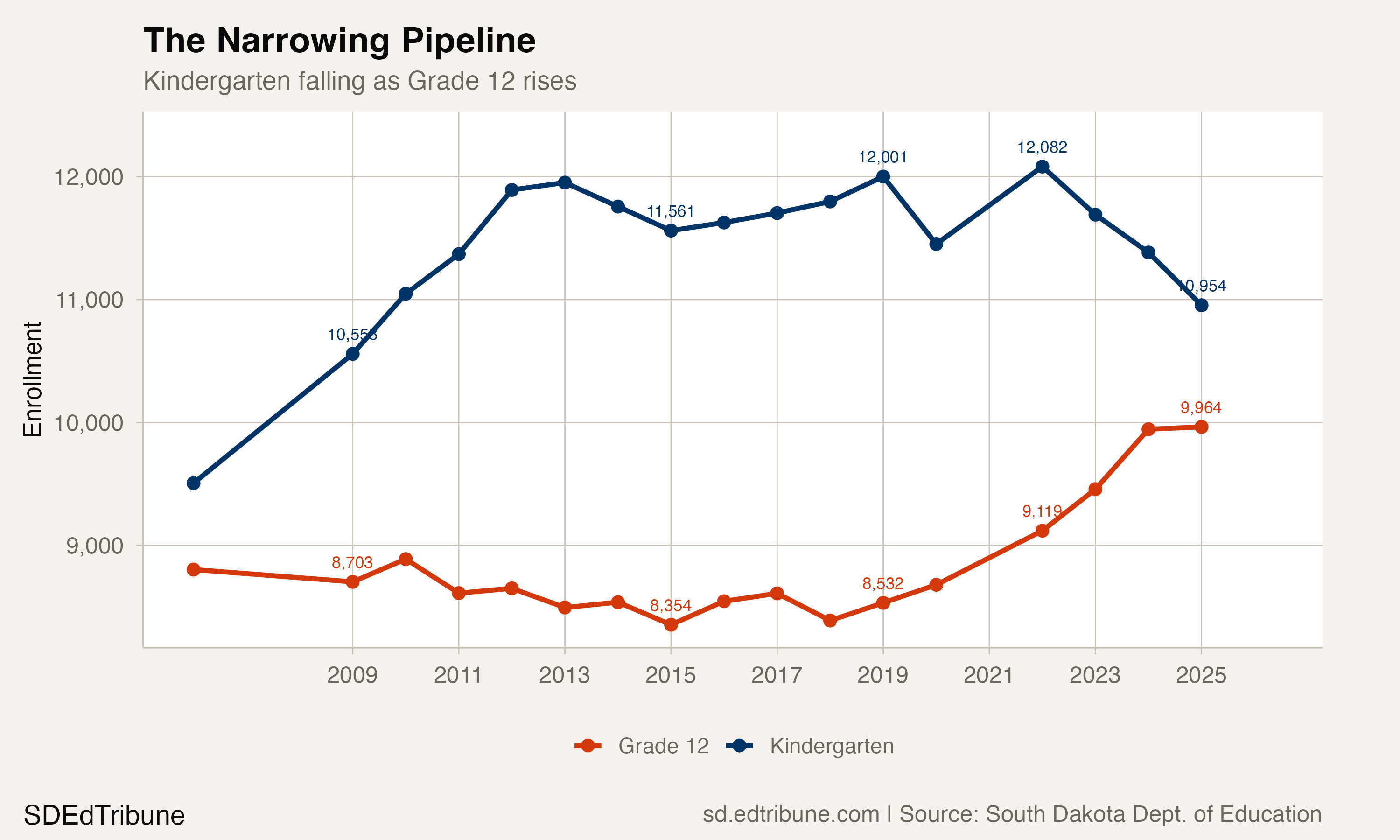
The kindergarten decline tracks South Dakota's falling birth rate. The state's birth rate dropped from 15 per 1,000 population in 2007 to 12.2 per 1,000 between 2022 and 2023, its lowest on record. State demographer Weiwei Zhang told a legislative committee in January 2024 that projections call for "fewer school-age kids" over the coming decade. Even so, South Dakota's fertility rate remains near the top nationally, above the national replacement level of 2.1, which means the kindergarten decline here is modest compared to states where birth rates collapsed a decade ago.
The grade 12 bulge will naturally resolve as the smaller kindergarten cohorts from 2020 onward work their way through the system. When they do, South Dakota will lose students from both ends simultaneously.
Where the students aren't going to school
Three districts account for 53.1% of the statewide decline since 2022. Rapid City Area↗ET lost 703 students, a 5.5% drop. Watertown↗ET lost 378, a 9.9% decline severe enough that the district considered closing an elementary school in 2023, though the board deadlocked 2-2 on the proposal. Sioux Falls↗ET, the state's largest district with 24,841 students, has shed 283 since 2022.
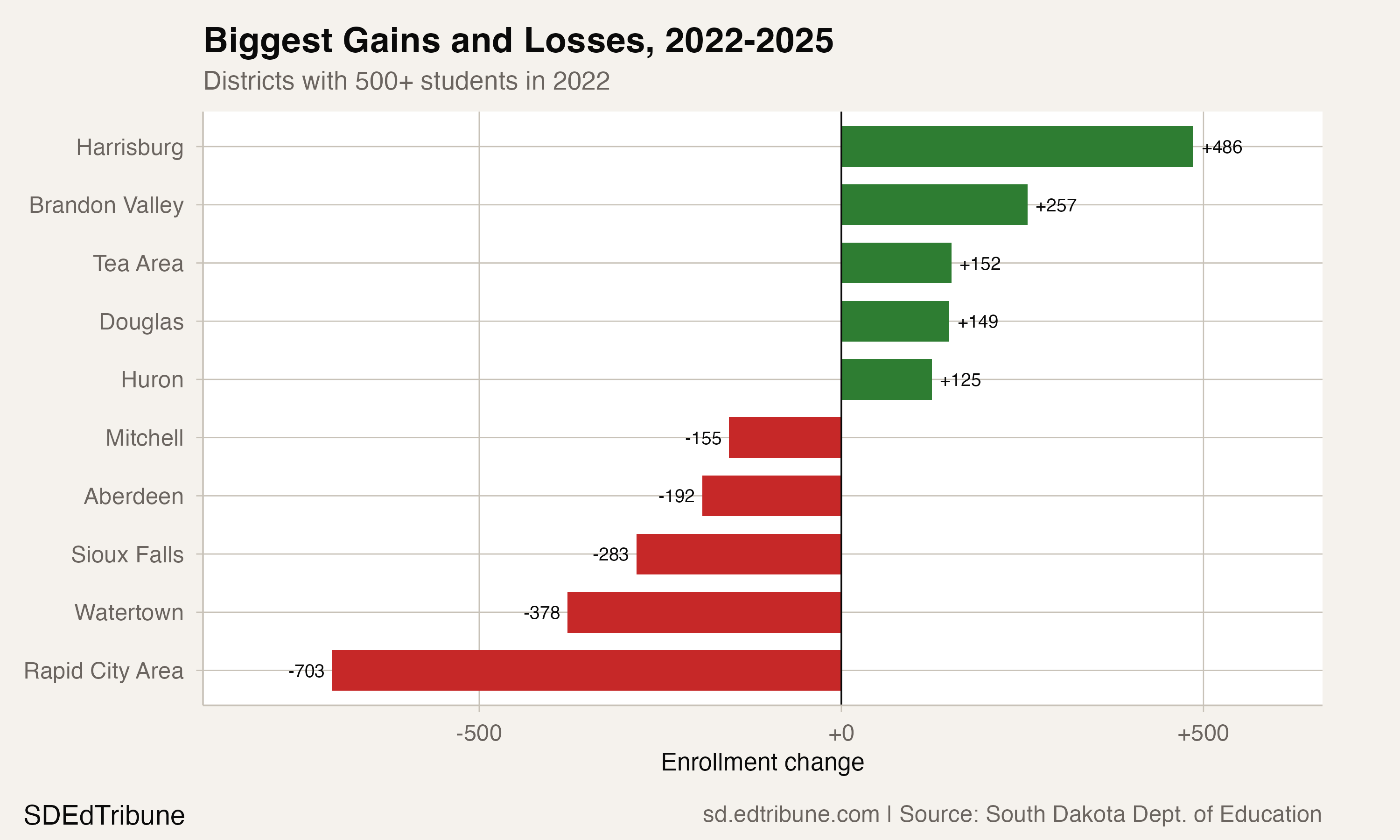
Rapid City's situation is the most acute. The district has lost nearly 2,000 students since its peak of 13,982 in 2012, a 13-year decline that predates any statewide trend. Board member Christine Stephenson told the Rapid City Journal: "We know that we're not losing kids in Rapid City. We know that people are moving here with their families. They're not enrolling in our schools, or they're pulling them out." The district lost another 273 students in the most recent year alone.
The alternative instruction drain
One factor distinguishing South Dakota's decline from national patterns is the scale of its shift toward alternative instruction. The state's alternative instruction enrollment, which includes homeschooling, unaccredited private schools, online programs, and microschools, reached 12,433 students in 2025, nearly triple the 3,933 enrolled in 2014. That 12,433 now represents 7.6% of all students receiving an education in South Dakota.
"South Dakota saw a 143 percent increase in home school enrollment in the last ten years, the highest of any state during that span." — KOTA TV, December 2025
The growth is not concentrated in rural areas. The Sioux Falls School District reported the largest single-district increase in alternative instruction in 2025, with 131 additional students. Harrisburg↗ET added 78, Brandon Valley↗ET added 67, and Rapid City added 64. Governor Larry Rhoden has indicated he expects public school enrollment to continue declining, citing both alternative instruction growth and lower birth rates.
Whether the alternative instruction surge represents families choosing a genuinely different educational model or families exiting a system they perceive as inadequate is not something enrollment data can answer. Lisa Fisher, president of Families for Alternative Instruction Rights in South Dakota, has pointed to school environment and academic concerns as the top reasons parents choose homeschooling.
The suburban exception
The statewide decline masks a sharp geographic divergence. South Dakota's Sioux Falls suburbs are still growing, and growing fast.
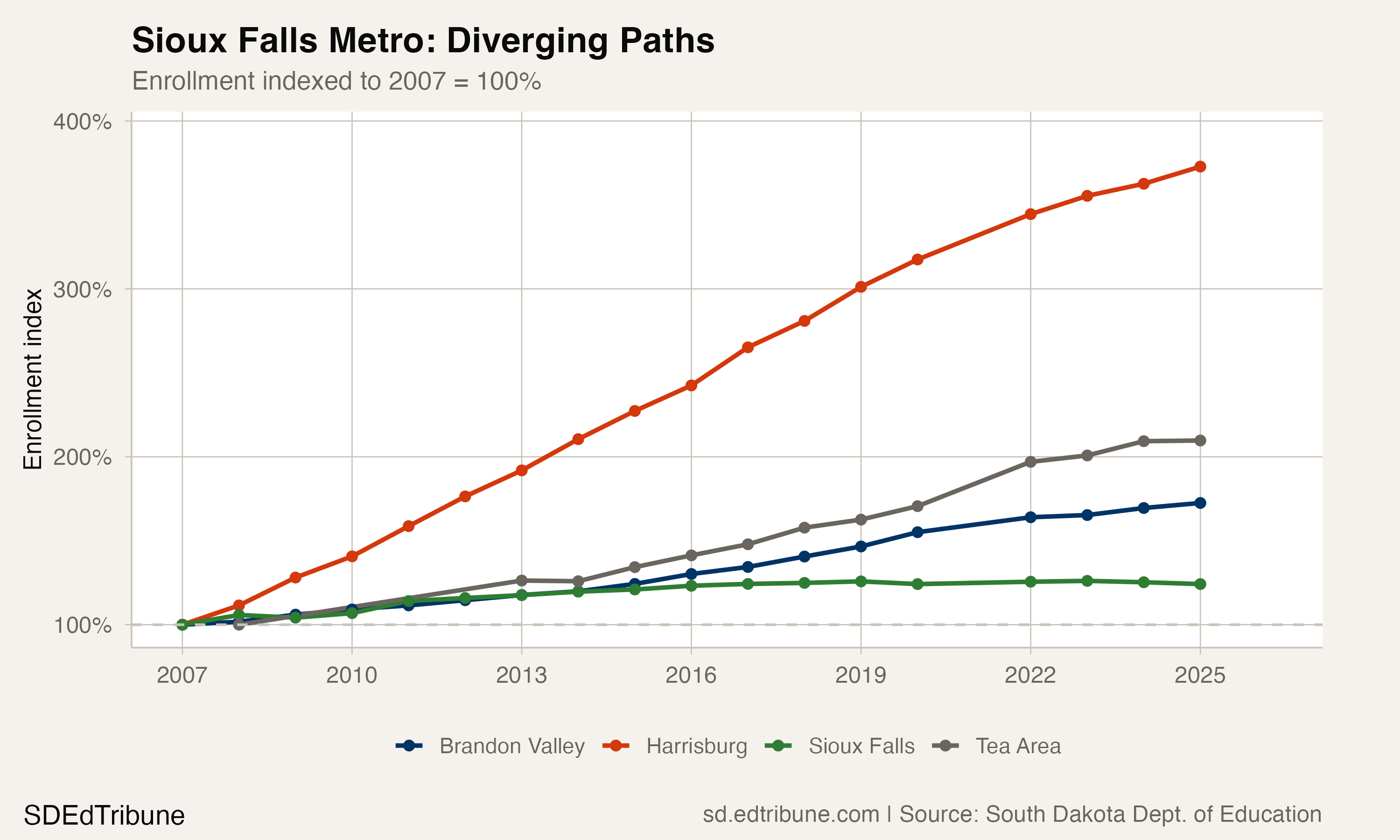
Harrisburg has grown every year since at least 2007, rising from 1,716 students to 6,398, a 272.8% increase that has made it the state's third-largest district. Superintendent Jennifer Lowery has said "there are 37,000 acres coming into the Harrisburg School District by 2030," with 900 new homes planned around just one elementary school in the next two to five years. Brandon Valley grew 72.5% over the same span, from 3,018 to 5,206. Tea Area↗ET more than doubled from 1,190 to 2,514.
Sioux Falls itself, by contrast, has essentially plateaued. The district enrolled 20,006 students in 2007 and 24,841 in 2025, a 24.2% gain that has stalled since 2023. The pattern is a classic suburban donut: the core district flatlines while bedroom communities on its perimeter absorb new housing development and the families that come with it.
The one outlier that does not fit the Sioux Falls metro pattern is Huron↗ET, 110 miles to the northwest. Huron grew from 2,149 students in 2007 to 3,042 in 2025, a 41.6% increase driven largely by refugee and immigrant resettlement in the city's meatpacking industry.
What to watch next
The 2025-26 school year data, when South Dakota's DOE publishes it, will determine whether the 1,726-student loss was an anomaly or the start of a steeper trajectory. Two indicators will be decisive. The first is kindergarten enrollment: if the 2026 K class falls below 10,900, it will confirm that the birth-rate decline is accelerating its way into classrooms. The second is alternative instruction: if the 12,433 figure keeps climbing toward 13,000 or beyond, it will suggest that the public school system is losing market share on top of losing population.
South Dakota spent 13 years as one of the few states in the country where public school enrollment reliably grew. That distinction is gone. Of the state's 147 districts, 86 shrank between 2022 and 2025. Ninety-six enroll fewer than 500 students. For those districts, a loss of even 20 students per year changes what programs they can offer and what staff they can retain. Watertown is considering closing an elementary school. Rapid City cannot fill its bus driver positions. Harrisburg is still building, but its growth rate has halved. The 1,726 students South Dakota lost last year will not be the largest loss on the ledger for long.
Detailed code that reproduces the analysis and figures in this article is available exclusively to EdTribune subscribers.
Discussion
Sign in to join the discussion.
Loading comments...