Correction (March 15, 2026): An earlier version of this article stated that Brandon Valley grew 69.5% since 2007. The correct figure is 72.5%. The error has been corrected.
In a state where enrollment peaked three years ago and has fallen by 2,568 students since, one district seven miles south of Sioux Falls has never once lost a student. Not during the Great Recession. Not during COVID. Not in any year in the dataset.
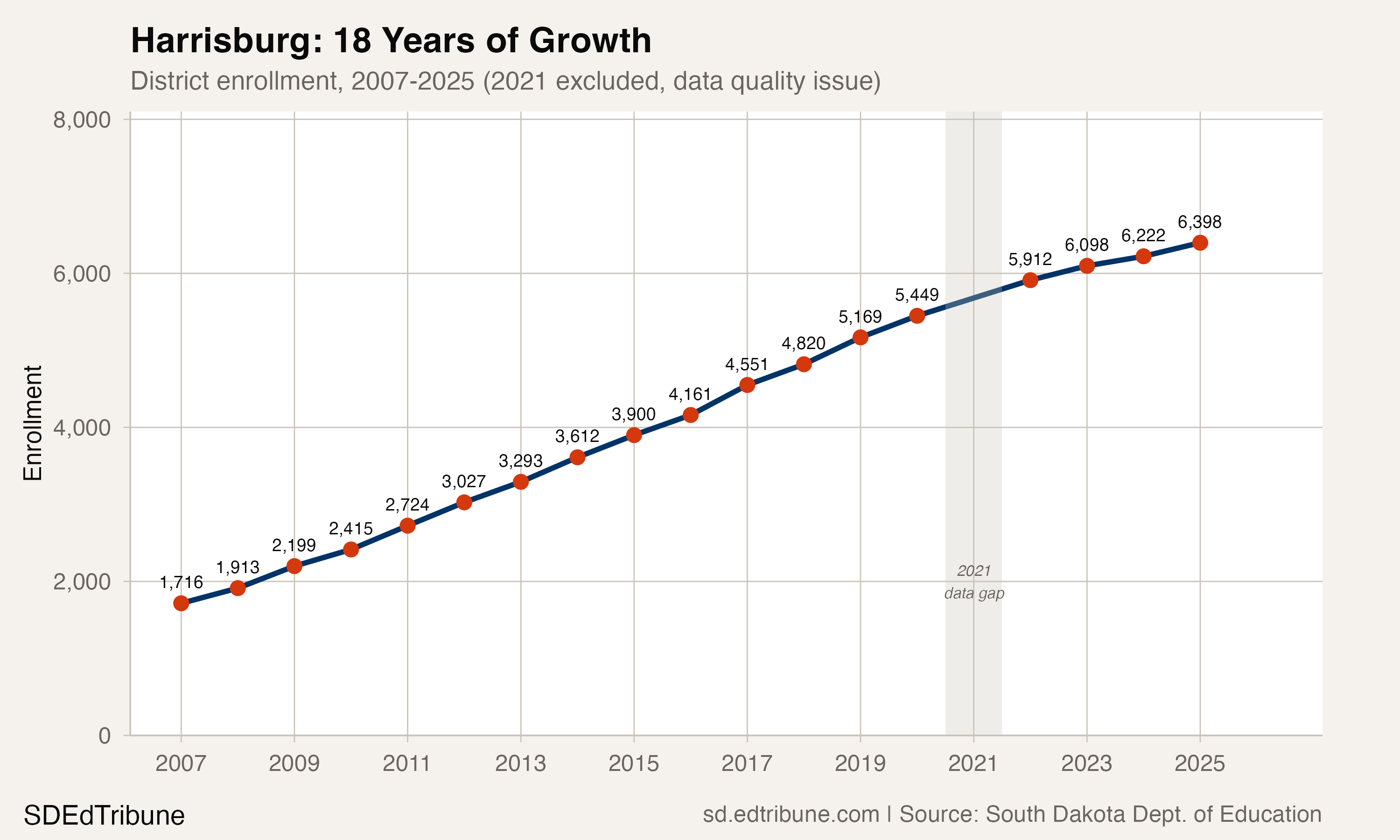
Harrisburg↗ET enrolled 1,716 students in 2007. By 2025, it enrolled 6,398, a gain of 4,682 students and 272.8% growth. In every available year of data, enrollment rose. (The 2021 reporting year is excluded due to a data quality issue; enrollment grew across the gap from 5,449 in 2020 to 5,912 in 2022.) Of 147 school districts in South Dakota with at least a decade of data, only two have never posted a decline: Harrisburg and Brandon Valley↗ET. Brandon Valley grew 72.5%. Harrisburg grew nearly four times as fast.
The streak has made Harrisburg the state's third-largest district, behind only Sioux Falls↗ET and Rapid City↗ET. In 2007, Harrisburg's enrollment was 12.8% the size of Rapid City's. It is now 53.1%.
A new school every two years
The building history reads like a construction log. Explorer Elementary opened in 2005. Journey Elementary followed in 2008. A new high school arrived in 2009. Freedom Elementary in 2011. North Middle School and Endeavor Elementary in 2013. Horizon Elementary in 2016. Adventure Elementary in 2021. East Middle School and a Freshman Academy in 2023. A rebuilt Liberty Elementary in 2024. That is 10 major facilities in 19 years, according to the district's 2024-25 Annual Report.
The district has managed to build at $166 per square foot, compared to $287 per square foot for 15 other school construction projects in eastern South Dakota. Voters have supported the pace: a $60 million bond passed with 83% approval in 2021, and a $30 million bond passed at 74% in 2022.
"We have such great community support. I feel spoiled in that sense. It seems like in the Harrisburg district, people understand the importance of public education." -- Mike Knudson, School Board Chair, SFSimplified
Local revenue to the district's general fund grew from $3.1 million in 2003-04 to $20.0 million in 2022-23, a 542% increase that tracks the expanding property tax base of a community that was farmland a generation ago.
The engine: housing south of Sioux Falls
Harrisburg's growth is not a mystery. The city's population grew 37.8% between July 2020 and July 2023, making it the fastest-growing South Dakota city with more than 5,000 residents, according to U.S. Census Bureau estimates. Lincoln County, where Harrisburg sits, grew 11.6% in the same period.
The residential pipeline remains active. From 2022 through 2024, Harrisburg issued building permits for 272 single-family homes, and at least six major developments are in progress, with new homes listed in the $400,000 to $500,000 range. New neighborhoods cluster near schools; the district itself functions as an amenity that developers market to young families.
The dynamic is familiar in fast-growing metro areas across the country: affordable land on the suburban fringe draws families priced out of the core city, and schools follow rooftops. What makes Harrisburg unusual is the duration and consistency of the curve. Most fast-growing suburban districts experience at least one correction as housing cycles shift or buildable land becomes scarce. Harrisburg has not.
The suburban ring is closing in
Harrisburg is part of a broader suburban ring around Sioux Falls that is reshaping the metro area's educational geography. In 2007, the combined enrollment of Harrisburg, Brandon Valley, and Tea Area↗ET equaled 29.6% of Sioux Falls' enrollment. By 2025, that ratio had nearly doubled to 56.8%.
Sioux Falls itself peaked at 25,228 students in 2023 and has since declined to 24,841, a loss of 387 students in two years. The three suburban ring districts added 623 students over the same span. The metro area is not shrinking. Students are redistributing.
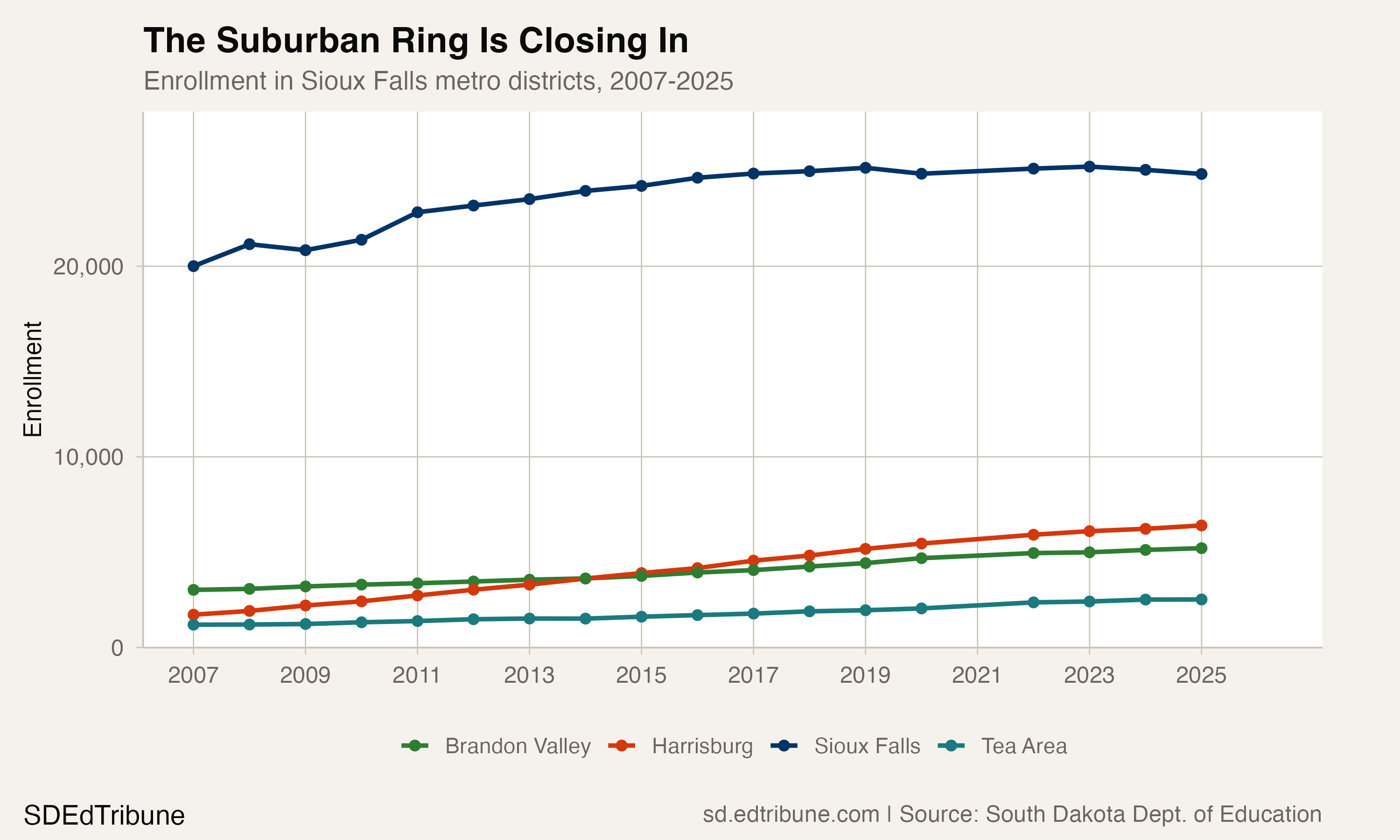
Brandon Valley, the other district with no down years in the data, grew 72.5% over the same period, from 3,018 to 5,206. Tea Area more than doubled, from 1,190 to 2,514. But neither matched Harrisburg's trajectory. Harrisburg alone added nearly as many students as Sioux Falls (4,682 vs. 4,835) despite starting at less than a tenth of Sioux Falls' size.
A district that grew into itself
In 2010, Harrisburg's grade structure told the story of a young, bottom-heavy district. Kindergarten enrolled 278 students. Twelfth grade enrolled 102. The wave of families with young children had not yet pushed through the secondary grades.
By 2025, the pipeline had matured. Every grade from K through 12 enrolled between 444 and 520 students. The 12th grade class reached 444, a 399% increase from the 89 seniors in 2009. Superintendent Tim Graf noted in the district's annual report that the 2025-26 year was expected to produce the first graduating class of over 400 students, after three prior classes exceeded 300.
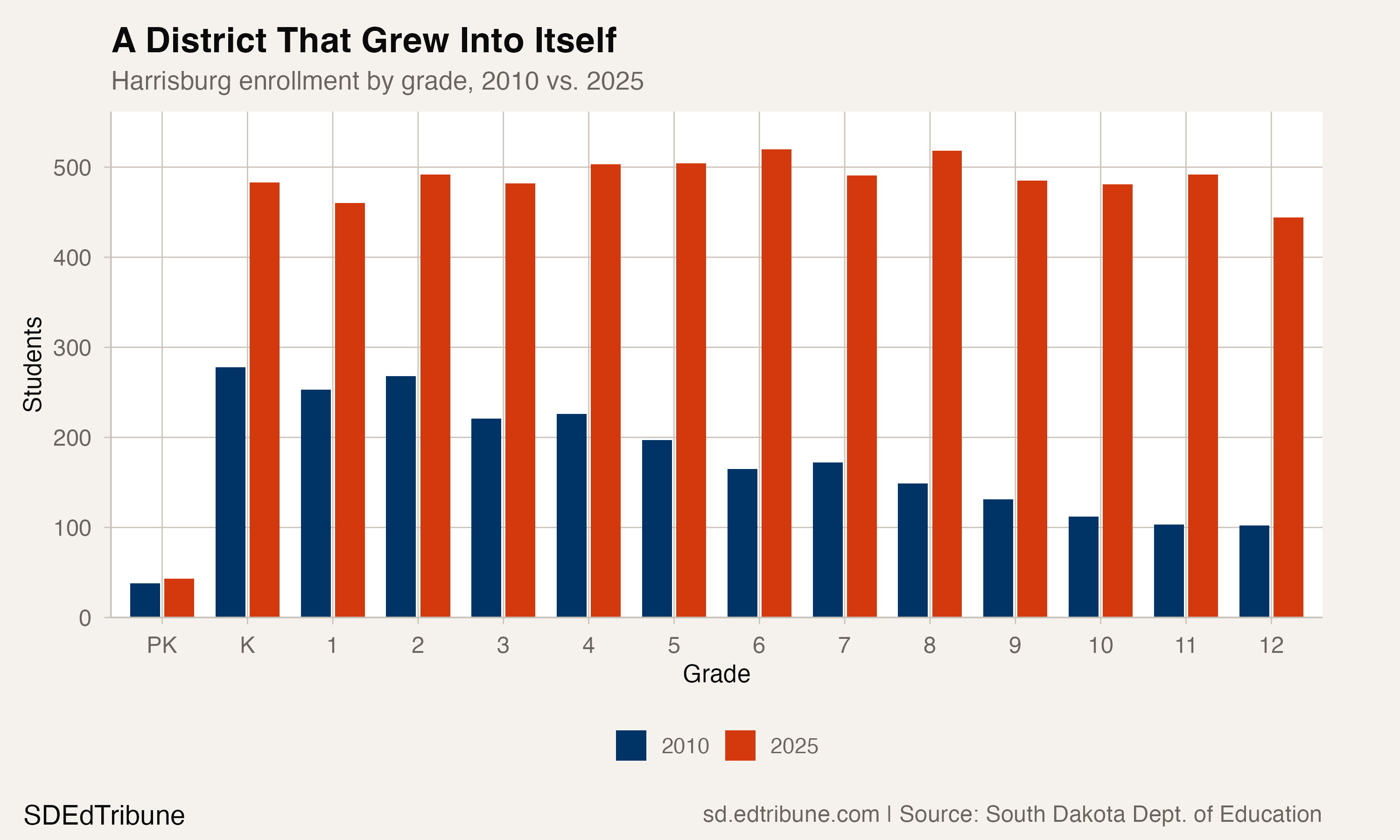
The flattening of the grade structure carries a structural implication. For years, Harrisburg's growth was self-reinforcing: each incoming kindergarten class was larger than the outgoing senior class, creating a net gain even if no new families moved in. As those cohort sizes converge, the district needs continued in-migration just to hold steady. The built-in growth multiplier is fading.
Still growing, but the rate is falling
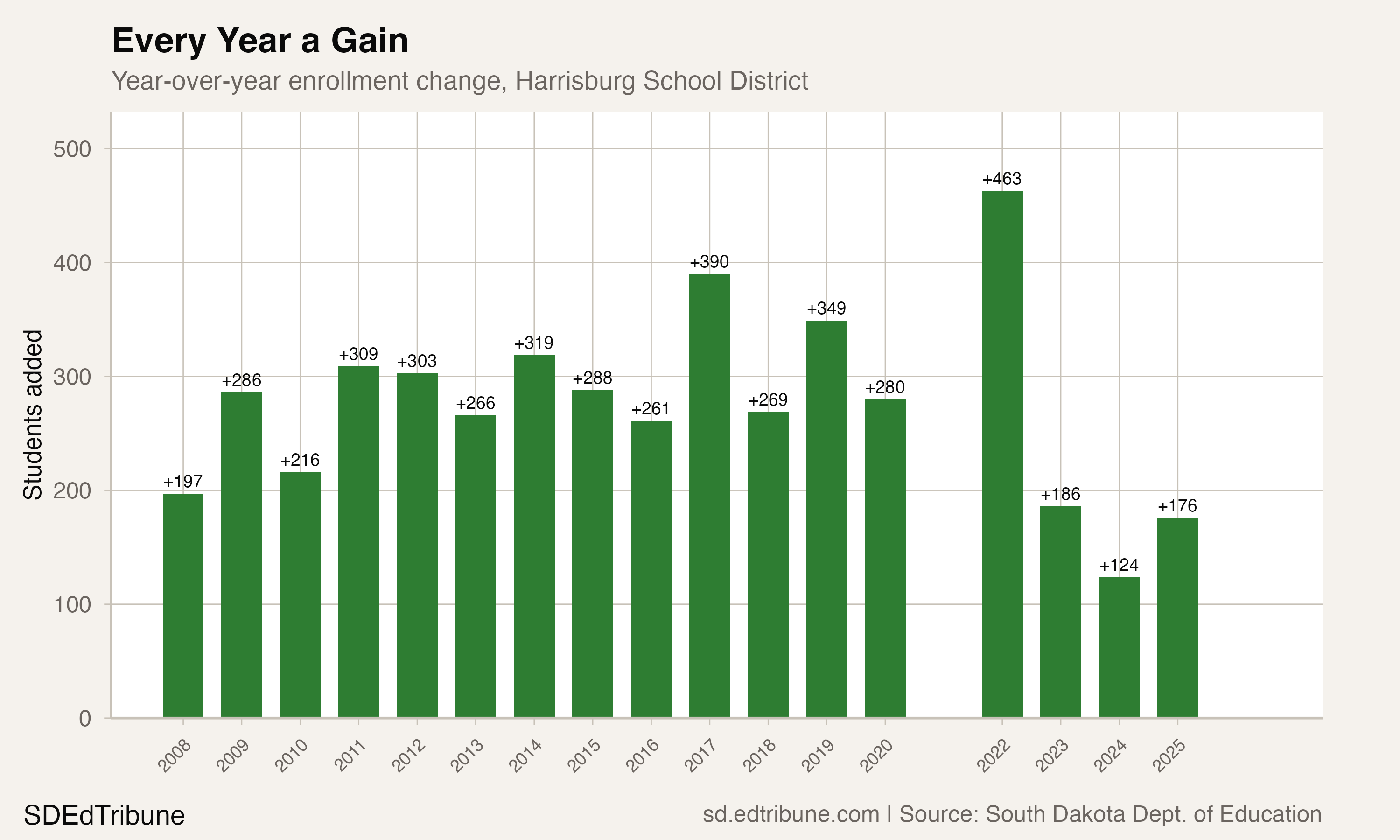
The headline number, growth in every available year since 2007, obscures a meaningful deceleration. From 2008 to 2014, Harrisburg grew at an average annual rate of 11.2%, adding roughly 271 students per year. From 2015 to 2020, the rate slowed to 7.1%, though the average annual gain actually increased to 306 students as the base grew. Since 2023, the rate has dropped to 2.6%, with an average gain of 162 students per year.
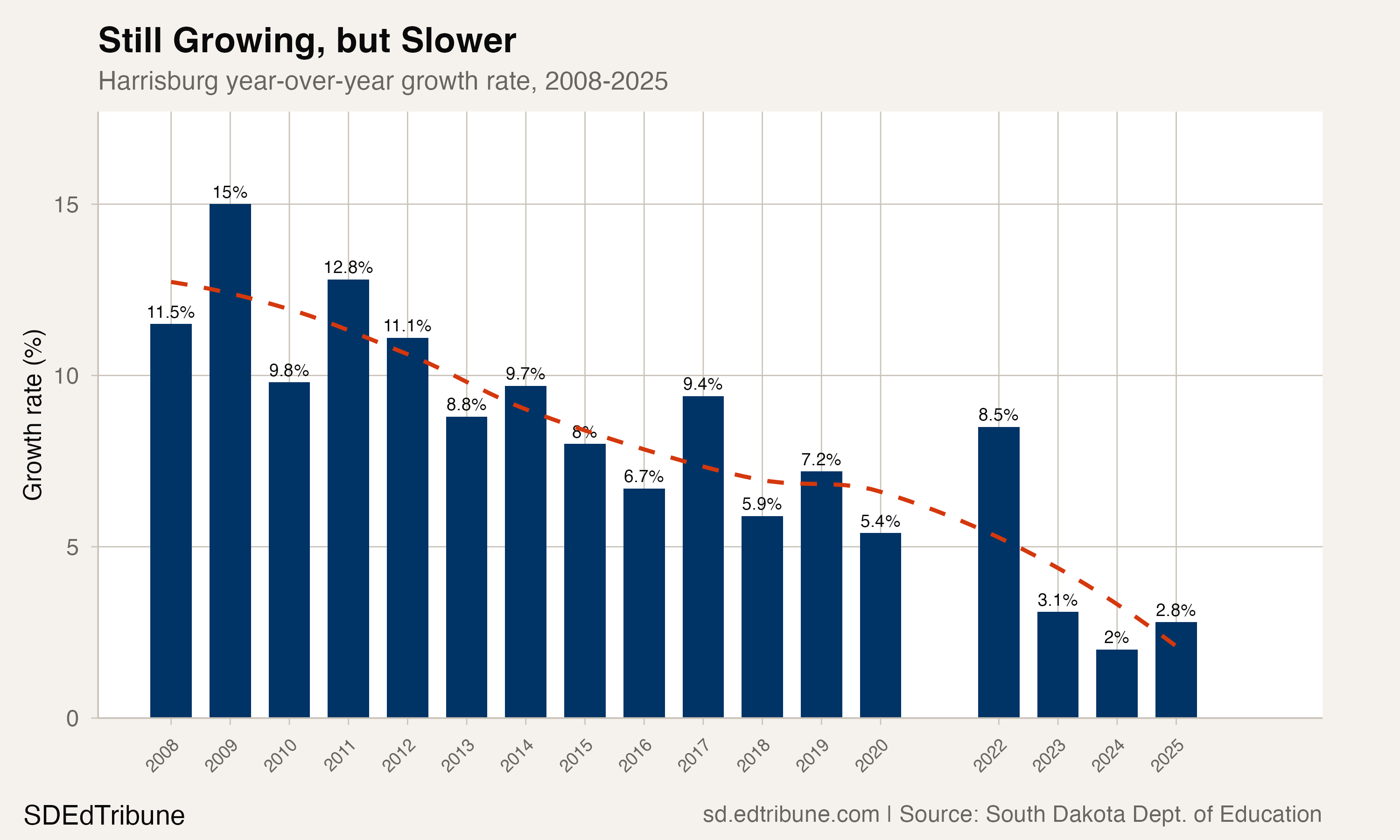
Graf acknowledged the shift in his annual report letter. "The pace of this increase has moderated compared to previous years," he wrote, adding that "we anticipate that new construction may not be necessary in the next few years." The district plans to redirect resources toward programming and curriculum.
The deceleration is not unique to Harrisburg. It is the mathematical reality of a large base. A district of 6,398 needs 166 new students to grow 2.6%. A district of 1,716 needed only 192 to grow 11.2%. But the shift matters for planning. A district that has built a new school roughly every two years for two decades is signaling that the building phase may be ending.
Diversifying faster than the state
Harrisburg's race data, available at the campus level for 2022 through 2025, shows a district that is diversifying rapidly from a predominantly white base. White students dropped from 85.3% to 78.1% in three years. Hispanic students grew from 4.5% to 6.6%, Black students from 3.7% to 5.8%, and multiracial students from 4.6% to 5.8%.
The shift reflects Harrisburg's transition from a rural-fringe community to a metro-integrated suburb drawing from Sioux Falls' broader population. Whether the diversification accelerates depends in part on whether affordable housing remains part of the development pipeline. The $400,000-to-$500,000 price point on new construction is accessible to dual-income professional families but out of reach for many.
From building to operating
Harrisburg's unbroken growth record built a suburban school system from scratch: seven elementary schools, three middle schools, a high school, and a freshman academy that will eventually become a second high school. The district passed $90 million in bonds in two years and built at costs well below regional averages.
Superintendent Tim Graf's annual report letter signals what comes next. "The pace of this increase has moderated," he wrote, and the district plans to redirect resources toward programming and curriculum. For the first time in two decades, Harrisburg is not constructing a new building. The streak may extend to 19 years, even 20. But the district that once measured success by how many classrooms it could pour is now measuring success by what happens inside them. That is a different kind of growth, and a harder one to sustain.
Detailed code that reproduces the analysis and figures in this article is available exclusively to EdTribune subscribers.
Discussion
Sign in to join the discussion.
Loading comments...