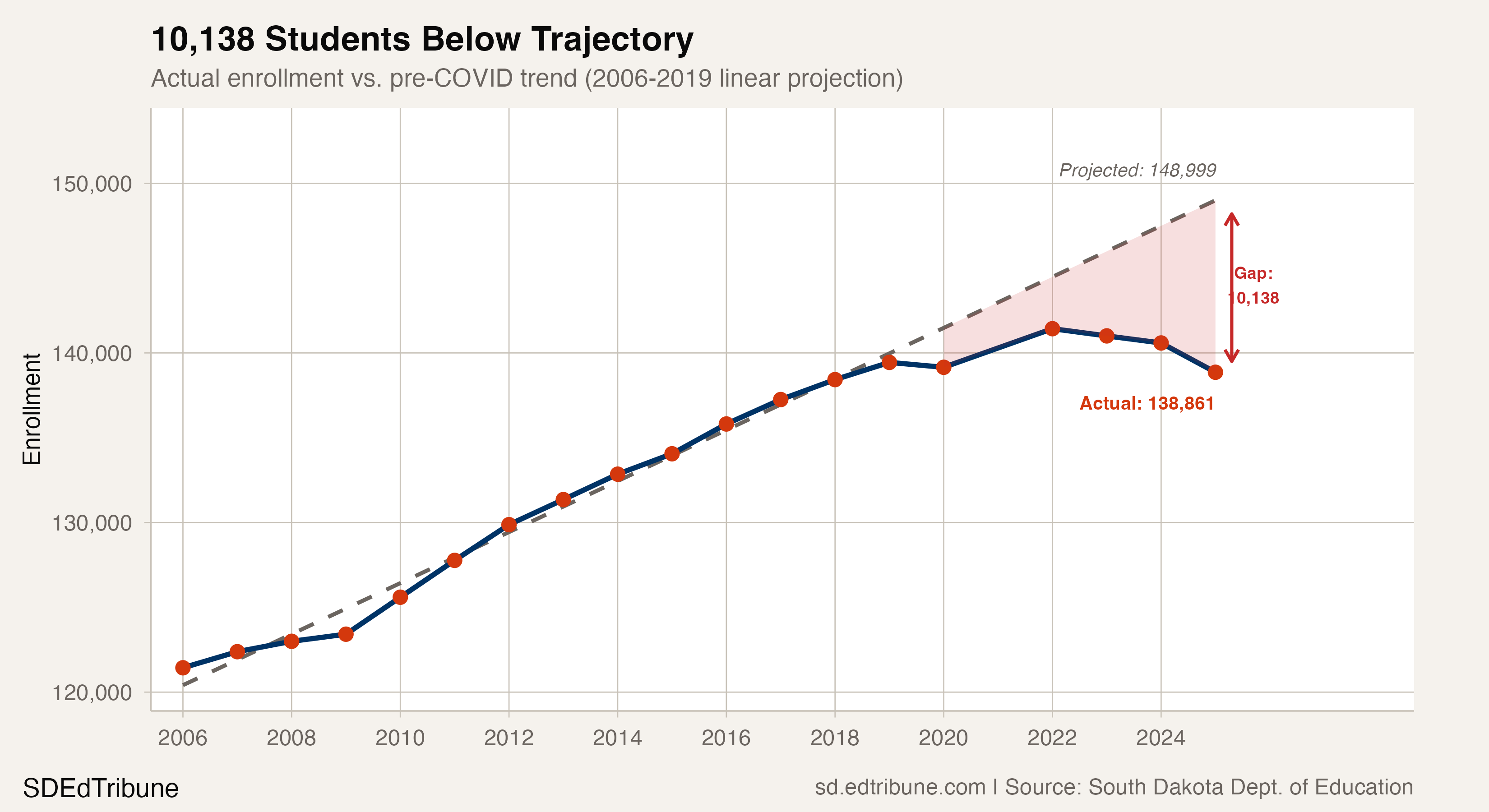
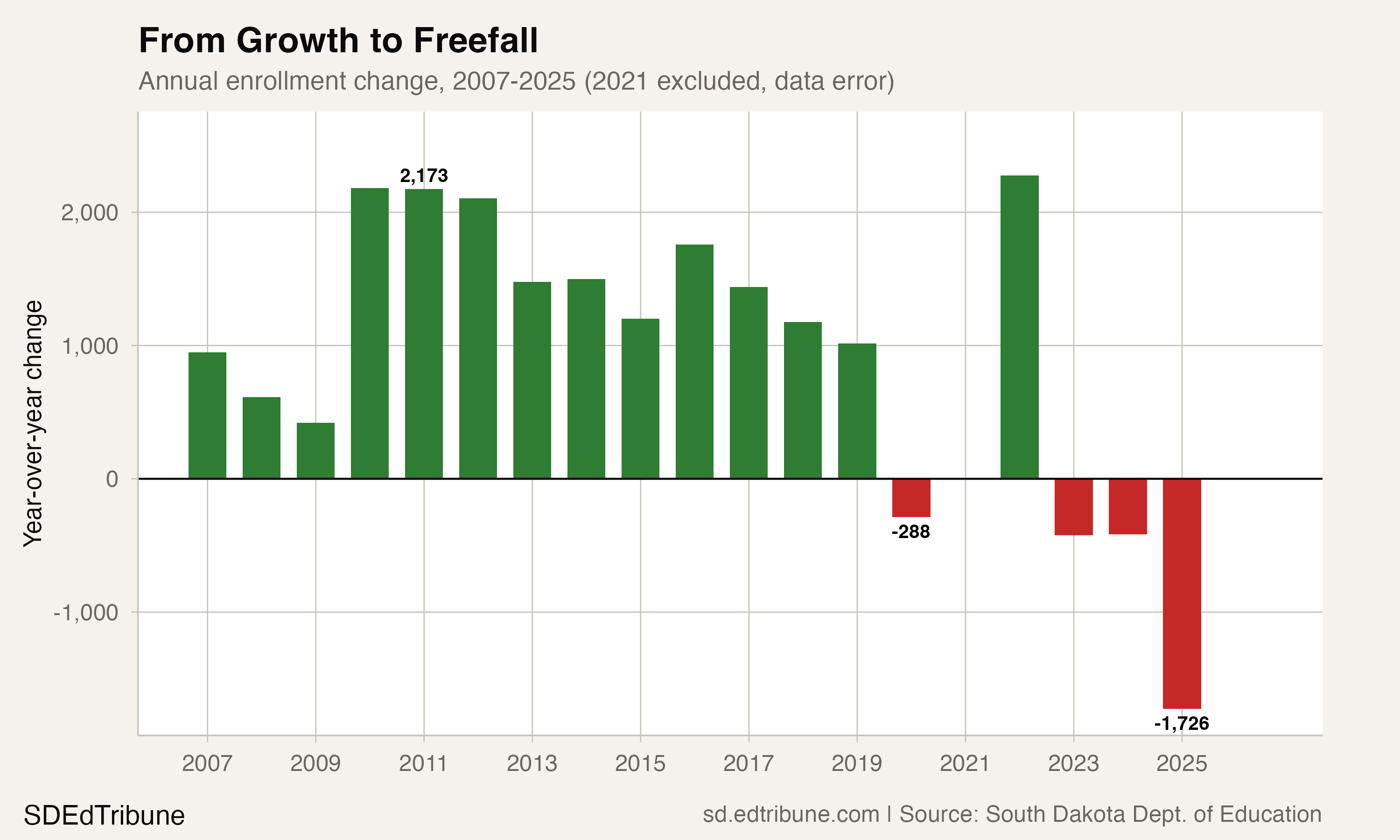
For 13 years, South Dakota's public schools grew like clockwork. From 2007 through 2019, enrollment rose every single year, adding an average of 1,505 students annually with the regularity of a state that had figured out growth: refugees arriving in meatpacking towns, young families filling subdivisions around Sioux Falls, a birth rate that ranked first or second nationally. A simple line drawn through those 14 data points predicted the future with 98.9% accuracy.
That line now predicts 148,999 students in 2024-25. The actual number is 138,861. The gap, 10,138 students, is 6.8% of the projected total and growing faster every year.
A gap that compounds
The trajectory divergence did not start with a single bad year. It started with a small miss in 2020 (2,322 below the trendline), held roughly steady through the post-COVID bounce of 2022 (3,056 below), and then accelerated. The gap widened by 1,929 students in 2023, by 1,922 in 2024, and by 3,231 in 2025, the largest single-year divergence yet.
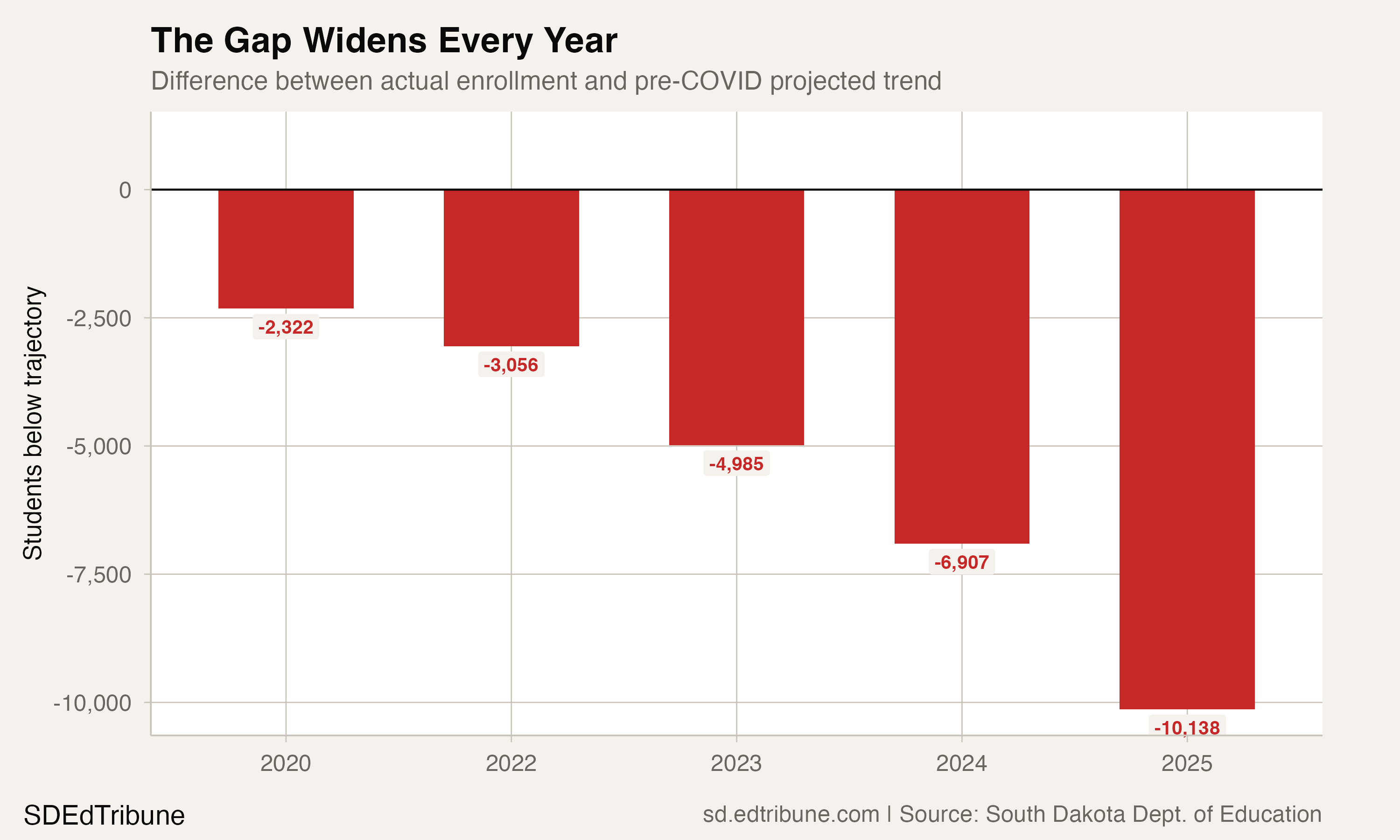
Put differently: South Dakota's public schools are now missing the equivalent of 10.7 average-sized districts. At the state's per-pupil funding level of $12,005, the seventh-lowest in the nation, that gap represents roughly $121.7 million in funding that would have flowed to districts if the pre-COVID trajectory had held. The money did not disappear. The students did.
Fewer walking in, more walking out
The pipeline tells much of the story. Kindergarten enrollment peaked at 12,082 in 2022 and has fallen to 10,954, a decline of 1,128 students (9.3%) in three years. Grade 12 enrollment, meanwhile, rose from 8,532 in 2019 to 9,964 in 2025, a 16.8% increase driven by the large cohorts born during South Dakota's high-fertility years working their way to graduation.
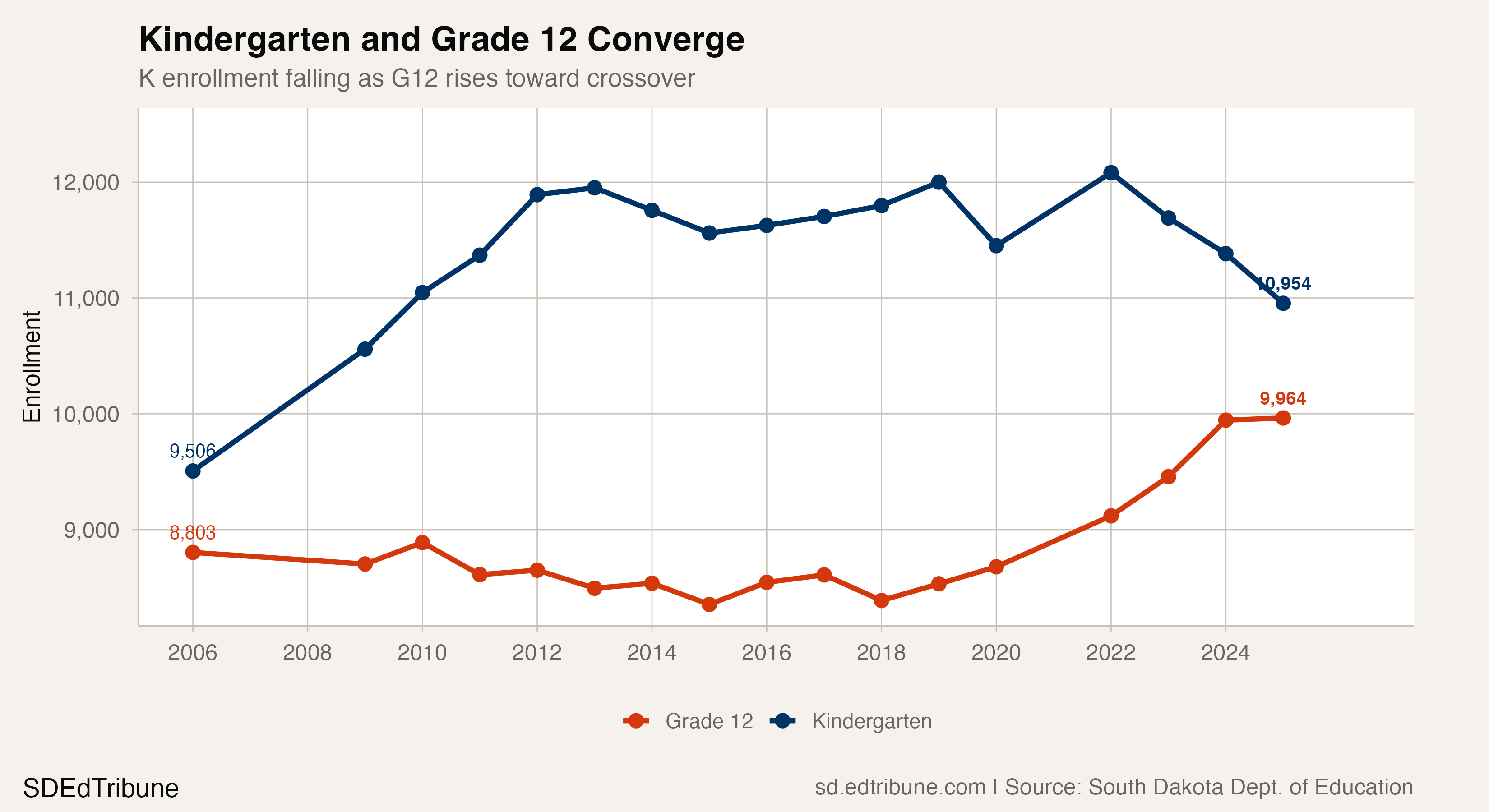
The kindergarten-to-grade-12 ratio quantifies this squeeze. In 2019, South Dakota enrolled 141 kindergartners for every 100 seniors. In 2025, that ratio is 110 to 100. If kindergarten continues to fall at its recent pace while grade 12 holds steady, the two lines could cross within a few years, something that has never occurred in the state's data history.
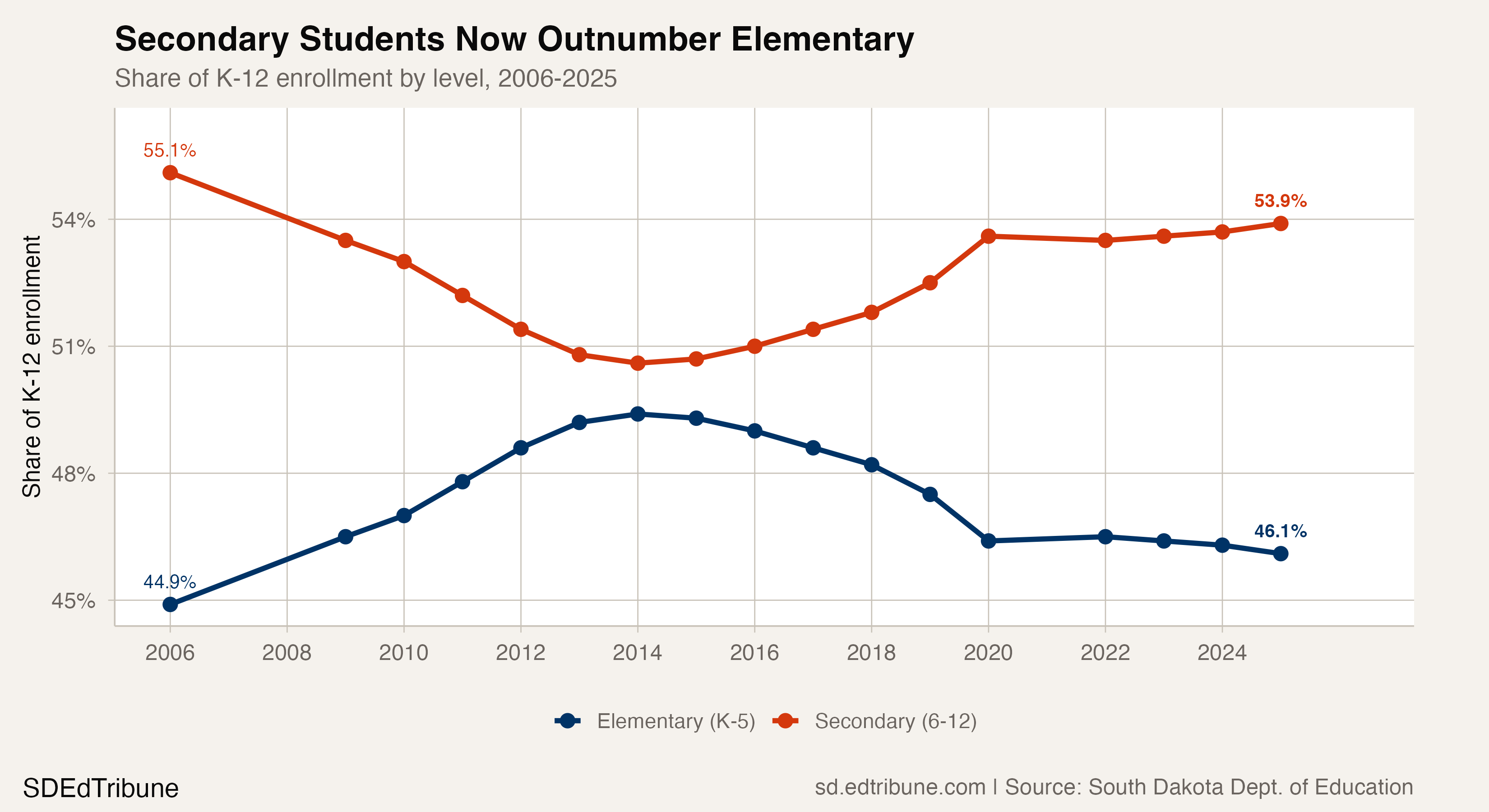
Elementary enrollment (K-5) has fallen by 2,163 students since 2019, a 3.3% decline. Secondary enrollment (6-12) has grown by 1,607, or 2.3%. The net effect: elementary students made up 44.9% of K-12 enrollment in 2006, peaked near 49% in the mid-2010s, and have fallen back to 46.1%.
Three forces pulling students out of the pipeline
South Dakota's birth rate offers the most direct explanation for the kindergarten decline. State demographer Weiwei Zhang told a legislative committee in January 2024 that the state's birth rate fell from 15 per 1,000 population in 2007 to 12 per 1,000, its lowest on record. Zhang's projections show the elderly population surpassing 20% of South Dakota's total by 2030 while the share of children drops below 20%. Even so, South Dakota's fertility rate remains near the national top, above the replacement level of 2.1 children per woman. The kindergarten decline here reflects a state that was unusually fertile dropping to merely average, not a demographic collapse.
The second force is the alternative instruction boom. South Dakota counted 12,433 students in homeschool, hybrid, or microschool settings in 2025-26, up from 11,489 the prior year and roughly 5,342 before the pandemic, a 130% increase since 2019. That growth has not slowed. According to Johns Hopkins University data, South Dakota's 143% increase in homeschool enrollment over the past decade is the highest of any state. Lisa Fisher, president of Families for Alternative Instruction Rights in South Dakota, told KOTA TV that "school environment is number one and academic concerns" drive families toward alternatives.
"Regardless of where they receive their education, my goal as governor is to support innovation, not to stand in the way." -- Governor Larry Rhoden, November 2025
The third force is decelerating population growth. South Dakota added just 6,364 people from 2023 to 2024, the smallest increase of the 2020s, according to the Dakota Institute. The state's growth rate dropped from seventh nationally in 2021-22 to 28th in 2023-24, falling below the national average for the first time this decade. Less in-migration means fewer school-age children arriving to offset the birth rate decline.
What the gap does not explain
A pre-COVID linear trendline is a useful benchmark, not a prophecy. South Dakota's growth was already decelerating before 2020: the state added 2,173 students in 2011 but only 1,014 in 2019. A more conservative model, one that accounted for the deceleration, would produce a smaller gap. The 10,138 figure represents the distance from the best-case scenario, not from the most likely one.
The gap also cannot distinguish between students who were never born, students who moved to South Dakota but chose private or home instruction, and students whose families left the state or never arrived. All three contribute. The enrollment data shows only the result: public school rosters are shorter than they used to be, by a margin that grows each year.
The funding math ahead
South Dakota distributes state aid on a per-pupil basis. Each lost student removes $12,005 from a district's allocation, but the fixed costs of buildings, buses, and administrative staff do not shrink proportionally. The 1,726 students South Dakota lost in 2025 alone represent $20.7 million in per-pupil funding that districts must now do without.
The federal funding picture compounds the pressure. In July 2025, the U.S. Department of Education paused $25.8 million in congressionally approved funds meant for South Dakota schools, leaving districts scrambling weeks before the school year started. Sioux Falls↗ET alone had up to $3.5 million in federal funds affected, equivalent to 40 full-time staff positions.
The kindergarten cohorts entering public schools now were born during the lowest-birth-rate years in South Dakota's history. The alternative instruction sector shows no sign of plateauing. In July 2025, the federal government paused $25.8 million in congressionally approved funding meant for South Dakota schools. If the gap continues to widen by 2,000 to 3,000 students annually, South Dakota could fall below 130,000 public school students before the end of the decade, a level not seen since before 2006. The state's public school system is not shrinking because it failed. It is shrinking because fewer children are being born, more families are choosing alternatives, and fewer people are moving in. The trend line that worked for 13 years stopped working three years ago, and nothing in the data suggests it will start again.
Detailed code that reproduces the analysis and figures in this article is available exclusively to EdTribune subscribers.
Discussion
Sign in to join the discussion.
Loading comments...