In a state where most districts are shrinking, one school district on the Pine Ridge Indian Reservation grew by 564 students between 2007 and 2025, a 49.4% increase. The Oglala Lakota County↗ET School District now enrolls 1,706 students, up from 1,142 eighteen years ago, making it the 10th-fastest-growing district in South Dakota among those with at least 100 students.
The headline number is real but requires unpacking. Nearly all of that growth arrived in a single year, and most of it came from a building that did not exist before 2020.
Lakota Tech changed the math
In the 2018-19 school year, the district enrolled 1,333 students. One year later, that number jumped to 1,811, a gain of 478 students, or 35.9%, in 12 months. That is not organic population growth. It is a structural change: the opening of Lakota Tech High School, the first career and technical education high school on any Indian reservation in the United States.
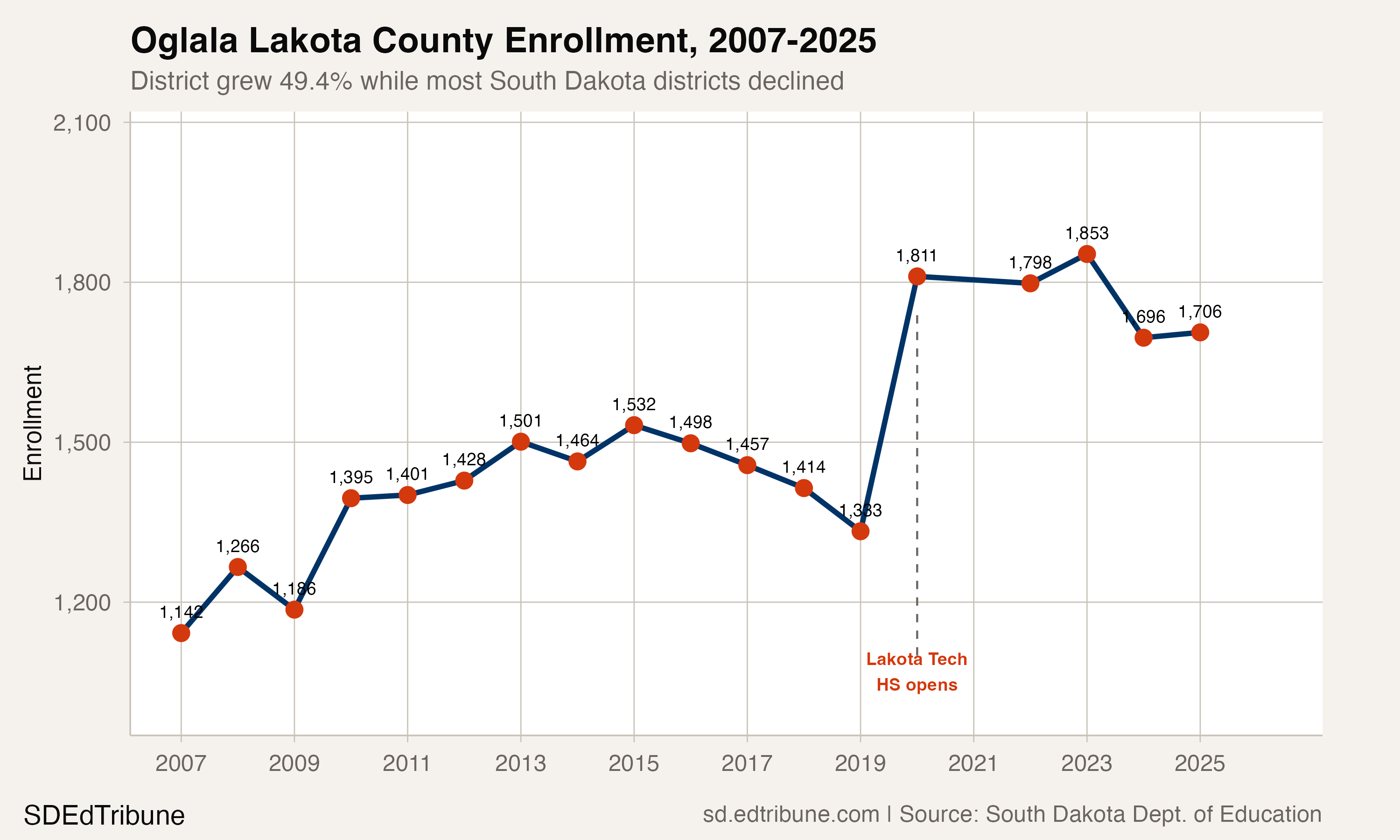
Before Lakota Tech, the district's high school enrollment hovered below 100. In 2018-19, just 96 students were enrolled in grades 9 through 12 across the entire district. Most reservation teenagers attended Bureau of Indian Education schools like Pine Ridge School or private institutions like Red Cloud Indian School, neither of which report through the state system. The opening of Lakota Tech in fall 2020 added 298 high school students to the district's rolls in its first year. By 2024-25, the school enrolled 498 students, making it the district's second-largest campus.
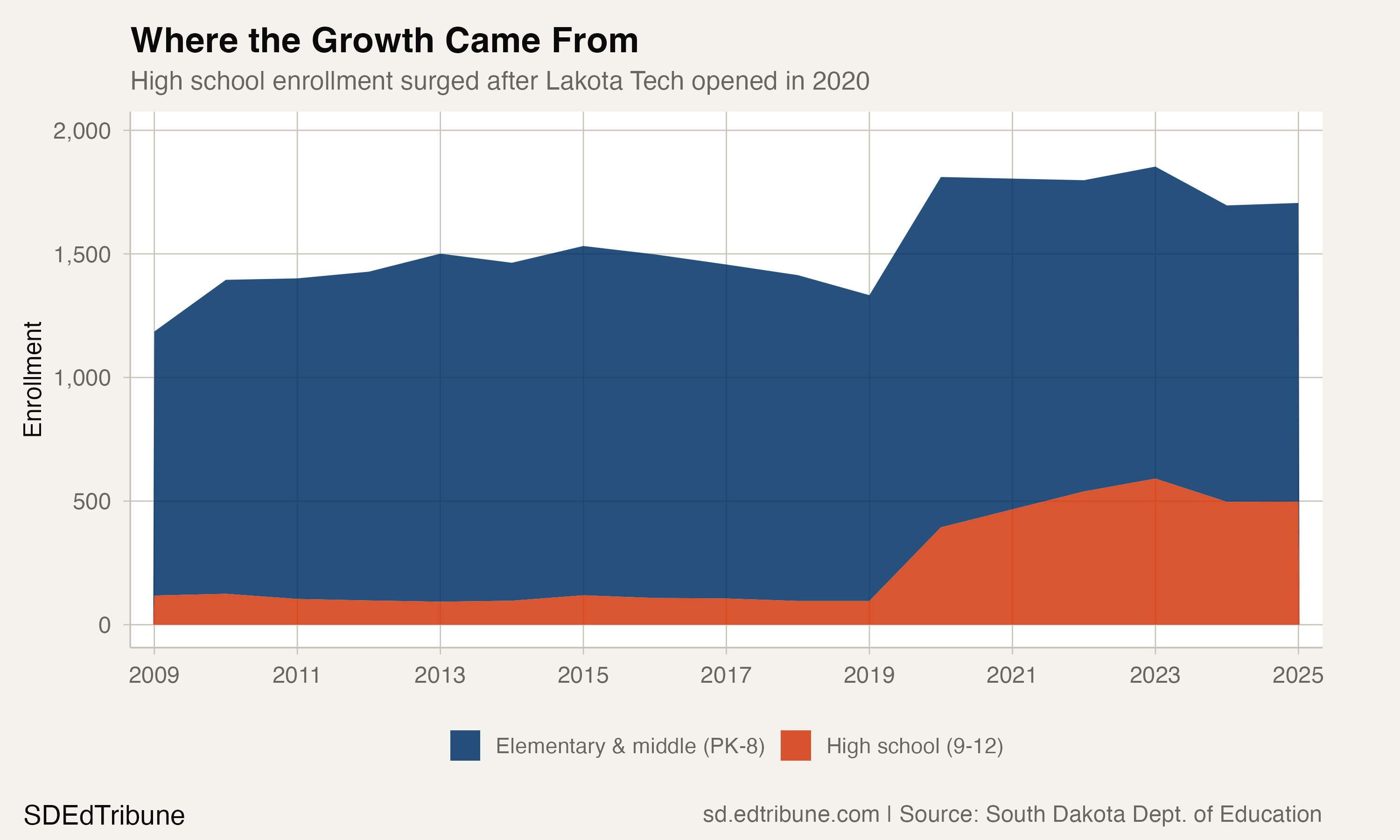
The decomposition tells the story plainly. Strip out the high school and the district's elementary and middle school enrollment grew from 1,068 in 2009 to 1,208 in 2025, a 13.1% gain. Still growth, and still against the grain of rural South Dakota. But not 49%.
A $26 million bet on career education
Lakota Tech was built through a partnership between the district and the state of South Dakota, announced in 2019. Governor Kristi Noem described the project as an effort to "bolster the area's workforce and empower students with real-life skills and career opportunities to help them succeed after graduation."
The $26.2 million facility was financed in part through $23.5 million in New Markets Tax Credits. The district itself acknowledged the school "would not have proceeded as planned" without that federal financing mechanism.
The school was designed for 400 students across 90,000 square feet, offering academies in health sciences, business, industrial arts, and public safety. It opened in August 2020, expecting 300 students and enrolling 311. By 2024-25, enrollment reached 498, exceeding the building's original design capacity.
The context for why a career-focused high school mattered here is grim. Before Lakota Tech, only about 25% of eighth graders in the district completed high school. Nationally, CTE programs report 93% graduation rates.
Five schools, 2,000 square miles
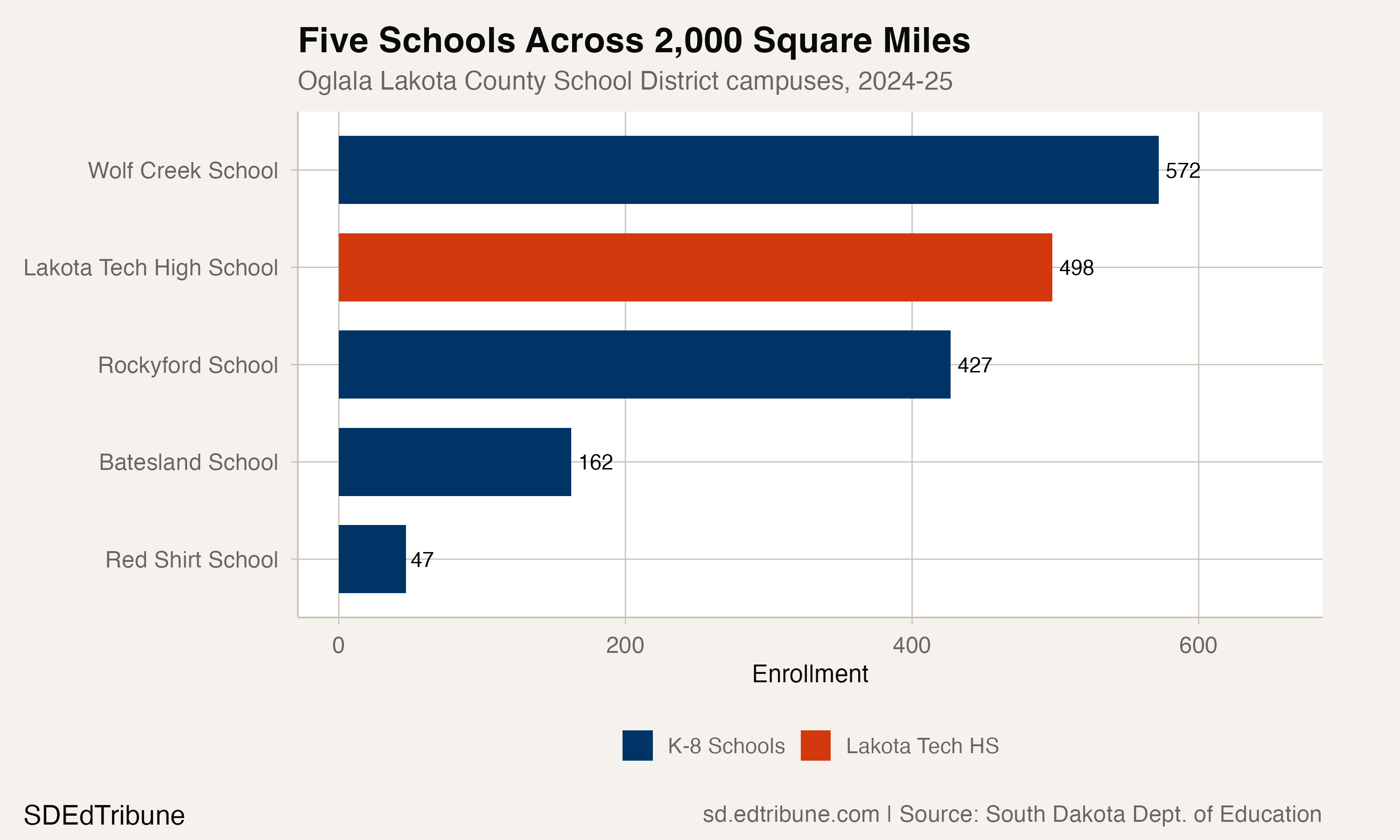
The district spans 22 communities across roughly 2,000 square miles of the Pine Ridge Indian Reservation. Its five campuses range from Wolf Creek School (572 students) to Red Shirt School (47 students), separated by distances that make a 30-mile bus ride a typical morning.
The rapid expansion created operational strain. By late 2023, the district had 101 job openings, 51 of them at Lakota Tech alone. The bottleneck was not applicants but housing: there is almost nowhere for teachers to live on the reservation. The district became a landlord, building 15 single-family homes and planning 12 duplexes through a state prison construction program to house incoming staff.
A reservation outlier among reservation districts
Oglala Lakota County's growth contrasts sharply with other reservation-serving districts in South Dakota. Todd County↗ET, serving the Rosebud Reservation, has been essentially flat since 2007, declining 1.1% from 1,977 to 1,956. Bennett County↗ET, on the southern edge of Pine Ridge, lost 23.4% of its enrollment over the same period, falling from 555 to 425. Eagle Butte↗ET, on the Cheyenne River Reservation, grew 37.8%, though from a much smaller base of 267 students.
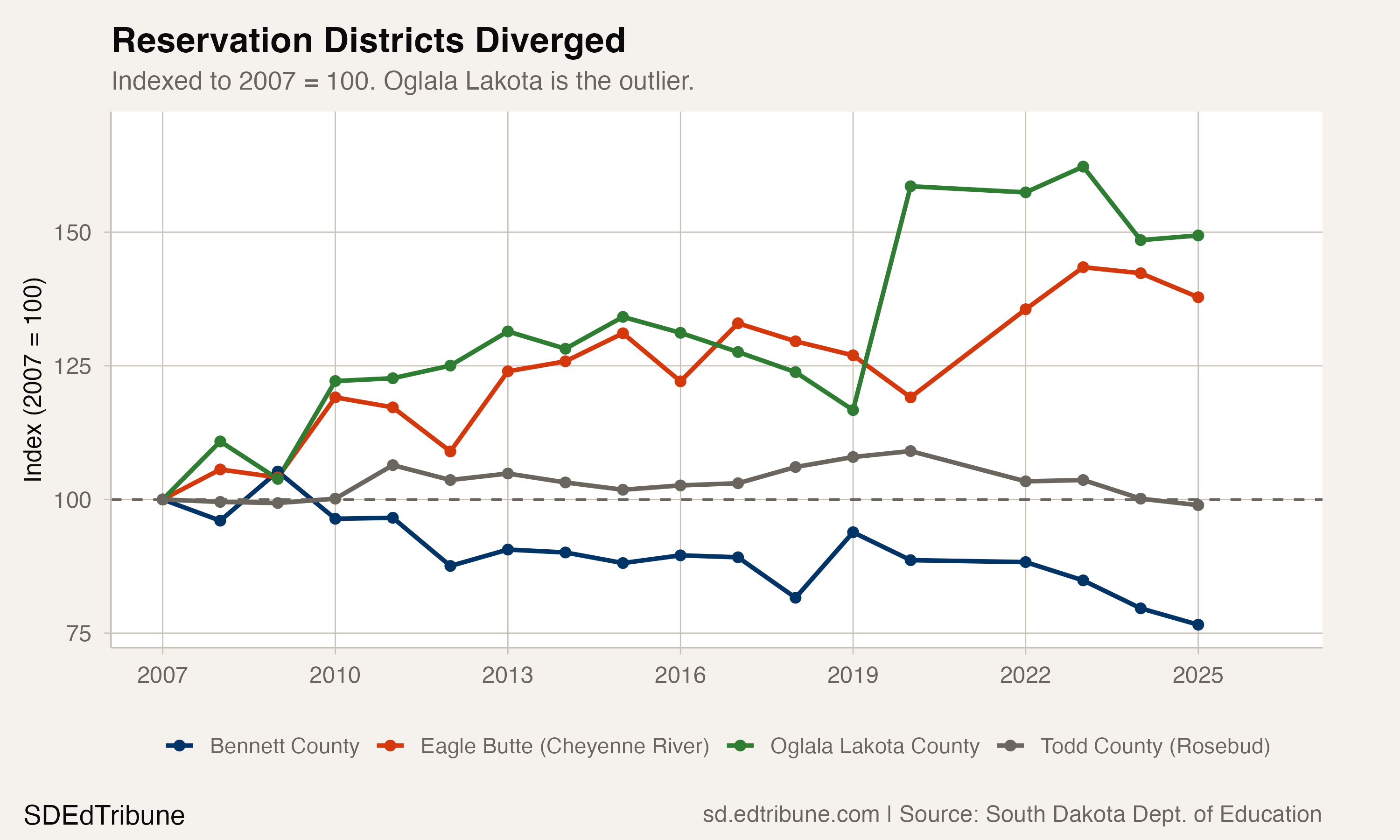
The divergence raises a question about what is being measured. Oglala Lakota County did not gain 564 children who were not being educated before. Most of the high school students enrolling at Lakota Tech were previously attending BIE schools, private institutions, or were among the roughly 75% of students who dropped out before completing high school. What changed is not the number of children on the reservation but which system counts them.
That distinction matters for understanding the 49% figure. It is a real enrollment increase in the state's public school system, reflecting a genuine expansion of the district's educational footprint. It is not, however, evidence that 564 more children moved to Pine Ridge.
What sits beneath the numbers
The Pine Ridge Indian Reservation is one of the poorest places in the United States. The official poverty rate is 53.75%, and per capita income is $7,773, roughly a quarter of the national average. The median age is 25.4 years, and 42.4% of the population is under 20, nearly double the statewide proportion.
That young population is a structural enrollment advantage. While much of rural South Dakota faces declining birth cohorts, the reservation's demographics push in the opposite direction. The district's K-8 enrollment grew 13.1% between 2009 and 2025 even without any structural change, a rate that most South Dakota districts would envy.
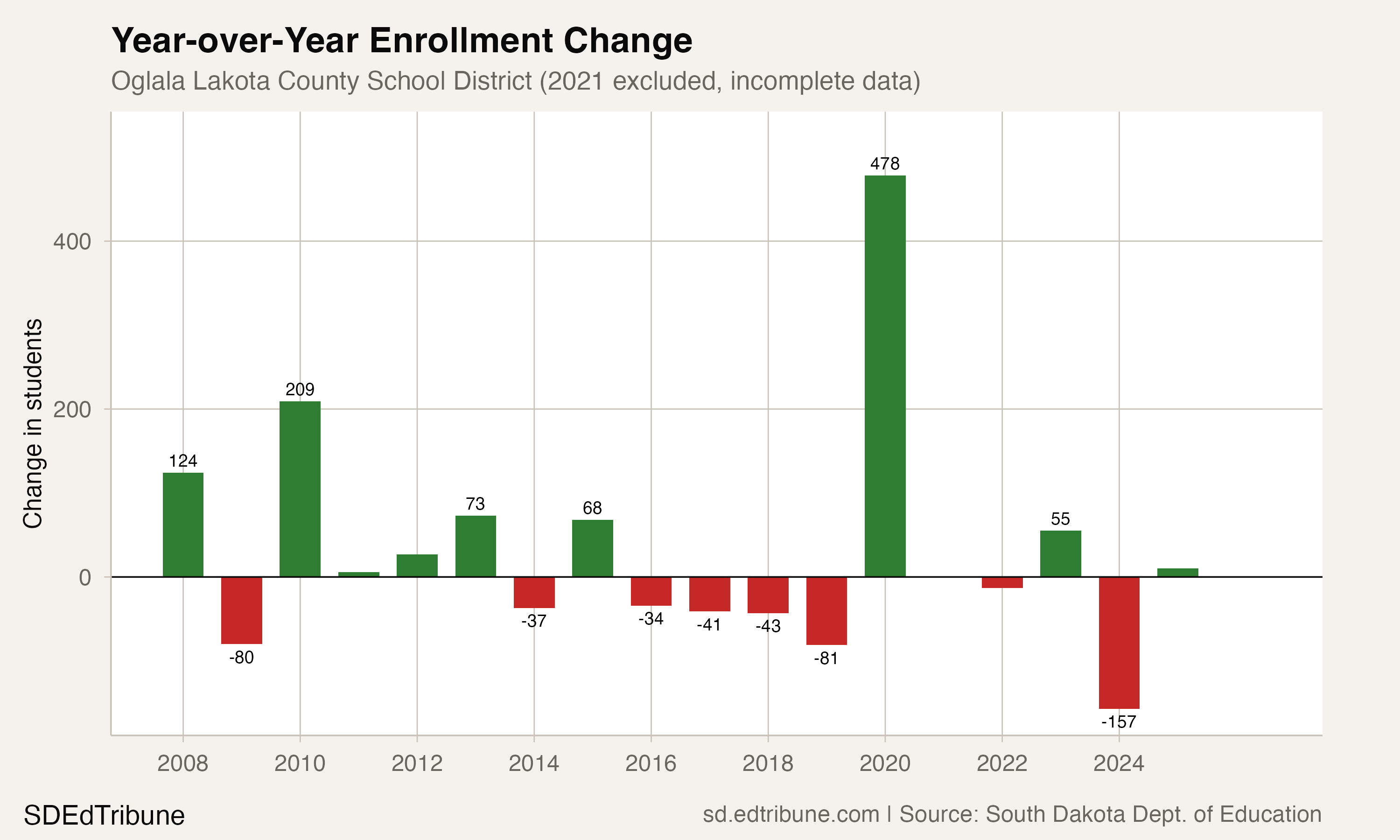
The year-over-year pattern shows two distinct eras. Before 2020, the district oscillated, gaining students in some years and losing them in others, with four consecutive years of decline from 2016 to 2019 that dropped enrollment from 1,498 to 1,333. The 2020 jump reset the baseline entirely. Since then, enrollment has fluctuated between 1,696 and 1,853, settling at 1,706 in 2024-25.
The question Lakota Tech cannot answer yet
The school's first cohorts are now graduating. Whether a CTE-focused curriculum on a reservation with 53% poverty actually changes long-term outcomes for Lakota students is the question that enrollment data cannot answer. Graduation rates, employment outcomes, and college persistence will take years to measure.
What the enrollment data does show is that building a public high school on Pine Ridge created a measurable shift in where reservation students are counted. The district went from the 20th-largest in South Dakota in 2019 to the 17th in 2025. Lakota Tech alone enrolls 498 students, more than what 95 of the state's 147 districts enroll in total. For a school that did not exist five years ago, in a county with the lowest per capita income in the nation, that is a fact worth watching.
Detailed code that reproduces the analysis and figures in this article is available exclusively to EdTribune subscribers.
Discussion
Sign in to join the discussion.
Loading comments...