In 2007, Harrisburg↗ET was a farm-town school district with 1,716 students, smaller than Aberdeen↗ET, Watertown↗ET, and Brookings↗ET. Eighteen years later, it enrolls 6,398 and has passed all three to become South Dakota's third-largest district. The transformation happened so fast that the community's mayor now describes the pace as "engineered growth" and the school district, for the first time in two decades, is not constructing a new building.
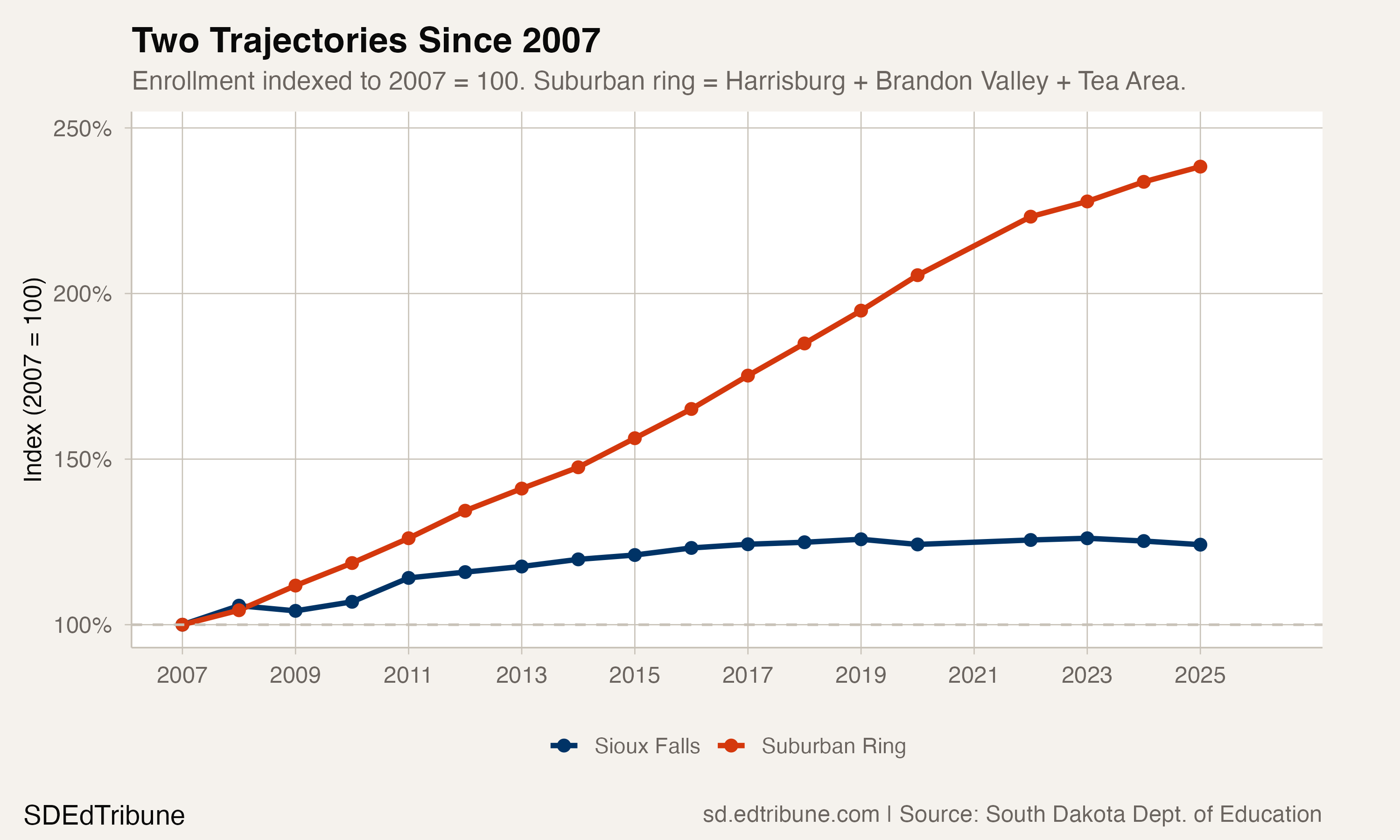
Harrisburg is the most visible part of a broader pattern reshaping the Sioux Falls metro. Three suburban ring districts, Harrisburg, Brandon Valley↗ET, and Tea Area↗ET, have collectively added 8,194 students since 2007, growing 138.3% while Sioux Falls↗ET itself grew 24.2%. The ring's share of statewide enrollment has doubled from 4.8% to 10.2%, crossing the 10% threshold for the first time in 2024-25. Sioux Falls, meanwhile, peaked at 25,228 in 2022-23 and has declined by 387 students over the past two years.
Where the growth lives
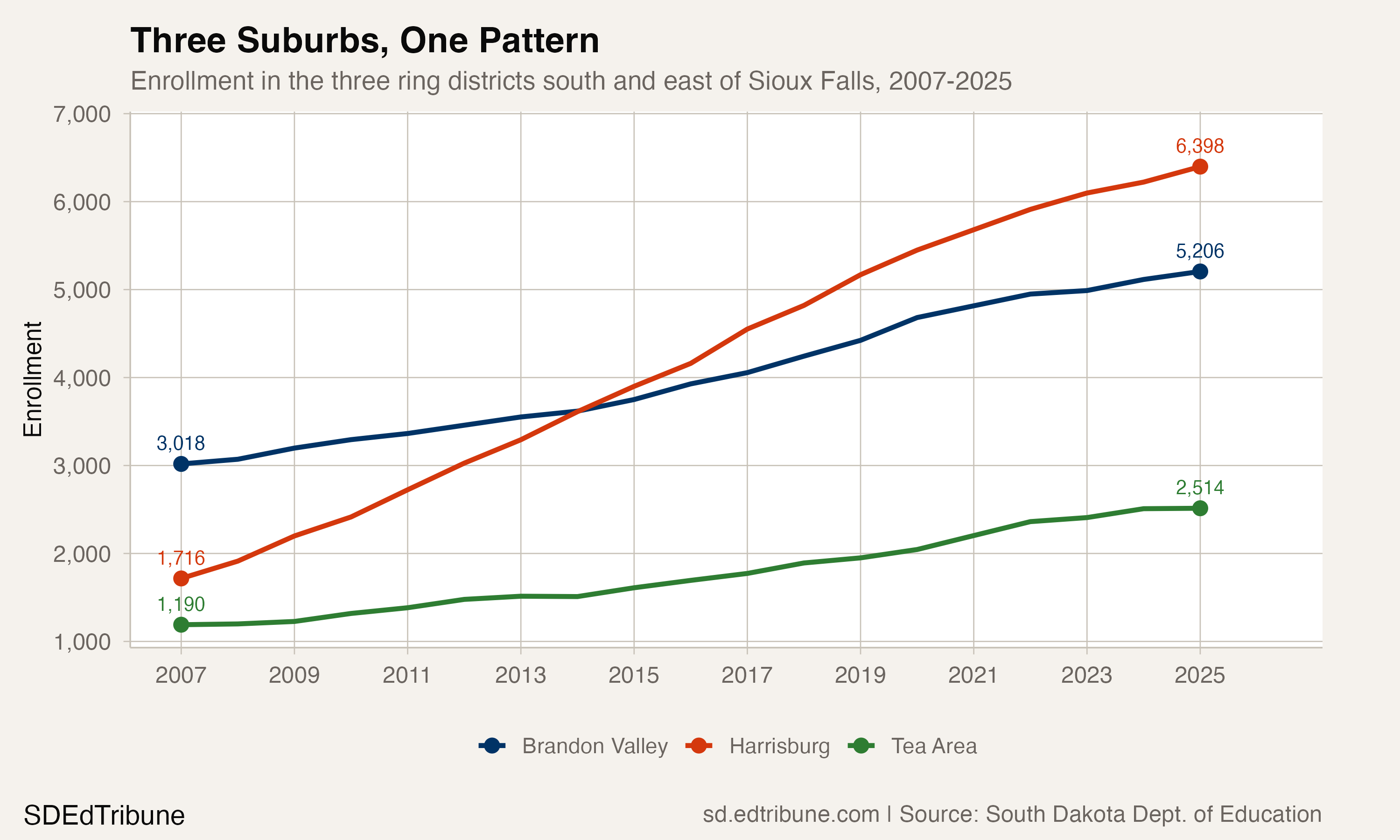
The three ring districts occupy Lincoln and Minnehaha counties along Sioux Falls' southern and eastern edges. Each has followed the same arc: steady acceleration through the 2010s, continued growth through COVID, and no sign of a plateau.
Harrisburg's trajectory is the steepest. It crossed 3,000 students in 2012, 4,000 in 2016, 5,000 in 2019, and 6,000 in 2023. Its 272.8% growth since 2007 dwarfs every other district in the state. Brandon Valley, east of the city, added 2,188 students over the same period (+72.5%) and now enrolls 5,206. Tea Area, to the south, more than doubled from 1,190 to 2,514 (+111.3%).
None of this is accidental. Lincoln County, home to both Harrisburg and Tea Area, grew 30.1% since 2010, making it South Dakota's fastest-growing county. A 2023 housing study found Harrisburg needs approximately 3,000 single-family homes and 1,000 rental units over the next decade to keep pace with demand. From 2022 through 2024 alone, the city issued permits for 272 single-family homes. Brandon, to the east, saw single-family permits jump from 20 to 48 in 2024, a 140% increase, and is planning a new elementary school for fall 2026.
Who is losing what the suburbs are gaining
Between 2007 and 2019, South Dakota added 17,058 students statewide. The growth was roughly evenly split: Sioux Falls accounted for 30.3%, the ring districts for 32.9%, and the rest of the state for 36.8%. All three segments were growing.
That balance broke after the state's enrollment peaked in 2022. From 2022 to 2025, the state lost 2,568 students. Sioux Falls lost 283. The rest of the state lost 3,180. The ring districts added 895, the only segment still growing.
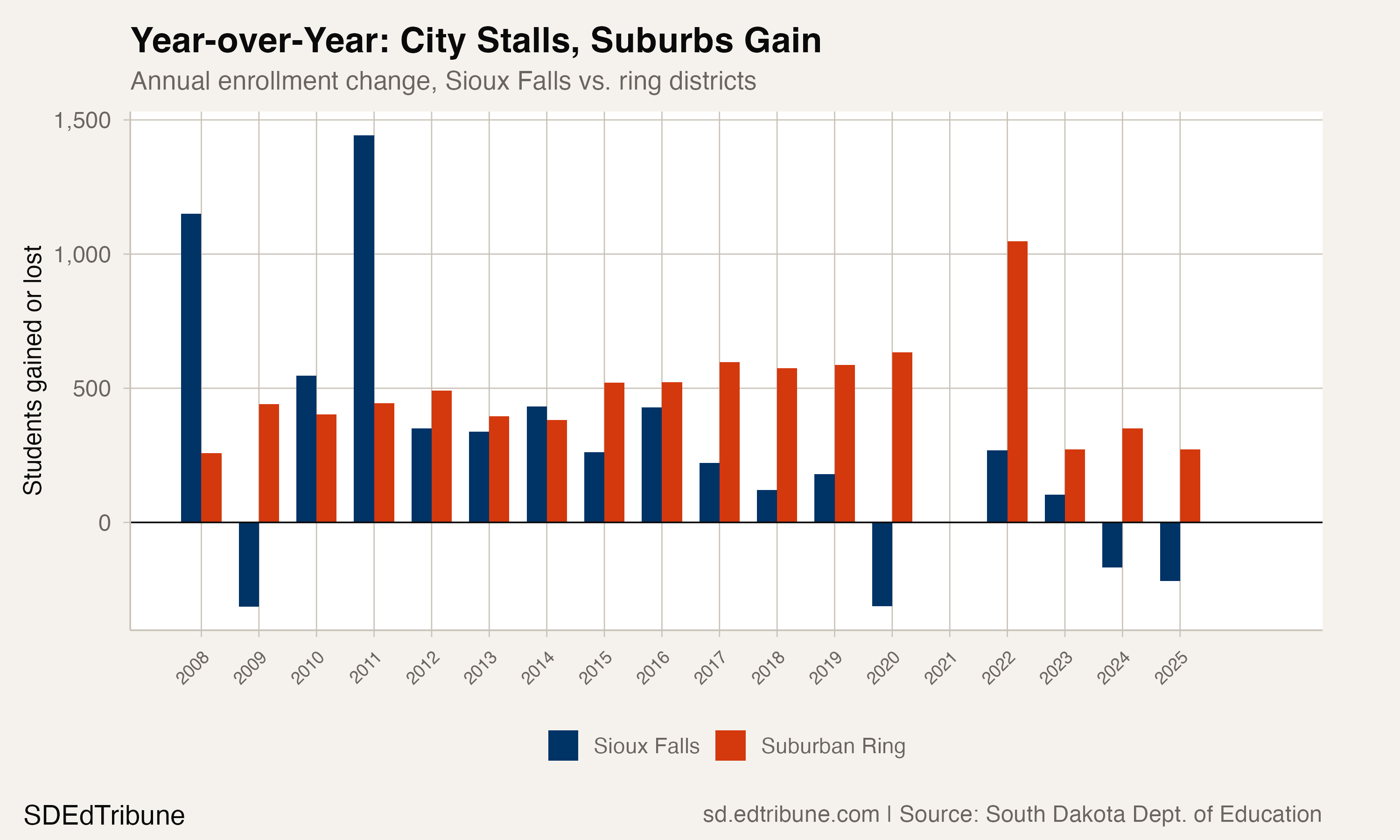
The year-over-year chart tells the story in sequence. Sioux Falls routinely added 300 to 500 students per year in the early 2010s. By 2018 and 2019, its annual gains had shrunk below 200. It has now posted back-to-back losses: -168 in 2023-24 and -219 in 2024-25. The ring, by contrast, has added 272 to 351 students annually since 2022.
Sioux Falls' situation is not collapse. The district still enrolls 24,841, up 4,835 from 2007, and its share of statewide enrollment actually rose from 16.3% to 17.9% over that period. The rest of the state shrank faster. But the growth has stopped, and the suburbs have not.
Residential migration, not open enrollment
The mechanism connecting suburban growth to Sioux Falls' plateau varies by ring district. Sioux Falls Live reported in September 2025 that 326 students open-enrolled from the Sioux Falls district to Harrisburg, 284 to Brandon Valley, 150 to Tea Area, and 114 to Tri-Valley. Those numbers describe transfers across district boundaries.
But for Harrisburg specifically, Superintendent Dr. Jennifer Lowery says that framing misses the larger story. "The Harrisburg School District's growth is due to the expansion of South Sioux Falls into the District's attendance boundaries," she wrote in response to questions about the district's growth. "There are very few students open-enrolled into the district. Two-thirds of the district is in the city limits of Sioux Falls."
That distinction matters. The map, not the policy, is doing most of the work. Harrisburg School District's attendance boundaries overlap with Sioux Falls city limits to an unusual degree. As water and sewer services push south from both Sioux Falls and Harrisburg, the housing built in those newly-serviced corridors falls inside Harrisburg School District. Families moving into those homes are new Sioux Falls residents whose children, by geography, are Harrisburg students.
"The largest district in the state has remained around 24,000 for the last few years as Sioux Falls population growth has jumped school borders." -- Sioux Falls Live, September 2025
The "jumped school borders" phrasing still fits: Sioux Falls population growth IS showing up in ring districts. But for Harrisburg, it is jumping by residence rather than by parental school choice. Dr. Lowery, who led Tea Area for fourteen years before Harrisburg, says the same pattern holds for Tea Area: its growth was residential rather than driven by open-enrollment transfers. Brandon Valley appears to pull more weight from open enrollment.
Tea Area Superintendent Dr. Tonia Warzecha framed the growth story from inside the district as one of intentional planning. "While the enrollment increase tells part of the story, what it doesn't show is how intentionally the Tea community has responded to that growth," Warzecha said. The district has grown at about 5% per year, which she described as "steady, rather predictable," and has aligned facilities, staffing, and programming to long-term projections rather than short-term pressures. A recent bond referendum passed with an 86% approval margin, which Warzecha called "a deep level of trust and commitment between the Tea Area community and our schools" that has allowed the district to both address immediate capacity needs and invest in expanded academic programming and performing arts space. "Our growth is ultimately a reflection of Tea's confidence in its schools," she said.
When asked what draws open-enrolled families in, Warzecha pointed to a combination: strong academics, personal connections with staff, and access to facilities and extracurriculars. "We consistently hear that families value the balance we offer at Tea Area: we have growing opportunities, but we do not lose sight of our students."
The fiscal math is direct: South Dakota spends among the lowest per pupil of any state, meaning every student who transfers or moves carries a thin funding margin out the door. The Dakota Scout reported in October 2025 that declining enrollment left Sioux Falls facing a $1.5 million budget shortfall, even as the number of students who are English learners and students with special needs, whose instructional programs carry higher per-pupil costs, continued to grow.
The kindergarten leading indicator
The most forward-looking metric in the donut pattern is kindergarten enrollment. In 2009, the three ring districts enrolled kindergartners equal to 35.4% of Sioux Falls' kindergarten class. By 2025, that ratio had nearly doubled to 66.7%. For every three kindergartners entering Sioux Falls, two are entering the ring.
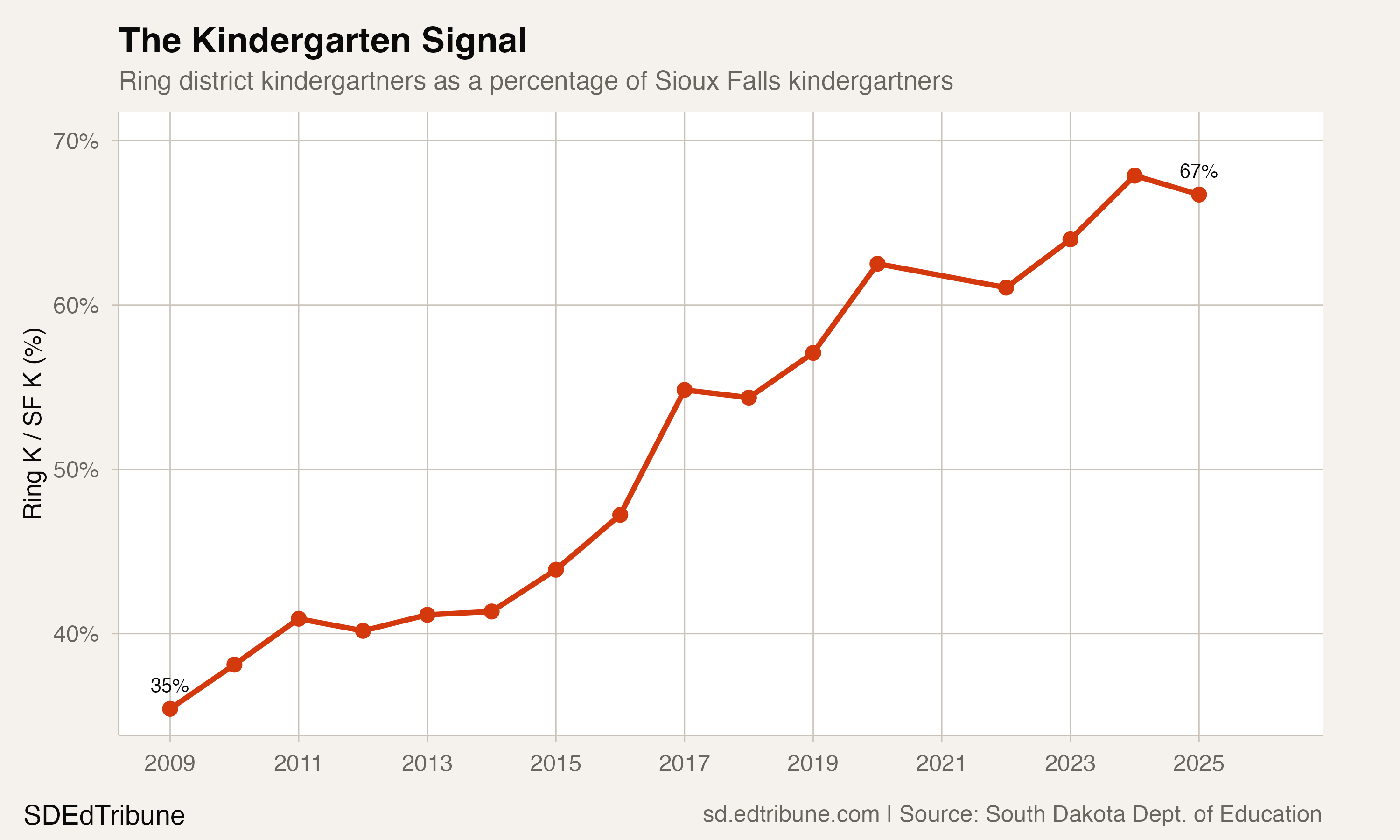
Sioux Falls kindergarten dropped from 1,863 in 2009 to 1,806 in 2025, while the ring's kindergarten rose from 660 to 1,205 over the same period. District officials have attributed the Sioux Falls decline in part to falling birth rates: kindergarten enrollment dropped 46 students in fall 2025, accounting for more than half the overall decrease that year. Birth rates affect every district, but the ring districts are adding enough new housing to offset the demographic headwind. Sioux Falls, which the district itself describes as "landlocked", cannot.
One metro, two fiscal realities
Together, Sioux Falls and the three ring districts now enroll 38,959 students, 28.1% of all South Dakota public school students, up from 21.2% in 2007. The metro area's share of statewide enrollment has grown by nearly seven percentage points in 18 years, reflecting both the metro's pull and the rest of the state's contraction.
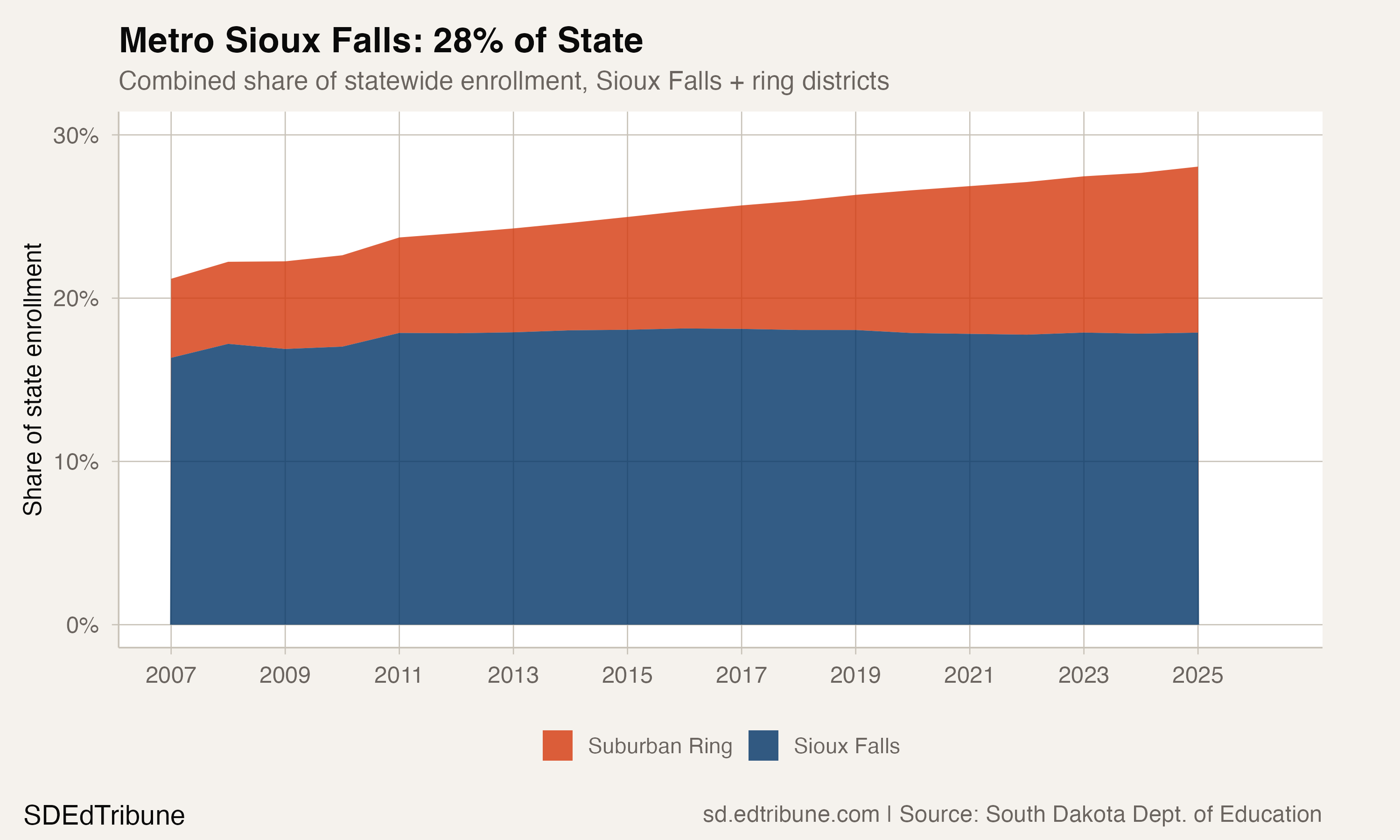
But within the metro, the trajectory has split. The ring districts are building schools and expanding capacity. Tea Area voters approved a $39 million high school expansion in 2022 by an 86% margin. Harrisburg's mayor told residents in February 2026 that the city, home to nearly 12,000 people and growing 7-12% annually, is projected to reach 18,000 by 2033. Meanwhile, Sioux Falls is redrawing attendance boundaries to manage internal shifts, with core-city schools declining while the city's western edge adds students.
Harrisburg's pause between building cycles, for the first time in twenty years, is not idle time. "The pause has provided an opportunity to focus on defining our core values and strategic pillars," Lowery said. "This is important as we prepare for the next growth cycle which will follow the water and sewer development between Veterans Parkway and 271st."
Planning for that next cycle is already a joint exercise with the cities themselves. "The cities of Harrisburg and Sioux Falls both work closely with our planning team," Lowery said. "The team is focused on creating an interactive map outlining future developments, the types of development, and the timelines for impact with additional children. This consistent communication and collaboration have allowed, and will continue to empower, the district to lead with our cities as we together care for our children and families."
Sioux Falls calls itself "landlocked." Harrisburg's mayor projects 18,000 residents by 2033. Brandon is planning a new elementary school for fall 2026. Tea Area voters approved a $39 million high school expansion by an 86% margin. The suburban ring is building for a future where the core city's schools plateau and the families keep coming south. At some point, those families will stop coming too. In the latest available data, roughly 760 students who live within Sioux Falls' boundaries open-enroll into the three ring districts, and the number grows each year.
Detailed code that reproduces the analysis and figures in this article is available exclusively to EdTribune subscribers.
Discussion
Sign in to join the discussion.
Loading comments...